Wednesday, July 6, 2016

Girls' Romances #159

Girls' Romances #159 (On Sale: July 6, 1971), has a cover by Don Heck and Vince Colletta.

We begin with "Made for Each Other" drawn by Artie Saaf. Candy and Jeff live together in poverty, each one making secret sacrifices so that the other one will be happy, until they find that they both would rather change their lives for the better.

Next is "Hold Me Hold Me" drawn by John Romita and reprinted from Girls' Romances #92 (1963). Susan loves Joey from afar as he dates one girl after another and breaks their hearts. When she finally gets her chance with Joey she then finds that she isn't sure of his love.

That is followed by "Love Letters" drawn by John Rosenberger. A girl reads letters from her late mother, written years earlier telling how she married her fiance in spite of the fact that she had a fatal illness so that they could have a year of happiness together, and a child.

Next up is "Please Don't Hurt Me!" created by persons unknown and reprinted from Girls' Love Stories #13 (1951), Abby is determined to concentrate on her job as a teacher and not to fall in love with Tod, the new teacher hired to help her. 

That brings us to  "Portrait of an Actress" by Robert Kanigher and Mike Peppe and reprinted from Falling in Love #58 (1963). Ann leaves behind her dreams of stardom on the stage when she finds love more important than the endless fighting for fame.

Edited by Dorothy Woolfolk.

Friday, July 1, 2016

Wonder Woman #196

Wonder Woman #196 (On Sale: July 1, 1971), has a cover by Mike Sekowsky and Dick Giordano.

The Sekowsky era ends this month with his last issue of Wonder Woman and this story, "Target for Today?" written and penciled by Mike Sekowsky and inked by Dick Giordano. A man dying of gunshot wounds stumbles into Diana's boutique, reveals that he is a secret agent for a government agency headed by General Stuart, for whom I-Ching also once worked, and tells her that Stuart must learn of an assassination planned on the Koronian ambassador. Then he dies. 

After Diana and Ching defeat two killers seeking the dead agent, Ching goes to Washington to contact Gen. Stuart, and Diana goes to Kennedy Airport, where she stops another apparent assassination attempt on Anatole Karoli, the ambassador from Koronia. 

Karoli insists on taking Diana out and begins romancing her, during which time she foils more attempts on his life. Later, Gen. Stuart and I-Ching meet with Diana. The general tells Diana that she is still in the Army Reserve, even though she has resigned her commission, and he reappoints her lieutenant with the task of keeping Karoli safe from assassination. Diana goes to Washington, D. C. with Karoli and saves him from still more apparent murder attempts. 

But, just after Karoli shakes hands with President Nixon, Diana knocks Karoli down, kicks a pistol he had been packing away from him, and knocks him unconscious. She removes a mask from "Karoli"'s face, explaining to the president that she saw the bottom of the mask poking out from under his collar. The "assassination attempts" were really faked, and the "ambassador" was really an assassin seeking the president's life. Later, the president tells Diana and Gen. Stuart that the killer was an agent of the party out of power in the Koronian government, and their plan was to make it appear that one of the opposition had been guilty of the assassination of the president. Reprinted in Diana Prince: Wonder Woman Vol. 3 TPB (2009) and Wonder Woman Diana Prince: Celebrating the '60s Omnibus HC (2019).

Our reprint is a goody, "Introducing Wonder Woman" by William Moulton Marston and Harry G. Peter and reprinted from All-Star Comics #8 (1941). U.S. Army Intelligence Captain Steve Trevor is forced to crash land on a magical island known as Paradise Island, home of the Amazons. His unconscious body is found by Princess Diana and Mala and brought to the hospital for recovery. Queen Hippolyte agrees to help him recover, but forbids her daughter Diana from contact with the man because she has fallen in love with him.

Hippolyte speaks to Aphrodite and Athena for advice on helping the man. They tell her that she must send the best Amazon to America with the man to help further the cause of freedom. A tournament is held to determine the Amazon who will accompany Trevor. Diana, forbidden to enter the tournament by her mother, enters in disguise and is victorious. She is rewarded with a costume and then entrusted with the mission of returning Steve Trevor to America. This story continues in Sensation Comics #1.

We end with a real treat, "The Stormy Menace of Goblin Head Rock" written and drawn by Harry G. Peter in the 1940s and never printed before. Diana learns that the Cheetah has escaped from Transformation Island but when she goes to tell Steve Trevor, he informs her that Professor Profundo, who was working on a device to control the weather, has disappeared. Meanwhile, Etta and the Holliday Girls are on a cruise ship off the eastern coast and strange weather is causing the ship to head for the rocky coast where a mysterious figure is dancing on the rocks.

When Army Intelligence learns of this and the fact that the ship is carrying gold bullion, Diana changes into Wonder Woman, picks up Steve and they head out in the invisible plane to the site of the shipwreck. Wonder Woman manages to get all the passengers to safety only to find Etta and the girls missing. 

Steve dives down to see if he can retrieve the gold but the Cheetah severs his air hose. Wonder Woman sees the Cheetah and goes after her, but when she sees Steve trapped under the sunk ship the Cheetah escapes. WW and Steve retrieve the gold in WW's plane but it is then pulled by strange weather to the Cheetah. When WW confronts the Cheetah she shows her that she has the Professor, Etta and the girls strapped to a lighthouse and with the push of a button will send a lightning bolt down to kill them all unless Diana surrenders. 

She and Steve are tied up to the lighthouse with Diana's own magic lasso, but when the Cheetah sends a bolt of lightning down it is absorbed by the lasso. They escape and take on the Cheetah and her gang, but rather than be caught, the Cheetah appears to jump to her death. Reprinted in Wonder Woman Diana Prince: Celebrating the '60s Omnibus HC (2019).

Edited for the final time by Mike Sekowsky.

Weird War Tales #1

Weird War Tales #1 (On Sale: July 1, 1971), has a cover by Joe Kubert and is our second new hit title of the month and the day.

DC had hit a goldmine with their mystery/horror books and kept looking for ways to expand their offerings. Here they blended the genre with war books and let Joe Kubert take the helm. Since the title lasted twelve years, I guess you could say it was a success.

The book begins with "Let Me Tell You the Things I've Seen" a series introduction written and drawn by Joe Kubert. In the winter of 1944, a lone G.I. is separated from his outfit and is lost in the woods that are located in German territory. He is almost hit by a German tank shell but is left with a broken leg. The G.I. painfully drags through the icy fog to try to find and warn his outfit about the Germans until he comes upon a house in the middle of a clearing. 

He is taken inside by an old man who then helps him patch his leg and giving him time to rest. When the G.I. insists on returning to his men despite his injury, his host tells him that he is too weak and that there is time to warn his friends. To spend the passage of time, the old man, the series host: Death, tells the G.I. stories about the wars that he had seen in his life.

Our first real story is "Fort Which Did Not Return" by Robert Kanigher and Russ Heath and reprinted from G.I. Combat #86 (1961). A bombardier returned from a mission to be greeted by his fellow airmen. As more bombers flew into the sky for another raid, the bombardier recalled the mission when he and his squadron flew in a B-51 bomber called "Mother Hen" to Munich. When Mother Hen and the other bombers entered Nazi territory, the enemies fired at them with artillery and sent their own planes, taking down the Brooklyn Belle and Powerhouse Pete.

 The American bombers exchanged fire with the Nazis as the former of the forces attempted to reach their target. All of the bombers except for Mother Hen were destroyed and Mother Hen's tail gunner, two pilots, and waist gunners were both killed, but the bombardier managed to drop their bombs on the target; three oil tanks. The bombardier noticed that nobody was piloting the plane and that more Nazi planes were chasing him, so he jumped out of Mother Hen in a parachute. In the present, the bombardier decided that he couldn't tell the others what had happened to Mother Hen. A week later, he was in another bomber, on a mission, and saw Mother Hen flying by.

Next up is "The Story Behind the Cover" written and drawn by Joe Kubert. A German patrol under Lance Corporal Mueller suddenly comes across an American patrol and a fight breaks out. In the narrow confines of the ditch both sides are in, a grenade is lobbed among them and explodes. By some miracle, only Mueller survived much to his astonishment. Mueller runs back to his position to warn his Lieutenant about the enemy.

Mueller tries to explain to the Lieutenant, who then doesn't speak a word to him and acting as if Mueller wasn't there. Mueller believes that the Lieutenant doesn't like his report and that he had failed him. When he tried to explain to his comrades, they too ignored him. Mueller thinks the men are shunning him for losing his patrol. Gripped by terrible guilt, Mueller believes that the only way to wipe out his shame and regain the respect of his comrades is by facing the entire Allied army by himself.

Mueller never felt the storm of lead that lashed him and the crushing death dealt by enemy guns. But the pain and agony will be with him forever, as a skeletal specter on the battlefield. Reprinted in Sgt. Rock #401 (1985)

We end this fort issue with "The End of the Sea Wolf" by Bob Haney and Joe Kubert and reprinted from Star Spangled War Stories #71 (1958). Sometime after World War II, a German ship was sailing through the North Sea, looking for Allied ships to salvage. The captain recalled the time he had captained a U-boat called the Sea Wolf. The Sea Wolf encountered an Allied fleet. They sunk one ship before they encountered a Q-boat that opened fire on them. The Sea Wolf fired back, taking down the Q-boat's guns. The Q-boat was sailing towards the Sea Wolf, about to ram into it. In the present, the captain of the ship came upon wreckage, which happened to be both the Q-boat and the Sea Wolf, which had been sunk while sinking the Q-boat.

All the new material was reprinted in Showcase Presents: Weird War Tales Vol. 1 TPB (2013).

Edited by Joe Kubert.

Our Army at War #236

Our Army at War #236 (On Sale: July 1, 1971), has a Sgt. Rock cover by Joe Kubert.

We begin with Sgt. Rock in "Face the Devil" by Robert Kanigher and Russ Heath. An old man comes out of the fog, claiming that Billy Boy is his lost son. Is the man real, or a ghost? Reprinted in Sgt. Rock #19 (1991).

Next up is "22 Hrs. to San Francisco" by Mike Friedrich and John Severin. Alan Tomasz returns home from Vietnam. Reprinted in Sgt. Rock #21 (1992).

Our first reprint is "The Empty Cockpit" by Hank Chapman and Joe Kubert and reprinted from Capt. Storm #3 (1964). Lt. Danner, a new Spad pilot, wants to fill the empty cockpit of the squadron's hero Captain Kelly.

That brings us to another reprint: "The Third Enemy" by Bob Haney and Russ Heath and reprinted from Our Fighting Forces #45 (1959). During World War II a rookie Allied Ski Soldier learns that every mountain contains three types of enemies.

We end with "No Beginning -- No End" by Robert Kanigher and Frank Thorne. A look at war through the ages, from cavemen, through knights to WWI and WWII.

Edited by Joe Kubert.

Ghosts #1

Ghosts #1 (On Sale: July 1, 1971), has a cover by Nick Cardy.

I guess I was one of the few readers who were bored by just about every book Murray Boltioff was editor of except the Brave and the Bold. Since it was mainstream DC, I bought this series but never cared for it at all, and the gimmick of "true" stories just made it even worse. Despite how I felt about it, this title would last for over eleven years.

Interesting tidbit: The indicia reads just Ghost, with a lot of white space on both sides of the word. The cover and later issues read as Ghosts. It appears that the book was at first to be titled True Ghost Stories, thus the white space in the indicia, but then it was changed to just Ghosts. When they updated the indicia they whited out "True" and "Stories," but they forgot to add the "s."

We begin with a one-page introduction to ghosts drawn by Tony DeZuniga.

Our first take is "Death's Bridegroom" by Leo Dorfman and Jim Aparo. The police discover the body of a young woman who committed suicide, with a note saying she took her own life because the man she was engaged to only courted her to steal her life savings and leave her penniless in a tenement. The swindler who stole from her ends up lost in a fog as he skips town, and comes across a mansion owned by a strange beautiful woman who claims to be waiting for her long-lost fiance. She seems the perfect new target to him, but little does he know she and her home have long rotted away and with his proposal, he joins her in the fog. Reprinted in Limited Collectors' Edition C-32 (1974).

That is followed by "Ghost in the Iron Coffin" by Leo Dorfman and Sam Glanzman. A resistance fighter is caught and executed while trying to sabotage a Nazi U-Boat but haunts the vessel killing its crew until he's able to use his spiritual powers to turn the U-Boat's own torpedoes against it and destroy it.

Next up is our first reprint: "The Tattooed Terror" by John Broome, Carmine Infantino, and Sy Barry and reprinted from Sensation Mystery #112 (1952).

We have another reprint up next in "The Last Dream" by John Broome, Carmine Infantino, and Frank Giacoia and reprinted from Sensation Comics #107 (1952). Tybalt Fletcher, the last of his line, dies in a feud with the Beaumont clan. His ghost then spends the next 400 years killing Beaumonts with the pistol he requested to be buried with.

We end with "The Spectral Coachman" by Leo Dorfman and Tony DeZuniga. Tombstone, Arizona, draws its name from the town graveyard where the greatest badmen of the west are buried. But tonight one of them lives again when a young modern prospector is rescued from a pack of wolves by the ghost of a long-dead stagecoach driver. Reprinted in Limited Collectors' Edition C-32 (1974).

All of the new material was reprinted in Showcase Presents Ghosts Vol. 1 TPB (2012).

Edited by Murray Boltinoff.

DC Special #14 (On Sale: July 1, 1971), has a Wanted: World's Most Dangerous Villians cover by Murphy Anderson proving that DC 100-Page Super Spectacular was not the only book named for the company that would be the launching pad for new titles.

We begin with Superman in "The Toyman's Castle" by Don Cameron, Ira Yarbrough, and Stan Kaye and reprinted from Superman #47 (1947). While in prison, the Toyman is allowed to create toys that discourage crime. However, his toys are actually robbery plans for his gang. Though Superman is able to stop the robbery, the Toyman is able to escape jail.

Toyman then creates a party machine designed to tell fortunes. His real plan is to steal the signatures of wealthy party guests. Lois sees him, so the Toyman takes her prisoner. When Superman catches him, he uses Lois as a hostage. Superman foils Toyman's plans using a toy jack-in-the-box and then sends the crook back to prison.

From 1943 to 1948, Ira Yarbrough drew 77 Superman stories and worked closely with Superman creator Joe Shuster.

Next up is the Flash in "The Heat Is On... for Captain Cold" by John Broome, Carmine Infantino, and Joe Giella and reprinted from Flash #140 (1963). Flash is asked by Henry Willens, an attorney, to search for a missing girl. The girl was lost in an accident many years before. Her father has died recently and his dying wish was to locate the girl. A diamond-shaped birthmark is the only clue Flash has to her identity.

While searching for the girl, Flash learns that Captain Cold has broken jail. He quickly catches up to Cold but is preventing from making the capture by a new villain, Heat Wave. Heat Wave teams temporarily with Cold, but the two have a dispute over the affections of a TV model, known as Dream Girl. The two crooks compete in a crime spree to win Dream Girl. They halt their rivalry again when Flash shows up. Flash is able to overcome both opponents and turn them into the authorities.

Learning of the crooks' passion for Dream Girl gives Flash an idea. He meets Dream Girl who turns out to be Priscilla Varner, the missing girl. Flash is able to take her to Mr. Willens to receive her inheritance.

We end this issue with Batman in "The Bird Sayings Crimes" by William Woolfolk, Lew Sayre Schwartz, and Stan Kaye and reprinted from World's Finest Comics #55 (1951). On his birthday, the Penguin receives presents containing mocking bird sayings from other criminals. For this reason, Penguin decides to use those same sayings as inspirations for crimes, and thus dispose of Batman and Robin, but as usual, he ends up captured by the Dynamic Duo.

Edited by E. Nelson Bridwell.


DC 100-Page Super Spectacular #5

DC 100-Page Super Spectacular #5 (On Sale: July 1, 1971), has a Love Stories cover by Bob Oksner. In this second issue of the comic, they had still not figured out they needed wrap-around covers.

This is a strange book. Unlike most of these We start with a new Table of Contents drawn by Tony DeZuniga and an actual new story, "How Do I Know When I'm Really in Love?" by Robert Kanigher and Winslow Mortimer.

Next up is "My Shameful Past" written by Robert Kanigher, with page one drawn by Jay Scott Pike and the rest of the story by Artie Saaf and Vince Colletta and reprinted from Young Love #60 (1967).

That is followed by another reprint: "My Sister Stole My Man" by Robert Kanigher and John Romita and reprinted from Girls' Love Stories #91 (1962).

Next up is a text feature, "How I Met My Boyfriend" with illustrations by John Rosenberger. In this ongoing contest, readers submit stories of their first meeting with their boyfriends.

The next tale is "The Other Girl" by Robert Kanigher and Bernard Sachs and reprinted from Girls' Romances #70 (1960).

They sneak in another bit of new material with "The Wrong Kind of Love" by Robert Kanigher, Ric Estrada, and Wally Wood.

Next up is television model Wendy Winthrop in "Made for Love" a two-part tale written by Jack Miller, with the first part drawn by Jay Scott Pike and the second part drawn by Pike and inked by Bob Oksner and reprinted from Girls' Romances #99 and #100 (1964).

We are back to the editor's Robert Kanigher obsession with "I Didn't Want His Love" by Robert Kanigher and Norman Nodel. I'm not sure how this story came about since it is only one of two stories Nodel (born Nochem Yeshaya in 1922 ) did for DC. His other piece is from the British Classics Illustrated comic book, an issue which the American publishers of Classics Illustrated decided not to publish and was sold instead to DC. This saw print as Showcase #43 (1963) featuring Doctor No. With this purchase, DC held the rights to a James Bond comic for ten years.  In 1972, as their rights were close to expiring, Jack Kirby and Alex Toth were contacted, but DC ultimately decided against it, feeling unsure about the future of the characters as Sean Connery made what he stated would be his last appearance as 007, in Diamonds Are Forever. Finally, something interesting about this book. This story was reprinted from Girls' Romances #130 (1968).

Our next reprint is "Good-Bye, Lover" by Robert Kanigher, Mort Drucker, and Bob Lander and reprinted from Girls' Romances #20 1953). Lander worked as an inker at DC from 1951 through 1953.

Next up is "Happy Ending" by Robert Kanigher, Mike Sekowsky, and Bernard Sachs. This is obviously an old story but may have never seen print before.

We end with a one-pager drawn by Mort Drucker entitled "Where Is Love?"

The entire book was reprinted in DC 100-Page Super Spectacular: Love Stories Replica Edition #5 (2001).

Edited by Dorothy Woolfolk.

Wednesday, June 29, 2016

Detective Comics #414

Detective Comics #414 (On Sale: June 29, 1971), has a stunning Batman cover by Neal Adams.

We begin this issue with Batman in "Legend of the Key Hook Lighthouse" by Denny O'Neil, Irv Novick, and Dick Giordano. Batman has followed a mob of gun-runners, who are providing weapons for a dictator, but one of the members of the gang decides to help Batman capture the war criminal in exchange for protection. Batman agrees and he is taken to a nearby lighthouse, where the exchange is supposed to take place. 

When General Ruizo and his men arrive, Batman takes them by surprise and finds a way to round up Ruizo's henchmen, but the General manages to escape. Batman is able to follow the General on his boat and witnesses how the army man is struck by the light coming from the lighthouse and driven mad by a supernatural presence. 

When Batman investigates the lighthouse, he is unable to find any evidence of anybody activating the light and he suspects that he has been helped by a powerful entity. Reprinted in Showcase Presents: Batman Vol. 6 TPB (2016).

The backup is Batgirl in "Invitation to Murder" by Frank Robbins and Don Heck. On the night of the anniversary of their first meeting, Jason Bard takes Barbara Gordon to go see the play "Invitation to Murder." The two are shocked to find that they are the only two people in the audience. When spotting a rifle set to shoot one of the actors, Jason stops the gunman but is knocked out. Changing into Batgirl in the darkness, Barbara tries to stop the shooter but the gunman still manages to get away. Changing back into her civilian guise, Babs checks on Jason and finds that he is all right.

Realizing that the wild shot must have hit somebody, they find that it winged Robbie Marlow who was viewing the play with his wife Tiz (both are referred to as the "Royal Couple" of Hollywood.) After questioning the couple they find out that they were given the tickets to a sold-out showing of the play by an anonymous admirer, and the only reason why Jason and Barbara happened to be there is because of a mix-up with the date they were going to see the show. Finding it all suspicious, Babs tells Jason to keep an eye on the couple while she goes to "call the police". This story continues next issue and was reprinted in Showcase Presents: Batgirl Vol. 1 TPB (2007) and Batgirl: The Bronze Age Omnibus Vol. 1 HC (2018).

The reprints begin with  "The Australian Code Mystery" by David V. Reed, Alex Toth, and Sy Barry and reprinted from World's Finest Comics #66 (1953).

We end with "Private Eye of Venus" by Gardner Fox and Carmine Infantino and reprinted from Strange Adventures #83 (1957).

Edited by Julius Schwartz.

Adventure Comics #409

Adventure Comics #409 (On Sale: June 29, 1971), has a Supergirl cover by Dick Giordano. This is the only cover of Mike Sekowsky's editorial reign that was not penciled by him. As we will see, he really did not edit this issue despite what the indicia says.

We begin with Supergirl in "Invasion of the Mer-Men Part II" written and penciled by Mike Sekowsky and inked by Dick Giordano. Continuing from the last issue, Supergirl looks underwater for her co-worker Johnny and her captors, the whole time blaming herself for her co-worker's demise. Finally, she finds the secret base of the Mer-Men and discovers they are loading giant "tanker" space-globes with water to be shipped to their home planet.

In the meantime, a coalition of Earth armies launches attack after attack to destroy the globes, but they have force-fields that resist any attempt Earth makes to destroy them. Supergirl locates Johnny as a patrol of Mer-Men attacks her and she lets herself be captured. Once inside the base, she rescues Johnny, gets him out of the water, and then comes back to smash the globes herself, letting them rain their waters back on Earth.

The Mer-Men leader gives up, telling Supergirl that they couldn't load enough water up in time to save his world, anyway. He and the other Mer-Men depart resigned to their eventual extinction. Realizing this, Supergirl cries.

Next is a story already showing the new direction for Supergirl. "Fight with Fire Drake" is by E. Nelson Bridwell, Artie Saaf, and Dick Giordano. Mr. Stanton, the owner of KSF-TV, is throwing a party on his yacht. Freddy Nero, a party-crasher, tries romancing Linda Danvers, much to Geoff's disgust and jealousy. Minutes later, a scuba-costumed, masked villain called Fire Drake, who "breathes fire" with an acetylene torch nosepiece, loots the yacht and its passengers with his gang. Linda changes clothes and attacks the thieves. Supergirl tries to follow them when they run away, but her powers fail and she is repelled by Fire Drake's flame. 

That night Supergirl's mother, Allura, pays her daughter a visit and both women head to Kandor, where Linda's father Zor-El has some new power-substitution gimmicks for her: a bracelet which can enhance her normal strength when she is depowered, replacing the exo-skeleta cyborg, and her Legion of Super-Heroes flight-ring, to replace her jet-boots.

With her new mechanical powers, Supergirl encounters Fire Drake a second time, captures him, and unmasks him as Freddy Nero.

Our reprint is the Legion of Super-Heroes in  "The Condemned Legionnaires" by Edmond Hamilton, Curt Swan, George Klein, and Sheldon Moldoff and reprinted from Adventure Comics #313 (1963). When most of the female members of the Legion of Super-Heroes (and Night Girl of the Legion of Substitute Heroes) come down with the Crimson Virus, they have to be sent to a quarantine planet. The rest of the female members are hunted down by a mysterious masked villain named Satan Girl, who seems to be infecting the female Legionnaires with the virus.

With the arrival of Supergirl, who is immune to the virus, the male Legion members try to learn the origins of Satan Girl. When she proves immune to Kryptonite, Lead, and an anti-android weapon, the heroes are puzzled to figure out her true identity. Unable to defeat her due to her superior powers, Supergirl has the Legion go and collect the Legion of Super-Pets, as Satan Girl's powers would not affect them. The Super-Pets manage to easily defeat Satan Girl, who is unmasked, revealing that she is really -- Supergirl!? The weakened Satan Girl explains that she is the product of Red Kryptonite, which Supergirl was exposed to upon entering the 30th Century. Knowing that she had only 48 hours of life, she adopted the guise of Satan Girl and created a device that would siphon the Red Kryptonite radiation and infect females with it, in hopes that once she had rid herself of the Red Kryptonite energies she could live past the 48 hour period which Red Kryptonite effects.

With her plan a failure, and the 48 hours running their course, Satan Girl merges with Supergirl. Afterward, the Legion learns that Satan Girl managed to handle Green Kryptonite because she wore a lead suit. After this revelation, although they are victorious and their female members restored to normal, the Legion takes a moment to feel pity for Satan Girl, for all she wanted to do was live.  

Though this book says it is edited by Mike Sekowsky, the internal DC Job Numbers show that only the first story has the  "M-" prefix that designated Mike Sekowsky. The rest of the book, including the cover has a "J-" signifying Joe Orlando who supposedly takes over next issue.

Action Comics #403

Action Comics #403 (On Sale: June 29, 1971), has a Superman cover by Carmine Infantino and Murphy Anderson.

We begin this issue with Superman in our cover story, "Attack of the Micro-Murderer" by Cary Bates, Curt Swan, and Murphy Anderson. Superman's body is invaded by a Zohtt, a magical wraith-being that attempts to destroy him, and not even a blood transfusion from most of Metropolis' citizens can save him.

Our backup Superman story is "The Man with the X-Ray Mind" by Leo Dorfman, Curt Swan, and Murphy Anderson. Superman learns that a Metropolis University janitor has psychic powers, including precognition, the ability to predict the future -- and that the janitor knows that he is Clark Kent.

Our first reprint is the Vigilante in "The Impossible Legend" by Dick Wood and Bob Brown and is reprinted from Action Comics #176 (1953). Vigilante proves an old legend by capturing criminals, two while deaf, two while he could not speak, and the final two when he could not see.

We end with a Superboy reprint, "When Krypto Was Superboy's Master" drawn by George Papp and reprinted from Adventure Comics #310 (1963). Professor Lang discovers several artifacts within a lost city. When he returns to Smallville his translations of the ancient inscriptions are questioned by the faculty of his school, and they force him to prove their validity in order to get a promotion.

Lang has not had enough time to translate everything, so Superboy pretends that one of the artifacts that the professor has translated switches his mind with Krypto’s. Superboy acts like a dog for a few days in order to convince the members of Lang’s school board. When the professor has completed his work, Superboy drops the act and claims the effect has worn off.

Edited by Murray Boltinoff.

Friday, June 24, 2016

Unexpected #126

Unexpected #126 (On Sale: June 24, 1971), has a cover by Nick Cardy.

We begin this issue with our cover story, "You Are Cordially Invited... to Die" by George Kashdan, Dick Dillin, and Vince Colletta. While on his deathbed, Hiram makes a deal with a mysterious figure for one more hour of life. He ends up having to become the Devil's go-between for others wishing to make the same bargain.

Next up is "Cat Tale" by Murray Boltinoff and Rich Buckler. Mrs. McDougal, an old cat lady, has a disagreement with your landlord.

Next, we have "The Doomsday Drum" by Dave Wood, Joe Maneely, and Joe Sinnott and reprinted from House of Secrets #9 (1958). 

Joe Maneely was mainly thought of as an Atlas (Marvel) artist, but the year before his death in 1958, he started working for DC as well, where he penciled 10 stories in all, half for the House of Mystery. Modern comic fans know little to nothing regarding Joe, who was a master of all genres of comic art and best known as the co-creator of the Black Knight, the Ringo Kid, the Yellow Claw, and Jimmy Woo. Had he not died in a commuter-train accident at 32, Maneely would have been one of the greats at Marvel. Stan Lee said, "Joe Maneely to me would have been the next Jack Kirby. He also could draw anything, make anything look exciting, and I actually think he was even faster than Jack."

Our next story is "Please Let Me Die" by Dave Wood and Bruno Premiani. Charlie Kimble hears the voices of his dead cellmates.

Bruno Premiani started his career at Prize Comics with Young Love #4 in 1949 and his first work for DC was that same year in World Finest Comics #42. By 1950, Bruno was working almost exclusively for DC, starting out as a western artist with Tomahawk #1. He stayed with that book for 36 issues. Bruno's real claim to fame came along in 1963 in My Greatest Adventure #80 where he and Arnold Drake created the Doom Patrol. He would stay with the Doom Patrol till the original series ended in 1968. After that series ended Bruno would only draw two more stories, this being his final comic work. All told, Bruno Premiani drew 175 stories for DC.

This story is followed by "The Town That Buried Me Alive" drawn by Alex Toth and reprinted from House of Mystery #149 (1965). A twin is having memory problems, uncertain which one he is.

We end this issue with "Seek Your Own Grave" by George Kashdan and Jerry Grandenetti. Three criminals kill an old prospector hoping to find his cache of gold.

Edited by Murray Boltinoff.

Superman's Girl Friend Lois Lane #112

Superman's Girl Friend Lois Lane #112 (On Sale: June 24, 1971), has a cover by Dick Giordano.

This issue begins with Lois Lane in "A Tree Grows in Metropolis" by Cary Bates, Werner Roth, and Vince Colletta. Superman saves an alien tree, the last remaining life-form on its planet, by bringing it to Earth and planting it in Metropolis Park. However, the "tree" is really a female alien who wants Superman for herself and tries to kill Lois.

Our reprint is "Superman's Secret Family" drawn by Kurt Schaffenberger and reprinted from Superman's Girl Friend, Lois Lane #30 (1962). Lois Lane visits the lab of Professor Burke, an astronomer who has invented a powerful telescope. Viewing distant worlds, Lois sees Superman with a mermaid wife and son. When he returns to Earth, Lois is upset that he did not tell her about his secret family.

Superman investigates and brings Lois to the small planet. They soon meet the mermaids and another Superman who turns out to be a robot. The robot explains that he is a damaged Superman robot X-3 that crashed on this world. A dying mermaid woman, Mooki, repaired him partially, but he was stranded on the planet. When Mooki died, X-3 built a robot Mooki and a son Nipper and lived as a family. Superman and Lois wish them well and return to Earth.

Our backup story is The Rose and the Thorn in "Rock and Rose" by Robert Kanigher and Dick Giordano. The Thorn saves her would-be assassin, Leo Lester, Jr., when the 100 turns on him, then she helps him start on the right path.  

Edited by E. Nelson Bridwell.

Green Lantern #85

Green Lantern #85 (On Sale: June 24, 1971), has a classic Green Lantern/Green Arrow cover by Neal Adams. If you saw this on the stands and did not buy multiple copies, you needed to check your pulse as you may have been dead.

We begin this issue with the classic Green Lantern/Green Arrow tale "Snowbirds Don't Fly" by Denny O'Neil and Neal Adams. Oliver Queen is attacked by thugs on the street, and despite beating them soundly, he is surprised when he is shot in the shoulder with one of his own arrows. Finding no help from strangers, he crawls to a hospital and collapses before anyone offers him help.

After being treated, Ollie calls up his friend Hal Jordan to discuss the significance of the arrow. Ollie suggests that he had been neglecting his ward Speedy, and worries that he may have been captured. They follow Ollie's lead to a basement, where they find a withdrawing junkie begging for a fix from a Mr. Browden. Green Arrow and Green Lantern force their way into Browden's apartment, capturing him and the junkie.

Elsewhere, the same thugs who attacked Oliver earlier are waiting for their friend, the same junkie that was caught by the heroes, to return with their fix. Roy Harper (Speedy) appears to be with them. Suddenly, Green Lantern and Green Arrow burst through the ceiling and subdue the junkies. Oliver assumes that Roy is undercover, and tells him to sit the remainder of the mission out, while he takes out the dealers.

The junkies lead Green Lantern and Green Arrow to the dealers' hideout, but they turn on the duo in order to get their fixes as a reward. With the heroes subdued, the dealers forcibly intoxicate them with their drugs and plan to discredit them by calling the police. Fortunately, before the police can arrive, Roy shows up gets them to safety, with some effort.

Back at Arrow's tenement, Roy explains that without a father figure, someone might look for comfort in drugs. Despite this, Oliver is horrified to discover that Roy has become a junkie himself, while he and Green Lantern were traveling cross-country. This classic tale has been reprinted in Green Lantern/Green Arrow #5 (1984), Green Lantern/Green Arrow Collection Vol. 2 TPB (1993), Green Lantern/Green Arrow Collection HC (2001), Green Lantern/Green Arrow Vol. 2 TPB (2004), Showcase Presents: Green Lantern Vol. 5 TPB (2011), Green Lantern/Green Arrow TPB (2012), Absolute Green Lantern/Green Arrow HC (2016), Green Arrow: A Celebration of 75 Years HC (2016), Green Lantern (Facsimile Edition) #85 (2020), and Green Lantern:80 Years of the Emerald Knight the Deluxe Edition HC (2020).

The backup is "The Strange Trial of Green Lantern" by John Broome, Gil Kane, and Joe Giella and reprinted from Green Lantern #11 (1962). After a series of uncharacteristic episodes in which Green Lantern had almost committed various crimes, he is brought before his fellow Green Lanterns for sentencing. The court of his peers is told of each incident: How Hal entered a bank, used his power ring to stun the tellers but left without taking any money; Hal almost bullied himself into not paying a $100 entry fee for a gallery; and finally how he procrastinated in saving a young man who had fallen out of a window. Deciding not to punish Hal because he had not actually done anything illegal, Hal demands that the other Green Lanterns punish him because he feels he has lost control. Putting it to a vote, they agree to do so, devest Hal of his Green Lantern emblem and power ring, seal him in a capsule, and launch it into space.

While traveling through the void, the capsule is suddenly transported to the Antimatter Universe and to the planet Qward, where Hal is brought before Sinestro. Sinestro explains that he escaped his imprisonment in his last encounter because he had a spare power ring hidden in the heel of his boot and manage to escape to Qward to plan an act of new revenge against the Green Lantern. He then explains he used a device to alter Green Lantern's personality so that he became selfish but couldn't push him into doing anything illegal.

Suddenly the other Green Lanterns arrive to save Hal, having suspected Sinestro's involvement they played into his hands. However, Sinestro traps them all in a room made of yellow material. Giving Hal back his power ring, he comes up with the idea of using it to pull chemicals out of the air and make an acid strong enough to melt through the walls. Freeing themselves, they easily capture Sinestro and subject him to his own machine. Imprisoning him with the device which would tell him over and over that he cannot escape.

Edited by Julius Schwartz.

Girls' Love Stories #161

Girls' Love Stories #161 (On Sale: June 24, 1971), has a cover by Bob Oksner.

We begin this issue with "Take Me As I Am" drawn by John Rosenberger. Kathy wants to change her boyfriend Wayne after her friend Sharon points out some of his flaws, and she nearly loses him for good.

Next up is "The Magic of Love" drawn by Werner Roth and reprinted from Secret Hearts #58 (1959). Hank just happened to be the first guy Cathy met in her new town. Nothing special, but they found the most interesting places...romantic places. If only she were with the right guy. It's when she meets the "right guy" that she finds the "magic" wasn't in the places, but with the "right guy."

That is followed by "Port of Hope" drawn by Frank Bolle and reprinted from Girls' Romances #103 (1964). On a Mexican vacation, Donna falls for Dirk, an artist, but she wonders whether it's just a summer romance or something more.

Next, we have "Kissing Cousins" drawn by Jay Scott Pike and reprinted from Young Romance #130 (1964). Louise invites her cousin Trudy to stay with her while Trudy looks for an apartment, but Trudy immediately sets out to steal Louise's fiance.

We end the issue with "Summer Sweetheart" by creators unknown. Ginny is determined to attract the attention of rich Hal Gorham and thinks she's succeeded when they start to date. Meanwhile, Tom, the local guy who really loves her, waits patiently for the chance to prove he's the better man.

Edited by Dorothy Woolfolk.

Wednesday, June 22, 2016

Sugar & Spike #97

Sugar & Spike #97  (On Sale: June 22, 1971), has a cover by Sheldon Mayer. 

We begin with "Who's Sorry Now?" written and drawn by Sheldon Mayer and reprinted from Sugar and Spike #4 (1956).

Next, we have "Raymond and the Angel" written and drawn by Sheldon Mayer 

That is followed by "The Mystery of the Bouncing Stick"  written and drawn by Sheldon Mayer and reprinted in Best of DC #29 (1982).

Sugar and Spike: "The Flash-Light" written and drawn by Sheldon Mayer and reprinted in Best of DC #29 (1982).

We end with "Spike Discovers the Ocean" written and drawn by Sheldon Mayer and reprinted from Sugar and Spike #3 (1956).

Edited by E.Nelson Bridwell.

Heart Throbs #133

Heart Throbs #133 (On Sale: June 22, 1971), has a cover by Don Heck and Vince Colletta.

We began with our cover story "A Girl's First Love" drawn by Lee Elias. Bill is jealous of the other guys his fiancee Gale has dated in the past, which nearly breaks them up until Gale finds a way to turn the tables on him.

Next is "Kid Sister" drawn by Artie Saaf and Vince Colletta. Mindy gets a makeover from her older sister Doris when she's taken on a double date, which makes her friend Chuck see her in a different light.

Next up is "The Perfect Couple" drawn by Bill Draut and Tony DeZuniga. Jori lives in a commune but falls in love with the son of the real estate developer who is trying to drive the group off their farm.

Following that, we have "Ashamed of My Love" drawn by John Rosenberger and reprinted from Young Romance #152 (1968). Lita likes Tony but since he isn't particularly handsome or fun-loving she tries to deny her feelings for him

We end with "I'll Never Go Home" drawn by Irv Novick and Bernard Sachs and reprinted from Falling in Love #8 (1956). Jane is determined to leave small-town life behind until a snowstorm strands her on her way to the big city and a new man makes her see what's really important.

Edited by Dorothy Woolfolk.

From Beyond the Unknown #12

From Beyond the Unknown #12 (On Sale: June 22, 1971), has a cover by Joe Kubert. This is another book that actually got smaller with the page expansion.

We begin with our cover story, "The Dawn-World Menace" by Gardner Fox, Carmine Infantino, and Joe Giella and reprinted from Strange Adventures #147 (1962). A time-space warp brings two savage cavemen riding pterodactyls into the present day.

Next up is "Mystery of the Runaway Meteor" by John Broome and Sy Barry and reprinted from Mystery in Space #27 (1955).

That is followed by "Earth for Sale" by France Herron, Carmine Infantino, and Bernard Sachs and reprinted from Strange Adventures #89 (1958).

Next, we have "The Sign Language of Space" by Otto Binder, Sid Greene, and Joe Giella and reprinted from Strange Adventures #63 (1955).

We end with  "Gateways to the Stars" by Gardner Fox and Sid Greene and reprinted from Mystery in Space #78 (1962).

Edited by Julius Schwartz.

Friday, June 17, 2016

Young Romance #173

Young Romance #173 (On Sale: June 17, 1971), has a cover by Jay Scott Pike.

We being with "Cage of Love" by Len Wein and John Rosenberger.

That is followed by "Please Don't Steal My Man" drawn by John Rosenberger, which may or may not be a reprint from 1965.

Next up is "What Love Is All About!" drawn by Jack Sparling and Vince Colletta.

We next come to  "Unhappy Birthday" drawn by Arthur Peddy and Bernard Sachs and reprinted from Falling in Love #1 (1955).

We end with "Love Is Standing on a Corner" inked by Bob Oksner.

Edited by Dorothy Woolfolk.

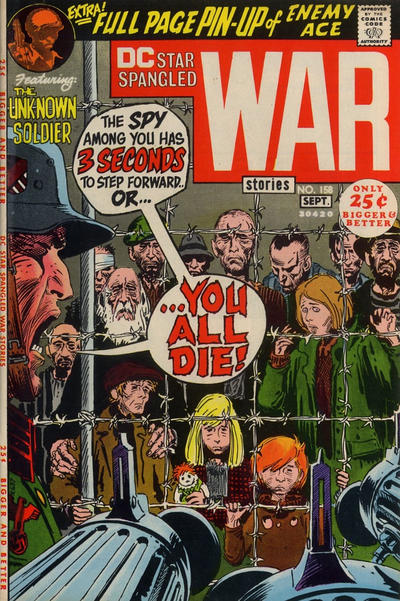
Star Spangled War Stories #158

Star Spangled War Stories #158 (On Sale: June 17, 1971), has an Unknown Soldier cover by Joe Kubert.

We begin with the Unknown Soldier in "Totentanz" by Bob Haney and Joe Kubert. The Unknown Soldier is sent to the Totentanz concentration camp to rescue Erika Hauser, code name "Berengaria," who helped hundreds of important people and children escape from the Nazis. Furthermore, she is deeply tied to the entire network of underground fighters in Germany. Berengaria was captured by the Gestapo, but they do not yet know of her identity.

The Soldier allows himself to be capture and taken to Totentanz. After smuggling a packet containing his disguise to the camp, he then disguises himself as Obersturmführer Adolf Eichmann and tricking the camp commandant Colonel Schneider into releasing Berengaria to his custody. The ruse is eventually discovered when the real Eichmann was on his way to the camp. Fortunately, the Soldier and Berengaria successfully escape to Switzerland. Reprinted in Showcase Presents the Unknown Soldier Vol. 1 TPB (2007). 

This is the kind of book that made the "25 cents bigger and better" slogan hard to swallow. The 11-page Unknown Soldier story is the only new content in this issue.

Our first reprint is "The Flattened Point" by Robert Kanigher and Irv Novick and reprinted from Our Fighting Forces #74 (1963).

This is followed by Enemy Ace in "Enemy Ace" by Robert Kanigher and Joe Kubert and reprinted from Our Army at War #151 (1965). Hans von Hammer celebrates his 50th kill when he is grazed by the wildly fired bullet of his 51st victim. He hovers in and out of consciousness but still manages to land his plane. He broods on the fact that even in the arms of a beautiful nurse and among his fellow pilots, he still feels lonely as if they stand apart from the "killing machine". 

He finds some solace in taking a rifle into the forest and hunting for a while with another predator, a wolf, who recognizes a kindred spirit. Then, Hans takes to the skies once more to defend a zeppelin on a bombing run from three enemy fighters. He manages to shoot two down, but the third deliberately rams his damaged plane into the zeppelin.

We end this issue with "Lame Duck Glider" by France Herron and Russ Heath and reprinted from All American Men of War #57 (1958).

Edited by Joe Kubert.

DC 100-Page Super Spectacular #4

DC 100-Page Super Spectacular #4 (On Sale: June 17, 1971), has a nice cover by Berni Wrightson. There were no issues 1-3 and the first three published issues (4-6) had subtitles - the first two of which were later used for ongoing comics series and the third became the title of a series of Mego figures based on comics super-heroes: #4 "Weird Mystery", #5 "Love Stories", and #6 "World's Greatest Super-Heroes".

The title then became the replacement for the "Giant" comics series (previously "80 Pg Giant") which ran as part of regular, ongoing series titles (i.e., #7 also known as Superman #245, #8 aka Batman #238, #9 aka Our Army at War #242, #10 aka Adventure Comics #416, #11 aka The Flash #214, #12 aka Superboy #185 and #13 aka Superman #252) for six issues.

Then, even later on, it reverted back to its own title again (#14 through #22, utilizing as cover titles the existing titles of regular, ongoing series, but not being part of those regular series' numbering - in other words, no corresponding issue numbers for those issues.

The planned issue #23 became Shazam! #8 and the Super Spectacular's own numbering disappeared and advertisements were added. The DC 100 Page Super Spectacular title itself was used on another 96 issues of varying regular, ongoing titles through 1975.

We begin this issue with a one-page Table of Contents by Sergio Aragones and that is followed by a one-page introduction drawn by Berni Wrightson. 

Next up is "I Was the Last Man on Earth" drawn by Mort Drucker and reprinted from My Greatest Adventure #8 (1956).

That is followed by "The Phantom Enemy" drawn by Carmine Infantino and Sy Barry and reprinted from Sensation Mystery #116 (1953).

Next, we have "I Fought the Clocks of Doom" drawn by Mort Meskin and reprinted from My Greatest Adventure #14 (1957).

That brings us to  "The Witch's Candles" drawn by John Prentice and reprinted from House of Secrets #2 (1957).

We have another Sergio Aragones humor page next, followed by a one-page Eerie Tales introduction page by Berni Wrightson.

Next is "I Was Lost in a Mirage" drawn by Mort Meskin and reprinted from My Greatest Adventure #12 (1956).

That is followed by Johnny Peril in "Horror in the Lake" by Robert Kanigher, Frank Giacoia, and Sy Barry and reprinted from Sensation Mystery #110 (1952).

Next up is The Phantom Stranger in "The Haunters from Beyond" by John Broome, Carmine Infantino, and Sy Barry and reprinted from Phantom Stranger #1 (1952). Anne Parris is haunted by two ghosts from the Salem witch trials. The ghosts blame Anne's ancestors for their deaths and curse her in revenge. Anne becomes distraught and nearly kills herself, but the Phantom Stranger stops her. He takes her home, where the ghosts show up again.

The Stranger is suspicious, so after the ghosts leave he asks Anne to stage her own death. Within minutes Anne's cousin Bryce and his fiancee arrive on the scene. The Phantom Stranger proves that they were the ones disguised as ghosts and forces Bryce to confess he set Anne up in order to steal her inheritance. After the pair are arrested, the Phantom Stranger disappears.

We have yet another Berni Wrightson introduction page, this one on Monsters.

That is followed by "I Was the Last Martian" drawn by Jim Mooney and reprinted from My Greatest Adventure #20 (1958).

Next, we have  "I Hunted the World's Wildest Animals" drawn by Nick Cardy and reprinted from My Greatest Adventure #15 (1957).

Another Berni Wrightson introduction, this on Science Fiction is followed by "The City of Three Dooms" drawn by Mort Meskin and reprinted from Tales of the Unexpected #15 (1957).

Next, is  "Jungle Boy of Jupiter" drawn by Lou Cameron and reprinted from Tales of the Unexpected #24 (1958).

Next up is "Childhood Haunt" a one-page text story illustrated by Berni Wrightson.

Our last reprint is "The Mysterious Mr. Omen" drawn by Leonard Starr and reprinted from House of Mystery #49 (1956).

We end with a one-page humor story Weird Tales by Lore Shoberg.

Edited by Joe Orlando.