Showing posts with label Robert Kanigher. Show all posts

Friday, August 12, 2016

Young Romance #175

Young Romance #175 (On Sale: August 12, 1971), has a cover by I'm not sure. Some say Jay Scott Pike, but, not likely I think. The grease pencil style of inking looks more like Win Mortimer or even Jack Sparling, but I don't think it is Sparling.

We begin with "The Wall Between Us" drawn by Artie Saaf and Vince Colletta. A social worker becomes infatuated with one of her out-of-work clients.

Next up is "Man's View" by Robert Kanigher and John Romita and reprinted from Girls' Love Stories #92 (1963). Jim has a girl in every port and doesn't want to get tied down, but when he meets Nina he can't get her out of his mind. Reprinted in Heart Throbs: The Best of DC Romance Comics HC (1979) and Heart Throbs: The Best of DC Romance Comics SC (1979).

That leads us to "A Girl Without Love" drawn by Artie Saaf and Vince Colletta. Gloria's family is affluent and her parents force her to go out with wealthy escorts, but she finds them boring. Then she meets a musician who works in a gas station to make ends meet.

Next, we have "My Summer Romance" drawn by Gil Kane and Bernard Sachs and reprinted from Secret Hearts #25 (1954). Vivian returns to Lighthouse Island to reminisce about a summer romance that had ended badly.

We end with "The Love Game" drawn by John Rosenberger and reprinted from Young Love #42 (1964). Phyllis' glamorous older sister teaches her that all fellows should be treated coldly and ruthlessly to avoid getting hurt by them.

Edited by Dorothy Woolfolk.

Wednesday, August 10, 2016

G.I. Combat #150

G.I. Combat #150 (On Sale: August 10, 1971), has a Haunted Tank cover by Joe Kubert.

We begin with "The Death of the Haunted Tank" by Robert Kanigher and Russ Heath. Reprinted in G.I. Combat #169 (1974) and Showcase Presents: Haunted Tank Vol. 2 TPB (2008).

Next up is "The Two-Legged Mine" by Bob Haney and Russ Heath and reprinted from All American Men of War #66 (1959).

That brings us to the U.S.S. Stevens in "Hip Shot" by Sam Glanzman. "Wild Bill" Rogers, a simple deck-hand, jumps into action firing a spread of torpedoes that saves the U.S.S. Stevens from a Japanese warship.Reprinted in U.S.S. Stevens: The Collected Stories (2016).

We end with Sgt. Rock in "Ice Cream Soldier" by Robert Kanigher and Joe Kubert and reprinted from Our Army at War #85 (1959). Phil Mason, a new replacement, joins Easy Company. Phil is just a kid and has no combat experience. When he melts under pressure, the other members of Easy name him the Ice Cream Soldier.

Easy falls under fire. Phil freezes up forcing Sgt. Rock to protect him. Rock is wounded by enemy fire. Phil blames himself for the incident. The rest of Easy continues to tease Phil, calling him Ice Cream Soldier.

Rock reassigns Phil to be the bazookaman's assistant. When tanks attack Easy during a snowstorm, Phil is cut off from the others. Despite a severe case of frostbite, Phil takes out the tanks with the bazooka. Phil survives the experience, keeping the Ice Cream Soldier nickname.

Edited by Joe Kubert.

Wednesday, August 3, 2016

Our Army at War #237

Our Army at War #237 (On Sale: August 3, 1971), has an interesting  Sgt. Rock cover by Joe Kubert.

We begin with Sgt. Rock in  "Nobody Cares" by Robert Kanigher and Russ Heath.

Next up is a Medal of Honor story "Assault on the Hermit Kingdom" drawn by Norman Maurer.

Our next story is a reprint, "Battle Sun" by Bob Haney and Russ Heath and reprinted from Our Army at War #61 (1957).

Our next reprint is "The Wall Around the War" by Bob Haney and Joe Kubert and reprinted from Our Fighting Forces #24 (1957).

We end with our final story "The Bloody Star" by Bob Haney and Fred Ray

Edited by Joe Kubert.

Friday, July 22, 2016

Unexpected #127

Unexpected #127 (On Sale: July 22, 1971), has a very nice cover by Nick Cardy.

We begin with  "Follow the Piper to Your Grave" by Robert Kanigher and George Tuska. A man leaves his girlfriend at a house in the swamp which turns out to be haunted by a killer. Once he realizes this, he rushes back into his car even though he has been warned that the bridge is out. Meanwhile, strange pipe music wakes the girl and compels her to follow it into the bog where she will drown. 

She prays for her man to save her and suddenly he appears to pull her from the bog. She wonders why the music doesn't affect him and, abruptly, he fades away. She is puzzled until the man who warned her boyfriend about the bridge being out appears. She learns that he died in attempting to jump the collapsed bridge in order to save her.

Next, we have "The Cats Who Knew Too Much" by Jack Kirby and reprinted from House of Secrets #8 (1958). Butler Michael Renner kills his employer but soon finds out that her will stipulates he must take care of her cats or he will receive no money. Soon he begins to imagine that the cats are out to get him.

That brings us to "The Ferry Was Waiting" drawn by John Giunta and reprinted from Sensation Comics #109 (1952). Doctor Rawlings is transported on a night ferry whose captain died shortly ago. This way the deceased captain pays off a debt to the doctor.

That is followed by "The 30,000 Corpses" by Murray Boltinoff, John Calnan, and Vince Colletta. A criminal is released from prison but he gets an unexpected surprise when he goes to retrieve the stolen money he hid before he was caught.

Next up is Johnny Peril in "Queen of the Snows" by Robert Kanigher,  Alex Toth, and Sy Barry and reprinted from Sensation Comics #107 (1952). Johnny Peril finds his friend Lee Allen, who just before he dies swears he has seen Subara the Ice Queen, who the natives believe lives on frozen Mt. Subara. Johnny returns to the mountain with two more friends, but only he encounters Subara. They refuse to believe he met the mythical woman until he produces her crown of roses.

That brings us to "Frightened to Death" by Murray Boltinoff and George Tuska. A man in a raft floating on the ocean finally finds land. 

We end with "Till Death Us Do Unite" by George Kashdan and Jim Aparo. Truman Wilkes kills and disposes of his wife, but with no physical body, he must wait seven years until she is ruled legally dead to inherit her money.

Edited by Murray Boltinoff.

Superman's Girl Friend Lois Lane #114

Superman's Girl Friend Lois Lane #114 (On Sale: July 22, 1971), has a nice cover by Dick Giordano.

We begin with Lois Lane and The Rose and the Thorn in "The Foe of 100 Faces" by Robert Kanigher, Werner Roth, and Vince Colletta, with an inking assist by Murphy Anderson. Lois Lane ventures into a black community to recruit a young black writer to work for the Daily Planet. When she arrives she finds Dave Stevens and his girlfriend Tina in the middle of planning a protest. 

As Lois and Dave walk outside of their building, they are attacked by henchmen from the 100. They are rescued by the vigilante Thorn and proceed to the protest site where they are fighting for better community conditions. Unbeknownst to them, the 100 have planted henchmen to disrupt the protest and violence soon breaks out. 

Thorn and Superman arrive to put down the violence. Superman offers to help with some construction that would be beneficial to office buildings and the community. Superman constructs a housing model and the community comes out to celebrate it. During the celebration, members of the 100 show up and throw a firebomb at the occupants. Lois picks up the bomb and throws it out of harm's way. 

As Lois disposes of the bomb she spots Thorn sneaking into the housing community. She follows and witnesses Thorn battling members of a group known as America Awakes which is a splinter group of the 100. Thorn subdues the gang members and Lois receives medical attention for her burnt hands. Dave Stevens is hired as the first black writer for the Daily Planet and Lois receives love and respect from Dave’s girlfriend Tina.

This issues reprint is "The Reptile Girl of Metropolis" by Leo Dorfman and Kurt Schaffenberger and reprinted from Superman's Girl Friend, Lois Lane #61 (1965). When Lois attends a nuclear experiment she is transformed by a radioactive accident into a reptilian. The nuclear physicist she was working with is also transformed. However, the scientist and the reporter are really imposters. The real Lois was taken prisoner during the experiment and held captive.

Lois escapes by drugging her guard, then she contacts Lucy and Jimmy. Lucy helps capture her imposter, then she joins the physicist to learn more. When she returns home, Lois discovers that Lucy was overpowered and the imposter escaped.

Lucy and Lois then track down the imposters. They watch as the pair is abducted by tiny aliens. Lois returns to the Daily Planet to report her story and discovers the reptilian imposter at her desk. Both imposters reveal themselves and turn out to be Superman and Supergirl.

Superman then explains that he found a scout to an invasion fleet, who planned to abduct the physicist. He and Supergirl disguised themselves so that they would be taken instead. Working together, the two heroes were then able to thwart the invasion and return to Earth.

Edited by E Nelson Bridwell.

Friday, July 15, 2016

Weird War Tales #1

Weird War Tales #1 (On Sale: July 15, 1971), has a  cover by Joe Kubert. The ever-expanding line of horror..er I mean weird books continues at DC. This title would prove to have some pretty great legs lasting over 11 years.

"Let Me Tell You the Things I've Seen" serves as an introduction to book host, Death and is written and drawn by editor Joe Kubert. In the winter of 1944, a lone G.I. is separated from his outfit and is lost in the woods that are located in German territory. He is almost hit by a German tank shell but is left with a broken leg. The G.I. painfully drags through the icy fog to try to find and warn his outfit about the Germans until he comes upon a house in the middle of a clearing. 

He is taken inside by an old man who then helps him patch his leg and gives him time to rest. When the G.I. insists on returning to his men despite his injury, his host tells him that he is too weak and that there is time to warn his friends. To spend the passage of time, the old man tells the G.I. stories about the wars that he had seen in his life.

This first tale is a reprint, "The Secret of the Fort Which Did Not Return" by Robert Kanigher and Russ Heath and reprinted from G.I. Combat #86 (1961). A bombardier returned from a mission to be greeted by his fellow airmen. As more bombers flew into the sky for another raid, the bombardier recalled the mission when he and his squadron flew in a B-51 bomber called "Mother Hen" to Munich. When Mother Hen and the other bombers entered Nazi territory, the enemies fired at them with artillery and sent their own planes, taking down the Brooklyn Belle and Powerhouse Pete. 

The American bombers exchanged fire with the Nazis as the former of the forces attempted to reach their target. All of the bombers except for Mother Hen were destroyed and Mother Hen's tail gunner, two pilots, and waist gunners were both killed, but the bombardier managed to drop their bombs on the target; three oil tanks. The bombardier noticed that nobody was piloting the plane and that more Nazi planes were chasing him, so he jumped out of Mother Hen in a parachute. In the present, the bombardier decided that he couldn't tell the others what had happened to Mother Hen. A week later, he was in another bomber, on a mission, and saw Mother Hen flying by.

Next is "The Story Behind the Cover" by Joe Kubert. A German patrol under Lance Corporal Mueller suddenly comes across an American patrol and a fight breaks out. In the narrow confines of the ditch both sides find themselves in, a grenade is lobbed among them and explodes. By some miracle, only Mueller survives much to his astonishment. Mueller runs back to his position to warn his Lieutenant about the enemy. 

Mueller tries to explain to the Lieutenant, who then doesn't speak a word to him and acting as if Mueller wasn't there. Mueller believes that the Lieutenant doesn't like his report and that he had failed him. When he tries to explain to his comrades, they too ignored him. Mueller thinks the men are shunning him for losing his patrol. Gripped by terrible guilt, Mueller believes that the only way to wipe out his shame and regain the respect of his comrades is by facing the entire Allied army by himself.

Mueller never felt the storm of lead that lashed him and the crushing death dealt by enemy guns. But by the pain and agony will be with him forever, as a skeletal specter in the battlefield. Reprinted in Sgt. Rock #401 (1985) and Showcase Presents: Weird War Tales Vol. 1 TPB (2013).

That is followed by "The End of the Sea Wolf" by Bob Haney and Joe Kubert and reprinted from Star Spangled War Stories #71 (1958). Sometime after World War II, a German ship was sailing through the North Sea, looking for Allied ships to salvage. The captain recalled the time he had captained a U-boat called the Sea Wolf. The Sea Wolf encountered an Allied fleet. They sunk one ship before they encountered a Q-boat that opened fire on them. The Sea Wolf fired back, taking down the Q-boat's guns. The Q-boat was sailing towards the Sea Wolf, about to ram into it. In the present, the captain of the ship came upon wreckage, which happened to be both the Q-boat and the Sea Wolf, which had been sunk while sinking the Q-boat.

Next up is "Baker's Dozen" by France Herron and Irv Novick and reprinted from Star Spangled War Stories #116 (1964). In Normandy, on Friday the 13th, a thirteenth member was assigned to Baker's Company, much to the sergeant's dismay, believing it to be bad luck. The company left without him, but the captain told the soldier to join them in battle. During the battle, Baker's Company saw a black cat as the thirteenth soldier had arrived. As the thirteenth soldier petted the black cat, a German fighter swooped in and opened fire on the company. 

Not wanting to be considered bad luck, the soldier opened fire on the fighter, shooting it down, but the sergeant chewed him out, believing he had almost been killed by debris. As the sun began to set, an enemy tank had appeared and the soldier decided to take it down himself, but the sergeant chewed him out again. They arrived in a town where the soldier broke a mirror, causing the sergeant to chew him out again. The soldier believed that he may actually be bad luck. When he saw a license plate that read "13-13", he entered the vehicle and drove towards a tank, with TNT inside, getting out before the explosion. Afterward, the sergeant insisted that the soldier stayed with them and that the enemy had to worry about the number thirteen.

We end with the final part of the framing sequence, "You Must Go" by Joe Kubert.  The old man has finished telling his stories and the G.I. is fully rested as the night is almost gone. So the G.I. is ready to reach his outfit and warn them about the enemy waiting in the woods. The G.I. suggests to his host that he should leave as his house will likely be caught in the inevitable crossfire. The old man reassures him that he is in no danger for he has seen war "swirl around [his] doorstep like winter snow!" The G.I. and the old man bid farewell to each other.

The G.I. continues wandering through the woods until he sees a villager gathering firewood. The villager helps him point the way to a nearby road before asking where he had come from. The G.I. explain to her about the cottage and the old man. The villager is very surprised to hear of this because there was no one living in that house because an artillery shell had landed on it and killed its owner...on the very last morning of the Great War. All that is left are ruins.

Edited by Joe Kubert.

Wednesday, July 13, 2016

Phantom Stranger #15

Phantom Stranger #15
(On Sale: July 13, 1971), has another beautiful cover by Neal Adams.

We begin with "The Iron Messiah" plotted by Joe Orlando, scripted by Len Wein, and drawn by Jim Aparo. John Kweli has returned to Africa to visit his home village and finds it in conflict with a land developer who is trying to claim the land by any means possible. When diplomacy with the owner of the company doesn't work, John creates the Iron Messiah, a robot based on their tribe's god Chuma, and based on his own personality.

Things get complicated when the Iron Messiah develops feelings for John's lover Ororo, however, her love is spurned. The Phantom Stranger, who has been watching and helping John whenever there was danger tries to convince the Iron Messiah to act like a man. The robot helps the villagers fight off their opposition, however, in a moment of jealousy it kills John in cold blood. The villagers don't react to this very well and destroy the robot with grenades. Reprinted in Showcase Presents Phantom Stranger Vol. 1 TPB (2006).

Next up is "I Battled for the Doom-Stone" by France Herron and Alex Toth and reprinted from My Greatest Adventure #61 (1961). An explorer discovers that a missing scientist has undergone a fantastic transformation.

That brings us to the other new tale in this issue, Doctor 13 in "Satan's Sextet" by Robert Kanigher and Tony DeZuniga. Dr. Thirteen is asked to stop a group called Satan's Sextet, a musical group that somehow manages to take control of their audiences and make them walk out into the ocean to drown. Thirteen learns their secret: bead and flower necklaces given to the audience members have a hallucinogenic effect on the audience.

Breaking free of their control, Dr. Thirteen goes after the members of Satan's Sextet. Taking them off guard and easily knocks them all out, turning them over to the police after. Reprinted in Showcase Presents Phantom Stranger Vol. 1 TPB (2006).

Our final story is Mark Merlin in "I Scout Earth's Strangest Secrets" by Bob Haney and Mort Meskin and reprinted from House of Secrets #23 (1959). Mark Merlin, the private investigator of the supernatural, takes on several cases that appear to have unnatural explanations. Some of the cases have a natural explanation, such as mountainside creatures that are really just large shadows. In another case, Mark is able to expose a deliberate hoax. Mark proves that a museum, which is believed to be haunted, has actually been the victim of a hoax using magnets to move metal objects invisibly.

Merlin also has a "Question Mark File" containing cases he can not explain or classify. In one such case, a strange creature is found in an unmapped cave. When Mark investigates he falls through a seam in the rock and discovers an entire species of giant single-celled creatures. The creatures attack him, but he seals off the seam, trapping them inside.

Edited by Joe Orlando.

Wednesday, July 6, 2016

Tomahawk #136

Tomahawk #136 (On Sale: July 6, 1971), has an amazing cover by Joe Kubert.

We begin with Hawk, Son of Tomahawk in "A Piece of Sky" by Robert Kanigher and Frank Thorne. Tomahawk and Hawk help two escaped slaves fight their master.

Next up is Firehair in "The Stallion" written and drawn by Joe Kubert. Firehair captures a wild stallion. Reprinted in Limited Collectors' Edition C-52 (1977).

This brings us to "Presidents' Firearms" written and drawn by Sam Glanzman. The weapons carried by two American Presidents.

We end with our only reprint featuring Tomahawk in "The Secrets of Sgt. Witch Doctor" by France Herron and Fred Ray and reprinted from Tomahawk #87 (1963). The British try to get Chief Mocking Bird's tribe to attack the American forces by telling them they can keep the evil mountain spirits from attacking the tribe.

Edited by Joe Kubert.

Our Fighting Forces #133

Our Fighting Forces #133 (On Sale: July 6, 1971), has a Losers cover by Joe Kubert.

We begin with the Losers in "Heads or Tails" by Robert Kanigher and John Severin. This story was reprinted in Showcase Presents: The Losers Vol. 1 TPB (2012).

Next is "The Anthill" by Bob Haney and Mort Drucker and reprinted from Our Army at War #76 (1958).

That brings us to "No Place for a PT Boat" by Hank Chapman and Joe Kubert and reprinted from Our Fighting Forces #76 (1963).

We end with The Balloon Buster in "The Firing Squad Can Wait" by Robert Kanigher and Ric Estrada. Count Von Ulricht faces a firing squad for abandoning his fellow pilots during an air battle. Allied pilot Steve Savage interrupts the execution to give testimony on behalf of his enemy. He explains that Von Ulricht broke off from formation to chase Savage. The Count is exonerated, but he does not thank his foe. Instead, he issues a challenge. Steve accepts and the two men battle it out in the skies. In the end, Savage saved Von Ulricht from the firing squad only to kill his opponent himself by shooting him down.

Edited by Joe Kubert.
Girls' Romances #159

Girls' Romances #159 (On Sale: July 6, 1971), has a cover by Don Heck and Vince Colletta.

We begin with "Made for Each Other" drawn by Artie SaafCandy and Jeff live together in poverty, each one making secret sacrifices so that the other one will be happy, until they find that they both would rather change their lives for the better.

Next is "Hold Me Hold Me" drawn by John Romita and reprinted from Girls' Romances #92 (1963). Susan loves Joey from afar as he dates one girl after another and breaks their hearts. When she finally gets her chance with Joey she then finds that she isn't sure of his love.

That is followed by "Love Letters" drawn by John Rosenberger. A girl reads letters from her late mother, written years earlier telling how she married her fiance in spite of the fact that she had a fatal illness so that they could have a year of happiness together, and a child.

Next up is "Please Don't Hurt Me!" created by persons unknown and reprinted from Girls' Love Stories #13 (1951), Abby is determined to concentrate on her job as a teacher and not to fall in love with Tod, the new teacher hired to help her. 

That brings us to  "Portrait of an Actress" by Robert Kanigher and Mike Peppe and reprinted from Falling in Love #58 (1963). Ann leaves behind her dreams of stardom on the stage when she finds love more important than the endless fighting for fame.

Edited by Dorothy Woolfolk.

Friday, July 1, 2016

Weird War Tales #1

Weird War Tales #1 (On Sale: July 1, 1971), has a cover by Joe Kubert and is our second new hit title of the month and the day.

DC had hit a goldmine with their mystery/horror books and kept looking for ways to expand their offerings. Here they blended the genre with war books and let Joe Kubert take the helm. Since the title lasted twelve years, I guess you could say it was a success.

The book begins with "Let Me Tell You the Things I've Seen" a series introduction written and drawn by Joe Kubert. In the winter of 1944, a lone G.I. is separated from his outfit and is lost in the woods that are located in German territory. He is almost hit by a German tank shell but is left with a broken leg. The G.I. painfully drags through the icy fog to try to find and warn his outfit about the Germans until he comes upon a house in the middle of a clearing. 

He is taken inside by an old man who then helps him patch his leg and giving him time to rest. When the G.I. insists on returning to his men despite his injury, his host tells him that he is too weak and that there is time to warn his friends. To spend the passage of time, the old man, the series host: Death, tells the G.I. stories about the wars that he had seen in his life.

Our first real story is "Fort Which Did Not Return" by Robert Kanigher and Russ Heath and reprinted from G.I. Combat #86 (1961). A bombardier returned from a mission to be greeted by his fellow airmen. As more bombers flew into the sky for another raid, the bombardier recalled the mission when he and his squadron flew in a B-51 bomber called "Mother Hen" to Munich. When Mother Hen and the other bombers entered Nazi territory, the enemies fired at them with artillery and sent their own planes, taking down the Brooklyn Belle and Powerhouse Pete.

 The American bombers exchanged fire with the Nazis as the former of the forces attempted to reach their target. All of the bombers except for Mother Hen were destroyed and Mother Hen's tail gunner, two pilots, and waist gunners were both killed, but the bombardier managed to drop their bombs on the target; three oil tanks. The bombardier noticed that nobody was piloting the plane and that more Nazi planes were chasing him, so he jumped out of Mother Hen in a parachute. In the present, the bombardier decided that he couldn't tell the others what had happened to Mother Hen. A week later, he was in another bomber, on a mission, and saw Mother Hen flying by.

Next up is "The Story Behind the Cover" written and drawn by Joe Kubert. A German patrol under Lance Corporal Mueller suddenly comes across an American patrol and a fight breaks out. In the narrow confines of the ditch both sides are in, a grenade is lobbed among them and explodes. By some miracle, only Mueller survived much to his astonishment. Mueller runs back to his position to warn his Lieutenant about the enemy.

Mueller tries to explain to the Lieutenant, who then doesn't speak a word to him and acting as if Mueller wasn't there. Mueller believes that the Lieutenant doesn't like his report and that he had failed him. When he tried to explain to his comrades, they too ignored him. Mueller thinks the men are shunning him for losing his patrol. Gripped by terrible guilt, Mueller believes that the only way to wipe out his shame and regain the respect of his comrades is by facing the entire Allied army by himself.

Mueller never felt the storm of lead that lashed him and the crushing death dealt by enemy guns. But the pain and agony will be with him forever, as a skeletal specter on the battlefield. Reprinted in Sgt. Rock #401 (1985)

We end this fort issue with "The End of the Sea Wolf" by Bob Haney and Joe Kubert and reprinted from Star Spangled War Stories #71 (1958). Sometime after World War II, a German ship was sailing through the North Sea, looking for Allied ships to salvage. The captain recalled the time he had captained a U-boat called the Sea Wolf. The Sea Wolf encountered an Allied fleet. They sunk one ship before they encountered a Q-boat that opened fire on them. The Sea Wolf fired back, taking down the Q-boat's guns. The Q-boat was sailing towards the Sea Wolf, about to ram into it. In the present, the captain of the ship came upon wreckage, which happened to be both the Q-boat and the Sea Wolf, which had been sunk while sinking the Q-boat.

All the new material was reprinted in Showcase Presents: Weird War Tales Vol. 1 TPB (2013).

Edited by Joe Kubert.

Our Army at War #236

Our Army at War #236 (On Sale: July 1, 1971), has a Sgt. Rock cover by Joe Kubert.

We begin with Sgt. Rock in "Face the Devil" by Robert Kanigher and Russ Heath. An old man comes out of the fog, claiming that Billy Boy is his lost son. Is the man real, or a ghost? Reprinted in Sgt. Rock #19 (1991).

Next up is "22 Hrs. to San Francisco" by Mike Friedrich and John Severin. Alan Tomasz returns home from Vietnam. Reprinted in Sgt. Rock #21 (1992).

Our first reprint is "The Empty Cockpit" by Hank Chapman and Joe Kubert and reprinted from Capt. Storm #3 (1964). Lt. Danner, a new Spad pilot, wants to fill the empty cockpit of the squadron's hero Captain Kelly.

That brings us to another reprint: "The Third Enemy" by Bob Haney and Russ Heath and reprinted from Our Fighting Forces #45 (1959). During World War II a rookie Allied Ski Soldier learns that every mountain contains three types of enemies.

We end with "No Beginning -- No End" by Robert Kanigher and Frank Thorne. A look at war through the ages, from cavemen, through knights to WWI and WWII.

Edited by Joe Kubert.

DC 100-Page Super Spectacular #5

DC 100-Page Super Spectacular #5 (On Sale: July 1, 1971), has a Love Stories cover by Bob Oksner. In this second issue of the comic, they had still not figured out they needed wrap-around covers.

This is a strange book. Unlike most of these We start with a new Table of Contents drawn by Tony DeZuniga and an actual new story, "How Do I Know When I'm Really in Love?" by Robert Kanigher and Winslow Mortimer.

Next up is "My Shameful Past" written by Robert Kanigher, with page one drawn by Jay Scott Pike and the rest of the story by Artie Saaf and Vince Colletta and reprinted from Young Love #60 (1967).

That is followed by another reprint: "My Sister Stole My Man" by Robert Kanigher and John Romita and reprinted from Girls' Love Stories #91 (1962).

Next up is a text feature, "How I Met My Boyfriend" with illustrations by John Rosenberger. In this ongoing contest, readers submit stories of their first meeting with their boyfriends.

The next tale is "The Other Girl" by Robert Kanigher and Bernard Sachs and reprinted from Girls' Romances #70 (1960).

They sneak in another bit of new material with "The Wrong Kind of Love" by Robert Kanigher, Ric Estrada, and Wally Wood.

Next up is television model Wendy Winthrop in "Made for Love" a two-part tale written by Jack Miller, with the first part drawn by Jay Scott Pike and the second part drawn by Pike and inked by Bob Oksner and reprinted from Girls' Romances #99 and #100 (1964).

We are back to the editor's Robert Kanigher obsession with "I Didn't Want His Love" by Robert Kanigher and Norman Nodel. I'm not sure how this story came about since it is only one of two stories Nodel (born Nochem Yeshaya in 1922 ) did for DC. His other piece is from the British Classics Illustrated comic book, an issue which the American publishers of Classics Illustrated decided not to publish and was sold instead to DC. This saw print as Showcase #43 (1963) featuring Doctor No. With this purchase, DC held the rights to a James Bond comic for ten years.  In 1972, as their rights were close to expiring, Jack Kirby and Alex Toth were contacted, but DC ultimately decided against it, feeling unsure about the future of the characters as Sean Connery made what he stated would be his last appearance as 007, in Diamonds Are Forever. Finally, something interesting about this book. This story was reprinted from Girls' Romances #130 (1968).

Our next reprint is "Good-Bye, Lover" by Robert Kanigher, Mort Drucker, and Bob Lander and reprinted from Girls' Romances #20 1953). Lander worked as an inker at DC from 1951 through 1953.

Next up is "Happy Ending" by Robert Kanigher, Mike Sekowsky, and Bernard Sachs. This is obviously an old story but may have never seen print before.

We end with a one-pager drawn by Mort Drucker entitled "Where Is Love?"

The entire book was reprinted in DC 100-Page Super Spectacular: Love Stories Replica Edition #5 (2001).

Edited by Dorothy Woolfolk.

Friday, June 24, 2016

Superman's Girl Friend Lois Lane #112

Superman's Girl Friend Lois Lane #112 (On Sale: June 24, 1971), has a cover by Dick Giordano.

This issue begins with Lois Lane in "A Tree Grows in Metropolis" by Cary Bates, Werner Roth, and Vince Colletta. Superman saves an alien tree, the last remaining life-form on its planet, by bringing it to Earth and planting it in Metropolis Park. However, the "tree" is really a female alien who wants Superman for herself and tries to kill Lois.

Our reprint is "Superman's Secret Family" drawn by Kurt Schaffenberger and reprinted from Superman's Girl Friend, Lois Lane #30 (1962). Lois Lane visits the lab of Professor Burke, an astronomer who has invented a powerful telescope. Viewing distant worlds, Lois sees Superman with a mermaid wife and son. When he returns to Earth, Lois is upset that he did not tell her about his secret family.

Superman investigates and brings Lois to the small planet. They soon meet the mermaids and another Superman who turns out to be a robot. The robot explains that he is a damaged Superman robot X-3 that crashed on this world. A dying mermaid woman, Mooki, repaired him partially, but he was stranded on the planet. When Mooki died, X-3 built a robot Mooki and a son Nipper and lived as a family. Superman and Lois wish them well and return to Earth.

Our backup story is The Rose and the Thorn in "Rock and Rose" by Robert Kanigher and Dick Giordano. The Thorn saves her would-be assassin, Leo Lester, Jr., when the 100 turns on him, then she helps him start on the right path.  

Edited by E. Nelson Bridwell.

Friday, June 17, 2016

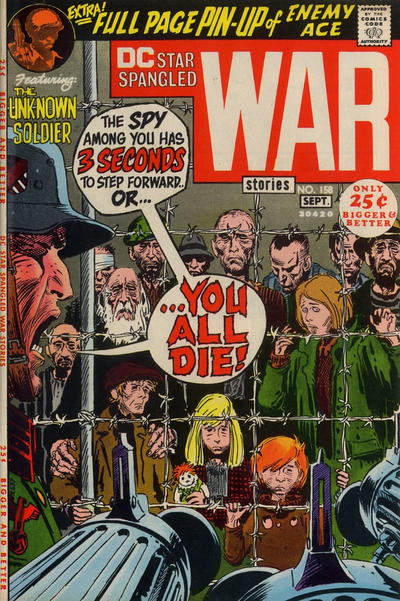
Star Spangled War Stories #158

Star Spangled War Stories #158 (On Sale: June 17, 1971), has an Unknown Soldier cover by Joe Kubert.

We begin with the Unknown Soldier in "Totentanz" by Bob Haney and Joe Kubert. The Unknown Soldier is sent to the Totentanz concentration camp to rescue Erika Hauser, code name "Berengaria," who helped hundreds of important people and children escape from the Nazis. Furthermore, she is deeply tied to the entire network of underground fighters in Germany. Berengaria was captured by the Gestapo, but they do not yet know of her identity.

The Soldier allows himself to be capture and taken to Totentanz. After smuggling a packet containing his disguise to the camp, he then disguises himself as Obersturmführer Adolf Eichmann and tricking the camp commandant Colonel Schneider into releasing Berengaria to his custody. The ruse is eventually discovered when the real Eichmann was on his way to the camp. Fortunately, the Soldier and Berengaria successfully escape to Switzerland. Reprinted in Showcase Presents the Unknown Soldier Vol. 1 TPB (2007). 

This is the kind of book that made the "25 cents bigger and better" slogan hard to swallow. The 11-page Unknown Soldier story is the only new content in this issue.

Our first reprint is "The Flattened Point" by Robert Kanigher and Irv Novick and reprinted from Our Fighting Forces #74 (1963).

This is followed by Enemy Ace in "Enemy Ace" by Robert Kanigher and Joe Kubert and reprinted from Our Army at War #151 (1965). Hans von Hammer celebrates his 50th kill when he is grazed by the wildly fired bullet of his 51st victim. He hovers in and out of consciousness but still manages to land his plane. He broods on the fact that even in the arms of a beautiful nurse and among his fellow pilots, he still feels lonely as if they stand apart from the "killing machine". 

He finds some solace in taking a rifle into the forest and hunting for a while with another predator, a wolf, who recognizes a kindred spirit. Then, Hans takes to the skies once more to defend a zeppelin on a bombing run from three enemy fighters. He manages to shoot two down, but the third deliberately rams his damaged plane into the zeppelin.

We end this issue with "Lame Duck Glider" by France Herron and Russ Heath and reprinted from All American Men of War #57 (1958).

Edited by Joe Kubert.

DC 100-Page Super Spectacular #4

DC 100-Page Super Spectacular #4 (On Sale: June 17, 1971), has a nice cover by Berni Wrightson. There were no issues 1-3 and the first three published issues (4-6) had subtitles - the first two of which were later used for ongoing comics series and the third became the title of a series of Mego figures based on comics super-heroes: #4 "Weird Mystery", #5 "Love Stories", and #6 "World's Greatest Super-Heroes".

The title then became the replacement for the "Giant" comics series (previously "80 Pg Giant") which ran as part of regular, ongoing series titles (i.e., #7 also known as Superman #245, #8 aka Batman #238, #9 aka Our Army at War #242, #10 aka Adventure Comics #416, #11 aka The Flash #214, #12 aka Superboy #185 and #13 aka Superman #252) for six issues.

Then, even later on, it reverted back to its own title again (#14 through #22, utilizing as cover titles the existing titles of regular, ongoing series, but not being part of those regular series' numbering - in other words, no corresponding issue numbers for those issues.

The planned issue #23 became Shazam! #8 and the Super Spectacular's own numbering disappeared and advertisements were added. The DC 100 Page Super Spectacular title itself was used on another 96 issues of varying regular, ongoing titles through 1975.

We begin this issue with a one-page Table of Contents by Sergio Aragones and that is followed by a one-page introduction drawn by Berni Wrightson. 

Next up is "I Was the Last Man on Earth" drawn by Mort Drucker and reprinted from My Greatest Adventure #8 (1956).

That is followed by "The Phantom Enemy" drawn by Carmine Infantino and Sy Barry and reprinted from Sensation Mystery #116 (1953).

Next, we have "I Fought the Clocks of Doom" drawn by Mort Meskin and reprinted from My Greatest Adventure #14 (1957).

That brings us to  "The Witch's Candles" drawn by John Prentice and reprinted from House of Secrets #2 (1957).

We have another Sergio Aragones humor page next, followed by a one-page Eerie Tales introduction page by Berni Wrightson.

Next is "I Was Lost in a Mirage" drawn by Mort Meskin and reprinted from My Greatest Adventure #12 (1956).

That is followed by Johnny Peril in "Horror in the Lake" by Robert Kanigher, Frank Giacoia, and Sy Barry and reprinted from Sensation Mystery #110 (1952).

Next up is The Phantom Stranger in "The Haunters from Beyond" by John Broome, Carmine Infantino, and Sy Barry and reprinted from Phantom Stranger #1 (1952). Anne Parris is haunted by two ghosts from the Salem witch trials. The ghosts blame Anne's ancestors for their deaths and curse her in revenge. Anne becomes distraught and nearly kills herself, but the Phantom Stranger stops her. He takes her home, where the ghosts show up again.

The Stranger is suspicious, so after the ghosts leave he asks Anne to stage her own death. Within minutes Anne's cousin Bryce and his fiancee arrive on the scene. The Phantom Stranger proves that they were the ones disguised as ghosts and forces Bryce to confess he set Anne up in order to steal her inheritance. After the pair are arrested, the Phantom Stranger disappears.

We have yet another Berni Wrightson introduction page, this one on Monsters.

That is followed by "I Was the Last Martian" drawn by Jim Mooney and reprinted from My Greatest Adventure #20 (1958).

Next, we have  "I Hunted the World's Wildest Animals" drawn by Nick Cardy and reprinted from My Greatest Adventure #15 (1957).

Another Berni Wrightson introduction, this on Science Fiction is followed by "The City of Three Dooms" drawn by Mort Meskin and reprinted from Tales of the Unexpected #15 (1957).

Next, is  "Jungle Boy of Jupiter" drawn by Lou Cameron and reprinted from Tales of the Unexpected #24 (1958).

Next up is "Childhood Haunt" a one-page text story illustrated by Berni Wrightson.

Our last reprint is "The Mysterious Mr. Omen" drawn by Leonard Starr and reprinted from House of Mystery #49 (1956).

We end with a one-page humor story Weird Tales by Lore Shoberg.

Edited by Joe Orlando.

Friday, June 10, 2016

G.I. Combat #149

G.I. Combat #149 (On Sale: June 10, 1971), has a Haunted Tank cover by Joe Kubert. They kept the "Bigger and Better" slug off this cover since the last few issues have been 64 pages for 25 cents.

We begin with the Haunted Tank in "Leave the Fighting to Us" by Robert Kanigher and Russ Heath. Some of the soldiers despise the new replacement, an observant Jewish sergeant. When he shows great valor and accomplishes the mission at the cost of his life, they're forced to reconsider. Reprinted in Showcase Presents: Haunted Tank Vol. 2 TPB (2008).

The backup is Sgt. Rock in "Last Man -- Last Shot" by Robert Kanigher and Joe Kubert and reprinted from Our Army at War #152 (1965). Sgt. Rock picks up a new group of recruits as replacements for Easy Company. As he returns with them to the front, they meet several attacks by enemy forces. The new recruits all freeze under fire and do not get off a shot. Rock is forced to stop the enemy attacks himself.

Between attacks, Rock tells them stories of other soldiers who were scared under pressure. He explains that they froze too. However, each one of them eventually overcame the fear and heroically died in combat.

Rock’s jeep is hit by another attack. He is forced to crawl toward the enemy forces, expecting his men to follow. They have frozen again. Rock is hit by enemy fire and goes down. Seeing their leader is human, the recruits finally return fire and fight off the enemy attack. Rock, who is wounded, then brings the troops to Easy Company.

Edited by Joe Kubert.

Wednesday, June 8, 2016

Justice League of America #91

Justice League of America #91 (On Sale: June 8, 1971), has a cover by Neal Adams.

We begin with the Justice Leage of America in "Earth -- The Monster-Maker" by Mike Friedrich, Dick Dillin, and Joe Giella. On a joy-ride between dimensions, an alien boy called A-Rym and his symbiotic pet, Teppy, are flung into the separate worlds of Earth-One and Earth-Two. They must be re-united, or both will die, but the environment of Earth changes both into rampaging, monstrous menaces. 

Flash has already been injured in an encounter with Teppy, while the Earth-Two Green Lantern falls prey to A-Rym, who takes his power ring, sensing that it can reunite him with his pet. Joined in the battle by the Robins of both Earths, the Justice League and Justice Society form two new teams to deal with the threats. Green Lantern joins the two Hawk-men and the two Robins against A-Rym, while Flash of Earth-Two teams with the two Supermen and the two Atoms against Teppy. 

While this second group successfully captures Teppy, on Earth-Two, Robin of Earth-One is injured in the struggle, and A-Rym finds an ally in the macabre Solomon Grundy. Concluded next issue. This has been reprinted in Crisis on Multiple Earths Vol. 3 TPB (2004), Showcase Presents: Robin the Boy Wonder Vol. 1 TPB (2008), Showcase Presents: Justice League of America Vol. 5 TPB (2011), Justice League of America Archives Vol. 10 HC (2012), Justice League of America:The Bronze Age Omnibus Vol. 1 HC (2017), and Justice League of America:The Last Survivors of Earth TPB (2019).

The first backup is Knights of the Galaxy in "The Day the World Melted" by Robert Kanigher, Carmine Infantino, and Joe Giella and reprinted from Mystery in Space #6 (1952). The Master of Doom transports the Galaxy Knights back in time to the 20th Century while he attempts to conquer their own time, and Lyle and his men find themselves fighting to save Earth from nuclear devastation. Ultimately, the power of the H-Bomb they manage to detonate harmlessly in space gives them the energy needed to return home and defeat their nemesis.

Our final backup is Hourman in "The Hour Hourman Died" by Gardner Fox, Dick Dillin, and Sid Greene and reprinted from Spectre #7 (1968). Hourman fights Tricky Dick Arnold to recover stolen Tyler Chemical Company blueprints. However, a shot from the Metalizer Gun that Tricky Dick used to get into Tyler's vault seems to have killed Hourman. 

Dick disposes of the Metalizer Gun, but Hourman isn't dead yet-- it would seem the radiation won't kill him until the Miraclo wears off! He pursues Arnold, captures him, and retrieves the gun, allowing him to find the antidote to reverse the effects of the Metalizer gun - just in time!

Edited by Julius Schwartz.


All-Star Western #7

All-Star Western #7 (On Sale: June 8, 1971), has a beautiful Outlaw, Billy the Kid, cover by Tony DeZuniga.

We begin with Outlaw, Billy the Kid, in "Bullet for a Gambler" by John Albano and Tony DeZuniga. After being saved twice by a man named Ace, from attacking Indians, Billy the Kid agrees to go with Ace to be safe from further attacks. Ace has a case of tuberculosis and is dead set on killing any Indian that happens on his path. However, the two are surrounded soon after Ace indiscriminately kills a hunting party.

However, the Indians let Billy go, as Billy tried to stop Ace from killing the Indian chief's son. Not wishing to be burned alive, Ace demands that Billy pay his debt, and reveals that he was the killer of Billy's father and that he knows that Billy is really a girl. Billy agrees to kill Ace in a draw only, and Ace tricks Billy into shooting him by not drawing when it's time to shoot. Reprinted in Jonah Hex and Other Western Tales #1 (1979) and Showcase Presents Jonah Hex Vol. 1 TPB (2006).

Next up is Davy Crockett in "The Challenge of Black Warrior" drawn by John Prentice and reprinted from Frontier Fighters #1 (1955).

That is followed by Buffalo Bill in "The Tenderfoot Caravan" by Dave Wood and Joe Kubert and reprinted from Frontier Fighters #1 (1955).

We end with El Diablo in "The Gypsy Curse" by Robert Kanigher, Alan Weiss, and Dick Giordano. Santano, a gypsy king, is convicted of crimes and sentenced to death by hanging. He issues a curse on those who persecuted him. 

Princess Nurka, Santano's daughter mourns the loss of her father and El Diablo tries to comfort her, but the other gypsies chase him away. Later Santano's curse unfolds, as the judge and sheriff are murdered. El Diablo is accused of the crime and thrown in jail. Nurka rescues him. That night Hutton, the man who hung Santano is killed. El Diablo catches the killer only to discover it is Nurka. She is arrested. As El Diablo rides out of town Nurka lays a curse on him, but El Diablo knows that he is already cursed.

Edited by Joe Orlando.

Friday, June 3, 2016

Flash #208

Flash #208 (On Sale: June 3, 1971), has a beautiful cover by Neal Adams.

We begin with the Flash in "A Kind of Miracle in Central City" by Robert Kanigher, Irv Novick, and Murphy Anderson. The Flash rescues a teenage boy from a fall off a rooftop. Vic, the boy, claims it was an accident, but the Flash suspects otherwise. Vic was thrown off the roof by a gang leader known as the Chief. Vic had been working for the gang, but he was made expendable when his sister Anne alerted her fellow nuns to the presence of the crooks in the church.

Since Vic won't accept outside help, the Flash uses his super speed to remain invisible. He then helps Vic and protects him from the gang. Vic makes things right, and the Chief and his partners are apprehended without anyone knowing that the Flash is involved.

The new backup is the Elongated Man in "Malice in Wonderland" by Len Wein and Dick Giordano. As Ralph Dibny is passing through the town of Dodgson it is celebrating its fiftieth anniversary. When he enters town Ralph is given a copy of Alice in Wonderland. While pausing to read the book, he sees a white rabbit. His curiosity is aroused and he follows, only to lose the rabbit in traffic.

The Elongated Man then meets a man dressed as the Mad Hatter. The man explains that his uncle who founded the town was a relative of Lewis Carroll, the author of Alice in Wonderland. The town is celebrating by dressing as characters from the book. Ralph still wants to catch up to the rabbit, who steals a rare first edition of the book on display at the town civic center. The Elongated Man tracks down the rabbit and his partners and retrieves the stolen book. He was tipped off by the fact that the criminal dressed like the movie version of the rabbit, instead of the original book version.

The reprint backup is the Kid Flash in "The Flash's Sensational Risk" by John Broome, Carmine Infantino, and Joe Giella and reprinted from Flash #149 (1964). A large explosion near Blue Valley draws the attention of Wally West aka Kid Flash. Kid Flash examines a crater created by the explosion and is transported to the other-dimensional world of Ikora. Kid Flash then discovers explosives used by Ikoran criminals are responsible for the damage on Earth. Kid Flash attempts to apprehend the criminals, but he is struck by one of their weapons.

Kid Flash returns to Earth to gain the aid of the Flash. After relating his story, Kid Flash loses his memory as a delayed side-effect of the ray weapon. Flash fails to restore Wally's memory until he devises a way to unmask on TV at super-speed. Wally's memory is shocked back to normal by the surprise.

Flash and his protégé return to Ikora and defeat the K-10 Gang. After turning them into Ikoran authorities, the speedsters return to Earth. Flash explains that because he unmasked at super-speed, only Wally's super-speed vision could identify his real face.

Edited by Julius Schwartz.