Showing posts with label Russ Heath. Show all posts

Wednesday, August 10, 2016

G.I. Combat #150

G.I. Combat #150 (On Sale: August 10, 1971), has a Haunted Tank cover by Joe Kubert.

We begin with "The Death of the Haunted Tank" by Robert Kanigher and Russ Heath. Reprinted in G.I. Combat #169 (1974) and Showcase Presents: Haunted Tank Vol. 2 TPB (2008).

Next up is "The Two-Legged Mine" by Bob Haney and Russ Heath and reprinted from All American Men of War #66 (1959).

That brings us to the U.S.S. Stevens in "Hip Shot" by Sam Glanzman. "Wild Bill" Rogers, a simple deck-hand, jumps into action firing a spread of torpedoes that saves the U.S.S. Stevens from a Japanese warship.Reprinted in U.S.S. Stevens: The Collected Stories (2016).

We end with Sgt. Rock in "Ice Cream Soldier" by Robert Kanigher and Joe Kubert and reprinted from Our Army at War #85 (1959). Phil Mason, a new replacement, joins Easy Company. Phil is just a kid and has no combat experience. When he melts under pressure, the other members of Easy name him the Ice Cream Soldier.

Easy falls under fire. Phil freezes up forcing Sgt. Rock to protect him. Rock is wounded by enemy fire. Phil blames himself for the incident. The rest of Easy continues to tease Phil, calling him Ice Cream Soldier.

Rock reassigns Phil to be the bazookaman's assistant. When tanks attack Easy during a snowstorm, Phil is cut off from the others. Despite a severe case of frostbite, Phil takes out the tanks with the bazooka. Phil survives the experience, keeping the Ice Cream Soldier nickname.

Edited by Joe Kubert.

Wednesday, August 3, 2016

Our Army at War #237

Our Army at War #237 (On Sale: August 3, 1971), has an interesting  Sgt. Rock cover by Joe Kubert.

We begin with Sgt. Rock in  "Nobody Cares" by Robert Kanigher and Russ Heath.

Next up is a Medal of Honor story "Assault on the Hermit Kingdom" drawn by Norman Maurer.

Our next story is a reprint, "Battle Sun" by Bob Haney and Russ Heath and reprinted from Our Army at War #61 (1957).

Our next reprint is "The Wall Around the War" by Bob Haney and Joe Kubert and reprinted from Our Fighting Forces #24 (1957).

We end with our final story "The Bloody Star" by Bob Haney and Fred Ray

Edited by Joe Kubert.

Friday, July 15, 2016

Weird War Tales #1

Weird War Tales #1 (On Sale: July 15, 1971), has a  cover by Joe Kubert. The ever-expanding line of horror..er I mean weird books continues at DC. This title would prove to have some pretty great legs lasting over 11 years.

"Let Me Tell You the Things I've Seen" serves as an introduction to book host, Death and is written and drawn by editor Joe Kubert. In the winter of 1944, a lone G.I. is separated from his outfit and is lost in the woods that are located in German territory. He is almost hit by a German tank shell but is left with a broken leg. The G.I. painfully drags through the icy fog to try to find and warn his outfit about the Germans until he comes upon a house in the middle of a clearing. 

He is taken inside by an old man who then helps him patch his leg and gives him time to rest. When the G.I. insists on returning to his men despite his injury, his host tells him that he is too weak and that there is time to warn his friends. To spend the passage of time, the old man tells the G.I. stories about the wars that he had seen in his life.

This first tale is a reprint, "The Secret of the Fort Which Did Not Return" by Robert Kanigher and Russ Heath and reprinted from G.I. Combat #86 (1961). A bombardier returned from a mission to be greeted by his fellow airmen. As more bombers flew into the sky for another raid, the bombardier recalled the mission when he and his squadron flew in a B-51 bomber called "Mother Hen" to Munich. When Mother Hen and the other bombers entered Nazi territory, the enemies fired at them with artillery and sent their own planes, taking down the Brooklyn Belle and Powerhouse Pete. 

The American bombers exchanged fire with the Nazis as the former of the forces attempted to reach their target. All of the bombers except for Mother Hen were destroyed and Mother Hen's tail gunner, two pilots, and waist gunners were both killed, but the bombardier managed to drop their bombs on the target; three oil tanks. The bombardier noticed that nobody was piloting the plane and that more Nazi planes were chasing him, so he jumped out of Mother Hen in a parachute. In the present, the bombardier decided that he couldn't tell the others what had happened to Mother Hen. A week later, he was in another bomber, on a mission, and saw Mother Hen flying by.

Next is "The Story Behind the Cover" by Joe Kubert. A German patrol under Lance Corporal Mueller suddenly comes across an American patrol and a fight breaks out. In the narrow confines of the ditch both sides find themselves in, a grenade is lobbed among them and explodes. By some miracle, only Mueller survives much to his astonishment. Mueller runs back to his position to warn his Lieutenant about the enemy. 

Mueller tries to explain to the Lieutenant, who then doesn't speak a word to him and acting as if Mueller wasn't there. Mueller believes that the Lieutenant doesn't like his report and that he had failed him. When he tries to explain to his comrades, they too ignored him. Mueller thinks the men are shunning him for losing his patrol. Gripped by terrible guilt, Mueller believes that the only way to wipe out his shame and regain the respect of his comrades is by facing the entire Allied army by himself.

Mueller never felt the storm of lead that lashed him and the crushing death dealt by enemy guns. But by the pain and agony will be with him forever, as a skeletal specter in the battlefield. Reprinted in Sgt. Rock #401 (1985) and Showcase Presents: Weird War Tales Vol. 1 TPB (2013).

That is followed by "The End of the Sea Wolf" by Bob Haney and Joe Kubert and reprinted from Star Spangled War Stories #71 (1958). Sometime after World War II, a German ship was sailing through the North Sea, looking for Allied ships to salvage. The captain recalled the time he had captained a U-boat called the Sea Wolf. The Sea Wolf encountered an Allied fleet. They sunk one ship before they encountered a Q-boat that opened fire on them. The Sea Wolf fired back, taking down the Q-boat's guns. The Q-boat was sailing towards the Sea Wolf, about to ram into it. In the present, the captain of the ship came upon wreckage, which happened to be both the Q-boat and the Sea Wolf, which had been sunk while sinking the Q-boat.

Next up is "Baker's Dozen" by France Herron and Irv Novick and reprinted from Star Spangled War Stories #116 (1964). In Normandy, on Friday the 13th, a thirteenth member was assigned to Baker's Company, much to the sergeant's dismay, believing it to be bad luck. The company left without him, but the captain told the soldier to join them in battle. During the battle, Baker's Company saw a black cat as the thirteenth soldier had arrived. As the thirteenth soldier petted the black cat, a German fighter swooped in and opened fire on the company. 

Not wanting to be considered bad luck, the soldier opened fire on the fighter, shooting it down, but the sergeant chewed him out, believing he had almost been killed by debris. As the sun began to set, an enemy tank had appeared and the soldier decided to take it down himself, but the sergeant chewed him out again. They arrived in a town where the soldier broke a mirror, causing the sergeant to chew him out again. The soldier believed that he may actually be bad luck. When he saw a license plate that read "13-13", he entered the vehicle and drove towards a tank, with TNT inside, getting out before the explosion. Afterward, the sergeant insisted that the soldier stayed with them and that the enemy had to worry about the number thirteen.

We end with the final part of the framing sequence, "You Must Go" by Joe Kubert.  The old man has finished telling his stories and the G.I. is fully rested as the night is almost gone. So the G.I. is ready to reach his outfit and warn them about the enemy waiting in the woods. The G.I. suggests to his host that he should leave as his house will likely be caught in the inevitable crossfire. The old man reassures him that he is in no danger for he has seen war "swirl around [his] doorstep like winter snow!" The G.I. and the old man bid farewell to each other.

The G.I. continues wandering through the woods until he sees a villager gathering firewood. The villager helps him point the way to a nearby road before asking where he had come from. The G.I. explain to her about the cottage and the old man. The villager is very surprised to hear of this because there was no one living in that house because an artillery shell had landed on it and killed its owner...on the very last morning of the Great War. All that is left are ruins.

Edited by Joe Kubert.

Friday, July 8, 2016

House of Mystery #194

House of Mystery #194 (On Sale: July 8, 1971), has an amazing cover by Berni Wrightson.

We begin with "Born Loser" by Jack Oleck and Alex Toth. A man uses magic spells to make him appear dead in his cell after he murders his wife and is scheduled to hang. He has made previous arrangements with his lover to collect the body, but when she goes to get it she is told the man has been cremated. Reprinted in DC Special Blue Ribbon Digest #24 (1982).

Next is our first reprint, "The Human Wave" drawn by Russ Heath and reprinted from House of Secrets #31 (1960).

Our next reprint is "The Negative Man" drawn by Jack Kirby and reprinted from House of Mystery #84 (1959).

Back to new material with "The King Is Dead" by Jack Oleck and Nestor Redondo. This was Nestor Redondo's first work at DC. He would go on to take over Swamp Thing after the departure of Berni Wrightson. A full moon turns the new king into a monster that murders many people. He tells his reluctant guards that he must be locked in the dungeon to save lives. The monster manifests in his cell and kills him, killing itself in the process.

All new material reprinted in Showcase Presents: The House of Mystery Vol. 1 TPB (2006) and House of Mystery: The Bronze Age Omnibus #1 (2018).

Edited by Joe Orlando.

Friday, July 1, 2016

Weird War Tales #1

Weird War Tales #1 (On Sale: July 1, 1971), has a cover by Joe Kubert and is our second new hit title of the month and the day.

DC had hit a goldmine with their mystery/horror books and kept looking for ways to expand their offerings. Here they blended the genre with war books and let Joe Kubert take the helm. Since the title lasted twelve years, I guess you could say it was a success.

The book begins with "Let Me Tell You the Things I've Seen" a series introduction written and drawn by Joe Kubert. In the winter of 1944, a lone G.I. is separated from his outfit and is lost in the woods that are located in German territory. He is almost hit by a German tank shell but is left with a broken leg. The G.I. painfully drags through the icy fog to try to find and warn his outfit about the Germans until he comes upon a house in the middle of a clearing. 

He is taken inside by an old man who then helps him patch his leg and giving him time to rest. When the G.I. insists on returning to his men despite his injury, his host tells him that he is too weak and that there is time to warn his friends. To spend the passage of time, the old man, the series host: Death, tells the G.I. stories about the wars that he had seen in his life.

Our first real story is "Fort Which Did Not Return" by Robert Kanigher and Russ Heath and reprinted from G.I. Combat #86 (1961). A bombardier returned from a mission to be greeted by his fellow airmen. As more bombers flew into the sky for another raid, the bombardier recalled the mission when he and his squadron flew in a B-51 bomber called "Mother Hen" to Munich. When Mother Hen and the other bombers entered Nazi territory, the enemies fired at them with artillery and sent their own planes, taking down the Brooklyn Belle and Powerhouse Pete.

 The American bombers exchanged fire with the Nazis as the former of the forces attempted to reach their target. All of the bombers except for Mother Hen were destroyed and Mother Hen's tail gunner, two pilots, and waist gunners were both killed, but the bombardier managed to drop their bombs on the target; three oil tanks. The bombardier noticed that nobody was piloting the plane and that more Nazi planes were chasing him, so he jumped out of Mother Hen in a parachute. In the present, the bombardier decided that he couldn't tell the others what had happened to Mother Hen. A week later, he was in another bomber, on a mission, and saw Mother Hen flying by.

Next up is "The Story Behind the Cover" written and drawn by Joe Kubert. A German patrol under Lance Corporal Mueller suddenly comes across an American patrol and a fight breaks out. In the narrow confines of the ditch both sides are in, a grenade is lobbed among them and explodes. By some miracle, only Mueller survived much to his astonishment. Mueller runs back to his position to warn his Lieutenant about the enemy.

Mueller tries to explain to the Lieutenant, who then doesn't speak a word to him and acting as if Mueller wasn't there. Mueller believes that the Lieutenant doesn't like his report and that he had failed him. When he tried to explain to his comrades, they too ignored him. Mueller thinks the men are shunning him for losing his patrol. Gripped by terrible guilt, Mueller believes that the only way to wipe out his shame and regain the respect of his comrades is by facing the entire Allied army by himself.

Mueller never felt the storm of lead that lashed him and the crushing death dealt by enemy guns. But the pain and agony will be with him forever, as a skeletal specter on the battlefield. Reprinted in Sgt. Rock #401 (1985)

We end this fort issue with "The End of the Sea Wolf" by Bob Haney and Joe Kubert and reprinted from Star Spangled War Stories #71 (1958). Sometime after World War II, a German ship was sailing through the North Sea, looking for Allied ships to salvage. The captain recalled the time he had captained a U-boat called the Sea Wolf. The Sea Wolf encountered an Allied fleet. They sunk one ship before they encountered a Q-boat that opened fire on them. The Sea Wolf fired back, taking down the Q-boat's guns. The Q-boat was sailing towards the Sea Wolf, about to ram into it. In the present, the captain of the ship came upon wreckage, which happened to be both the Q-boat and the Sea Wolf, which had been sunk while sinking the Q-boat.

All the new material was reprinted in Showcase Presents: Weird War Tales Vol. 1 TPB (2013).

Edited by Joe Kubert.

Our Army at War #236

Our Army at War #236 (On Sale: July 1, 1971), has a Sgt. Rock cover by Joe Kubert.

We begin with Sgt. Rock in "Face the Devil" by Robert Kanigher and Russ Heath. An old man comes out of the fog, claiming that Billy Boy is his lost son. Is the man real, or a ghost? Reprinted in Sgt. Rock #19 (1991).

Next up is "22 Hrs. to San Francisco" by Mike Friedrich and John Severin. Alan Tomasz returns home from Vietnam. Reprinted in Sgt. Rock #21 (1992).

Our first reprint is "The Empty Cockpit" by Hank Chapman and Joe Kubert and reprinted from Capt. Storm #3 (1964). Lt. Danner, a new Spad pilot, wants to fill the empty cockpit of the squadron's hero Captain Kelly.

That brings us to another reprint: "The Third Enemy" by Bob Haney and Russ Heath and reprinted from Our Fighting Forces #45 (1959). During World War II a rookie Allied Ski Soldier learns that every mountain contains three types of enemies.

We end with "No Beginning -- No End" by Robert Kanigher and Frank Thorne. A look at war through the ages, from cavemen, through knights to WWI and WWII.

Edited by Joe Kubert.

Friday, June 17, 2016

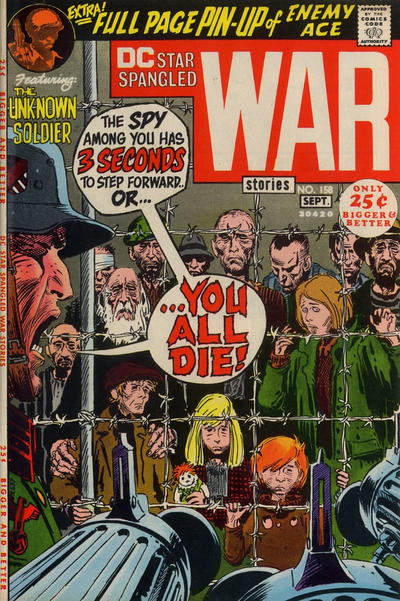
Star Spangled War Stories #158

Star Spangled War Stories #158 (On Sale: June 17, 1971), has an Unknown Soldier cover by Joe Kubert.

We begin with the Unknown Soldier in "Totentanz" by Bob Haney and Joe Kubert. The Unknown Soldier is sent to the Totentanz concentration camp to rescue Erika Hauser, code name "Berengaria," who helped hundreds of important people and children escape from the Nazis. Furthermore, she is deeply tied to the entire network of underground fighters in Germany. Berengaria was captured by the Gestapo, but they do not yet know of her identity.

The Soldier allows himself to be capture and taken to Totentanz. After smuggling a packet containing his disguise to the camp, he then disguises himself as Obersturmführer Adolf Eichmann and tricking the camp commandant Colonel Schneider into releasing Berengaria to his custody. The ruse is eventually discovered when the real Eichmann was on his way to the camp. Fortunately, the Soldier and Berengaria successfully escape to Switzerland. Reprinted in Showcase Presents the Unknown Soldier Vol. 1 TPB (2007). 

This is the kind of book that made the "25 cents bigger and better" slogan hard to swallow. The 11-page Unknown Soldier story is the only new content in this issue.

Our first reprint is "The Flattened Point" by Robert Kanigher and Irv Novick and reprinted from Our Fighting Forces #74 (1963).

This is followed by Enemy Ace in "Enemy Ace" by Robert Kanigher and Joe Kubert and reprinted from Our Army at War #151 (1965). Hans von Hammer celebrates his 50th kill when he is grazed by the wildly fired bullet of his 51st victim. He hovers in and out of consciousness but still manages to land his plane. He broods on the fact that even in the arms of a beautiful nurse and among his fellow pilots, he still feels lonely as if they stand apart from the "killing machine". 

He finds some solace in taking a rifle into the forest and hunting for a while with another predator, a wolf, who recognizes a kindred spirit. Then, Hans takes to the skies once more to defend a zeppelin on a bombing run from three enemy fighters. He manages to shoot two down, but the third deliberately rams his damaged plane into the zeppelin.

We end this issue with "Lame Duck Glider" by France Herron and Russ Heath and reprinted from All American Men of War #57 (1958).

Edited by Joe Kubert.

Friday, June 10, 2016

G.I. Combat #149

G.I. Combat #149 (On Sale: June 10, 1971), has a Haunted Tank cover by Joe Kubert. They kept the "Bigger and Better" slug off this cover since the last few issues have been 64 pages for 25 cents.

We begin with the Haunted Tank in "Leave the Fighting to Us" by Robert Kanigher and Russ Heath. Some of the soldiers despise the new replacement, an observant Jewish sergeant. When he shows great valor and accomplishes the mission at the cost of his life, they're forced to reconsider. Reprinted in Showcase Presents: Haunted Tank Vol. 2 TPB (2008).

The backup is Sgt. Rock in "Last Man -- Last Shot" by Robert Kanigher and Joe Kubert and reprinted from Our Army at War #152 (1965). Sgt. Rock picks up a new group of recruits as replacements for Easy Company. As he returns with them to the front, they meet several attacks by enemy forces. The new recruits all freeze under fire and do not get off a shot. Rock is forced to stop the enemy attacks himself.

Between attacks, Rock tells them stories of other soldiers who were scared under pressure. He explains that they froze too. However, each one of them eventually overcame the fear and heroically died in combat.

Rock’s jeep is hit by another attack. He is forced to crawl toward the enemy forces, expecting his men to follow. They have frozen again. Rock is hit by enemy fire and goes down. Seeing their leader is human, the recruits finally return fire and fight off the enemy attack. Rock, who is wounded, then brings the troops to Easy Company.

Edited by Joe Kubert.

Wednesday, June 1, 2016

Our Army at War #235

Our Army at War #235 (On Sale: June 1, 1971), has a so-so Sgt. Rock cover by Joe Kubert.

We begin with Sgt Rock in  "Pressure Point" by Robert Kanigher and Russ Heath. I do not have much on this one, though I have it in a box somewhere.

Next up is the U.S.S. Stevens in "Kamikaze" by Sam Glanzman. Tatsuno Sakigawa flies his plane on a Kamikaze attack against US forces at Okinawa. Reprinted in America at War: The Best of DC War Comics HC (1979), America at War: The Best of DC War Comics SC (1979), and Sgt. Rock #20 (1992).

That is followed by "The Glory Boys" by Robert Kanigher and Alex Toth. Reprinted in America at War: The Best of DC War Comics HC (1979), America at War: The Best of DC War Comics SC (1979), and DC Goes to War HC (2020).

The reprints start with "Wall for a Fighting Man" by Bob Haney and Russ Heath and reprinted from Our Army at War #52 (1956).

We end with "Instant Hero" by Hank Chapman and Joe Kubert and reprinted from Capt. Storm #6 (1965).

Edited by Joe Kubert.

Wednesday, May 4, 2016

Our Army at War #234

Our Army at War #234 (On Sale: May 4, 1971), has a nice Sgt. Rock cover by Joe Kubert.

We start this issue with Sgt. Rock in "Summer in Salerno" by Joe Kubert and Russ Heath. Sgt. Rock leads Easy Company into Italy during the Summer of 1943. In the town of Salerno, Easy enters a farmhouse and discovers an elderly couple living inside. When the men are pinned down by three enemy tanks, the couple leads Easy into the cellar for protection. Rock takes on the tanks himself. He destroys two, but the third has him pinned down. The old man comes out of the cellar and firebombs the Nazi tank. His tactic is successful, and Easy finishes liberating the town.

Next up is a Battle Album featuring Grenade Launcher! by Sam Glanzman. Information about different Grenade Launchers, including a 1685 Naval Brass Launcher, 1940 M1 30 Caliber rifle with M17 Launcher, 1965 40 MM Grenade Launcher, and 1969 M16 with 40 MM launcher. Also includes a cross-section of a typical WWII grenade.

We end with a tale by Ric Estrada; "Mercy Brigade" is a fictionalized retelling of the lives of three men destined to be great writers, Ernest Hemingway, F. Scott Fitzgerald, and John Dos Passos, during WWI.

Edited by Joe Kubert.

Wednesday, April 13, 2016

G.I. Combat #148

G.I. Combat #148 (On Sale: April 13, 1971), has a so-so cover by Joe Kubert.

We begin with The Haunted Tank in "The Gold-Plated General" by Robert Kanigher and Russ Heath. After an encounter with a Nazi tank, Jeb Stuart and the crew of the Haunted Tank make their way back to the command post to meet their new commanding officer, General Norton (who bears a striking resemblance to George C. Scott in Patton). The general is a stickler for appearance. He wears a gold helmet and brandishes golden pistol sidearms. The men begrudgingly follow his orders to clean themselves up.

A short time later, Jeb leads his newly polished crew into battle. The general is right beside him in another tank. The brash general charges the enemy position and leads the surge to overtake them. Following the victorious battle, the general's clothing is soiled. The men hope he will relax discipline now that their leader is no longer immaculate. Reprinted in Showcase Presents: Haunted Tank Vol. 2 TPB (2008).

Next up is our first reprint, "Blind Bomber" by Hank Chapman and Mort Drucker and reprinted from Star Spangled War Stories #84 (1959). In the skies above their target, a bomber is blinded by flak fire. He is told to just circle the area slowly and once they drop their bombs, the other bombers will talk him home. Best laid plans, as they say, and the other bombers miss their target requiring our blind bomber to make a run at the targets, sight unseen. He drops his bombs perfectly and somehow manages to dodge the MIGs trying to shoot him down. Back at their carrier, they are under attack, but the pilot is able to land on the deck while under heavy enemy fire. Once down he learns that his sight should return in a week or so. 

Next, we have "Cry 'Wolf' Mission" by Bob Haney and Russ Heath and reprinted from Star Spangled War Stories #91 (1960). Davey Lee is a frogman and his senses have developed for his specialty of working underwater. While attempting to get at an enemy sub, Davey sets off a few underwater mines and has to call the mission off. The skipper of their ship decides to send Davey back with his brother, Ben, as his partner. They return and find the sub and the pen that protected it are both gone. Some searching turns up the sub, but it is now unprotected. They set charges and blow it up, but back on the ship the skipper is worried that Davey made up or hallucinated the traps he found the first time. even Ben wonders if his brother was simply crying wolf. Two days later one of their ships is destroyed and the skipper wants to know how. Now both brothers are looked at with suspicion. 

The next day on a practice run, the brothers once again encounter the underwater net and traps and are attacked by enemy frogmen. They manage to fight them off and find the submarine again. They again set charges and blow it up. Back on the ship, the skipper explains that intelligence discovered that the traps Davey first encountered were real, but when he set off the mines, the enemy removed them and put a dummy submarine in their place. This time, they blew up the real sub.

That is followed by "Soften 'em Up" by Bob Haney and Irv Novick and reprinted from Our Fighting Forces #57 (1960). A green recruit and a savvy vet watch the artillery, bombers, and tanks work over the city of Dulac. While the greenhorn is sure the town will be "softened up" the vet says not to take anything for granted. Although the town appears "softened" they soon find themselves avoiding Nazi tanks, snipers, and machine-gun nests. The two men then take out the sniper, blow up the nest and take out the tank proving the town to not be as soft as the greenhorn thought.

We end this issue with another Haunted Tank story, "Battle Window" by Robert Kanigher and Joe Kubert and reprinted from G.I. Combat #102 (1963). The ghost of General Stuart warns Jeb that his life will depend on a single shot. Later that day, the Haunted Tank is attacked by several German tanks, Jeb and his crew manage to escape and destroy the enemy tanks, but their gun is jammed. When a fighter attacks from above they are unable to fire back until Rick repairs the gun for a single shot. They shoot down the plane, but the General explains that it was not the single shot he was talking about.

When the Haunted Tank enters an abandoned French town that serves as a Nazi trap, an old French soldier manages to warn the crew in time. The Haunted Tank is chased through the streets until it eventually prevails against the German opponents. The French soldier then saves Jeb from a sniper with a single shot.

Edited by Joe Kubert.

Wednesday, March 2, 2016

Our Army at War #232

Our Army at War #232 (On Sale: March 2, 1971), has a Sgt. Rock cover by Joe Kubert.

We being with Sgt. Rock in "3 Men in a Tub" by Robert Kanigher and Russ Heath. Sgt. Rock and Easy Company capture three Italian soldiers who claim to be working against the Nazis. Easy takes the prisoners with them and soon discovers that they possess useful skills including shoemaking and cooking. When Rock receives orders to attack Nazi-held Cortina Castle, the Italians claim to know a secret entrance.

Rock allows the Italians to guide him past Nazi patrols. However, the Italians seemingly turn against him and turn Rock over to the Nazis. The betrayal is only a ruse, and the Italians help Rock to invade the castle. They clear a path for the rest of Easy to take control and defeat the Nazis.

The back-up is "Buck Taylor You Can't Fool Me", another tale of the U.S.S. Stevens by Writer/Artist Sam Glanzman. Buck Taylor gets sent home for acting crazy. Or was it really an act? Reprinted in U.S.S. Stevens: The Collected Stories (2016).

Edited by Joe Kubert.

DC Special #12

DC Special #12 (On Sale: March 2, 1971), has a Viking Prince cover by Joe Kubert.

We begin with Viking Prince in "Battle for the Dragon Ship" by  Robert Kanigher and Joe Kubert and reprinted from Brave and the Bold #1 (1955). This reprints the first appearance of the Viking Prince. In the year 964 AD, Norwegian fisherman Captain Olaf comes upon a young lad floating on a log at sea. He brings him aboard his vessel, but the youth has no memory of his true name or identity. Olaf and his men bring the youth to shore, where a man named Sardluk the spy watches them from afar. 

Sardluk recognizes the blond-haired lad and reports back to his master Baron Thorvald. Thorvald is animated when he hears the news and orders his men to kill the boy. Sardluk's soldiers raid Captain Olaf's home, but the man fights back, ensnaring the soldiers with Olaf's fishing nets. He then picks up a stray sword and injures Sardluk. The boy has no idea why he is so proficient with a blade. Sardluk and his men run away, but promise to return to finish the job. 

Captain Olaf's daughter Gunnda is so impressed with the boy's bravery that she names him Jon the Viking Prince, after a famed Viking hero. A few days later, Baron Thorvald learns that Olaf's men have put to sea, and orders his dragon ship to give chase. As the dragon ship overtakes Olaf's fishing vessel, Jon has the Captain load him onto a spring-loaded harpoon and fire him across to the other ship. Once onboard, Jon swings across the mast then tears through one of the sails with his sword. He fights valiantly against the Viking warriors, forcing Baron Thorvald to flee by diving off his own ship. Jon is concerned that the Baron had information concerning his true identity and fears that he will never learn the truth about his own mysterious past.

Next is another Viking Prince tale, "The Ice Dragon" by Bill Finger and Joe Kubert and reprinted from Brave and the Bold #5 (1956). With winter setting in, the men of Olaf's tribe are forced to fish day and night to ensure there will be enough food to last. When a sea serpent attacks their fishing boats, the men are too scared to return to the water. Olaf's daughter Gunnda goes out by herself to show the men bravery.

Jon follows her and encounters the serpent. When he gets close, he discovers that the serpent is really a disguised iceberg, moved by one of Thorvald's boats. Jon and Gunnda are captured by Thorvald, but he escapes. When Thorvald's men pursue him, he harpoons a whale. The whale becomes enraged and overturns Thorvald's boats, allowing Jon and Gunnda to get away safely.

Our final Viking Prince story is "The Viking and the Mermaid" by Robert Kanigher and Joe Kubert and reprinted from Brave and the Bold #16 (1958). Jon, the Viking Prince, attempts to claim his throne by completing Thor's twelve tasks. Torgunn, the Claw, who sits on the throne as regent, seeks to thwart Jon. After the Viking Prince defeats Sven the Giant in combat to complete the first task, Torgunn's wife drugs Jon and causes him to temporarily lose his memory.

Accompanied only by a mute bard, Jon is sent to retrieve an ice demon's helm full of fire. The heat of a lava field clears Jon's head and restores his memory. He then battles the ice demons, saves a maiden, and fills one of the demon's helmet with fire.

Jon attempts to take the maiden, Ylla, back to her father, King Harold of Skane. Torgunn then attacks Jon at sea. The maiden falls into the ocean. Jon dives to the bottom of the sea to save her. However, the dive causes Jon to lose his memory yet again. Ylla is returned to her father, while Jon and the bard sail away with the Viking Prince once again seeking his true past.

Next is the origin of the Silent Knight in "Duel in Forest Perilous" by Robert Kanigher and Irv Novick and reprinted from Brave and the Bold #1 (1955). In the 6th century England, a jousting tournament was taking place between two rulers, Sir Oswald Bane and Sir Edwin Kent. When Kent's Lance strikes against Bane's armor, the lance shatters as if made of rotted wood. When he and Bane then duel with swords, Kent's weapon becomes slack, and he is dealt a fatal blow.

Brian Kent, Edwin's son, rushes to his father's side. With his dying breath, Edwin tells him that he will soon come of age that he can rule alongside Sir Oswald, as a just and merciful ruler. Oswald offers his sympathy to young Brian, lamenting that such an accident had to happen. Brian is not sure it was an accident, however. 

He soon becomes apprenticed to the knights and is trained by his father's friend, Sir Grot. Though Brian seems to be excelling in his training, Grot, strangely, keeps informing Bane that he is talent-less and a waste of time. One day, while Grot starts Brian on Hawkery training, Sir Bane's favorite hawk, Slasher, escapes out of the exit, and Brian gives chase. Slasher leads Brian into the Perilous Forest, so named because of the dangers that await within. When he catches up to Slasher, Brian finds him perched on a branch where a marvelous shining suit of armor, sword, and shield hung as if waiting for him. 

Suited in the armor, Brian follows the path back where he sees a young woman and her father being harassed by Oswald's men. Staying silent, so as not to give his identity away, Brian comes to the travelers' aide, fighting off the other knights' attacks, with Slasher assisting with his talons. His refusal to speak earns him the title of Silent Knight by Bane's men. Soon, Brian has warded off all the others and they retreat into the woods. He escorts the girl and her father back to the castle where they will be safe, then Brian returns to the forest, hiding his armor where he found it until he needs it again.

Back at the training camp, Sir Grot complains that while Brian was out cavorting with hawks, the word arrived of a mysterious Silent Knight that has been seen around the kingdom. Brian just shrugs and returns to his duties.

Following that tale is the origin of the  Golden Gladiator, "The Thunder of the Chariots" by France Herron and Russ Heath and reprinted from Brave and the Bold #1 (1955). In ancient Rome, a shepherd named Marcus stares into a fountain. From behind him, a centurion named Cinna ambushes Marcus and brings him before the Praetor Clodius Crassus. He accuses Marcus of trying to assassinate Crassus, even though it was actually Cinna and his men who tried to murder him. Marcus however, proves to be an apt patsy to cover up for Cinna's crimes. 

Praetor Clodius orders Marcus thrown into the slave galley. Aboard the galley, a Nubian lion escapes from his cage and begins attacking the crew. Marcus wrenches his slave chains from their moorings and uses them as a weapon against the lion. The ship's overseer is so impressed with Marcus' fighting prowess that he recommends him for gladiatorial combat. 

Marcus is brought back to Rome where he is forced to fight in the arena. His opponent Caius ensnares Marcus with a net then charges at him with his trident. Marcus is injured but manages to catch the spear and turn it back upon his foe. The Praetor rules to spare Caius' life so that he can "burn with rage" against Marcus. Cinna makes Marcus fight a second time – this time against a charging bull. Cinna deliberately arms him with a faulty spear, hoping that the bull will kill him. The bull indeed breaks Marcus' spear, but the former shepherd still succeeds in conquering the beast. Marcus' next challenge is a chariot race. He races against a fellow gladiator named Cotta and manages to unseat him with a hearty toss from his shield. Marcus manages to win the race and is granted his freedom.

Lastly, we have Robin Hood in "Three Arrows Against Doom" by Bob Haney and Russ Heath and reprinted from Brave and the Bold #9 (1956). Robin Hood, disguised as an old trader, tells the story of three different arrows that saved him from trouble.

Edited by E. Nelson Bridwell.

Thursday, February 11, 2016

G.I. Combat #147

G.I. Combat #147 (On Sale: February 11, 1971), has a cover by Joe Kubert.

we begin with the Haunted Tank in "Rebel Tank" by Robert Kanigher and Russ Heath. After his old commanding officer dies in combat, Jeb Stuart is reassigned to the command of Major Bragg. The major is offended that a Yankee has been given the name of a confederate general, so he orders Jeb to sit out of combat and make supply runs instead. The crew of the Haunted Tank complies, but after a while, they want to get back in the fight.

Eventually, Jeb disobeys orders and sends the Haunted Tank to Mount Abruzzi, where Major Bragg has launched an offensive. Jeb finds Bragg's tank and the others destroyed, Bragg orders Jeb to retreat, but once again he disobeys orders and attacks the Nazi position. By guiding the small tank along a mountain goat trail, the Haunted Tank is able to surprise the Nazis from behind and deliver the knock-out blow to their installation. Reprinted in Showcase Presents: Haunted Tank Vol. 2 TPB (2008).

Next, we have "Sniper's Roost" by Bob Haney and Mort Drucker and reprinted from All American Men of War #71 (1959). The story of a Nazi sniper, called "The Hawk" and how he looks at his targets as toys or insects until one gets far too close. Really wonderful artwork by MAD's Mort Drucker.

That is followed by "Tin Pot Listening Post" by Bob Haney and Jerry Grandenetti and reprinted from All American Men of War #70 (1959). A young recruit is sent into the jungle to be the forward listening post for his outfit. He is so jumpy he mistakes insects, monkeys, and birds for the enemy but each such mistake brings out a real enemy that the young recruit takes care of himself.

Next up is "Broomstick Pilot" by France Herron and John Severin and reprinted from Our Army at War #69 (1958). A young co-pilot on his way to bomb a Nazi submarine pen is startled when the pilot leaves formation and drops low to the ground to avoid enemy aircraft. The pilot says they are now "broomstick pilots" as they fly on at 100 feet, running enemy planes into tension wires and poles, dodging the fire of tanks and ground artillery. They take out the submarine pen then head back home hugging the ground all the way. 

Our next tale is "Battle Window" by Robert Kanigher, Ross Andru, and MikeEsposito and reprinted from All-American Men of War #36 (1956). New recruit Terry was a window washer before the war and everything in the war reminds him of the windows he hates.

This issue ends with "Target for an Ammo Boy" by Robert Kanigher and Joe Kubert and reprinted from All American Men of War #71 (1959). On a Pacific island, a recruit tags along with T.K., known by the men as Tank Killer. Everywhere they look, they find hidden tanks.

Edited by Joe Kubert.

Tuesday, February 2, 2016

Our Army at War #231

Our Army at War #231 (On Sale: February 2, 1971), has a Sgt. Rock cover by Joe Kubert.

We begin this issue with Sgt. Rock in "My Brother's Keeper" by Robert Kanigher and Russ Heath. Easy Company is joined by five new recruits. Rock assigns four of them to be watched over by the veterans. The fifth, Danny Anderson, keeps tabs on himself because Danny reminds Rock of his kid brother Eddie, who died in a motorcycle accident as a kid. Rock protects Danny during a mortar attack, but Danny is anxious to prove himself.

Later Rock leads a small group to secure and hold a position. Danny is left behind. When Rock and his team are pinned down, Danny disobeys orders and follows them. Danny helps to defeat the attacking Nazis, but he is killed in so doing.

Next is a one-page Warrior featuring "Ch'in-Shih-Huang-Ti" by Sam Glanzman. Information is given on Shih-Huang-Ti who conquered most of ancient China.

This is followed by a two-page Battle Album, "Suicide Weapons" by Sam Glanzman. Information is given about various Japanese Suicide Weapons during WWII.

We end with the U.S.S. Stevens in "In the Frying Pan" also written and drawn by Sam Glanzman. The U.S.S. Stevens abruptly loses power at an inopportune time.

Edited by Joe Kubert.

Thursday, January 14, 2016

Our Fighting Forces #130

Our Fighting Forces #130 (On Sale: January 14, 1971), has a nice Losers cover by Joe Kubert.

We begin with the Losers in "Nameless Target" by Robert Kanigher, Ross Andru, and Mike Esposito. The Losers are sent to attack Rouen Beach as part of a fake invasion force intended to draw attention away from the real target, Normandy. The plane carrying the Losers across the English Channel is shot down miles from their intended target. As the Nazis chase the soldiers across the countryside, the Losers discover a town filled with weapons and ammunition. When the fighting continues in the town, the weapons caches are hit, and they explode.

The Losers escape the town with the assistance of a Frenchman. Despite their failure to reach their assigned target, the destruction of the unnamed town proves to be a significant distraction, drawing attention away from Normandy. As a result, the real mission was a success. Reprinted in Showcase Presents: The Losers Vol. 1 TPB (2012).

We end with "Three Graves to Eternity" by Robert Kanigher and Russ Heath. One night, as the men of Dog Company make their way across the African desert they come across three graves, marked by new rifles, helmets, and dog tags. As they wonder who the three men were we are taken back in time as Hank, Red, and Rooster Anderson walk across the same desert on their way to join Dog Company. They think back to their time in an orphanage and how they would not allow themselves to be separated, even if it meant not being adopted. They grow older and join the army and are thrilled to be stationed together. 

They are attacked by a big enemy patrol and fight them back, but Red is killed. Hank digs a grove for him and they bury him in the desert. As they start to move forward,  the patrol has returned, this time with a tank Hank takes out the tank with a bazooka, but is killed as he does. Rooster alone pushes back the rest. Afterward, he digs a grave for Hank and buries him. He also digs a grave for himself. Hank holds them off as best he can, but eventually he is killed by a rocket that covers him in his grave. 

Dog Company never learns who the men were, but given how well they fought, they must have been Dog Company men. A nice story that has never been reprinted.

Edited by Joe Kubert.

Tuesday, January 5, 2016

Our Army at War #230

Our Army at War #230 (On Sale: January 5, 1971), has a Sgt. Rock cover by Joe Kubert.

We begin with Sgt. Rock in "Home Is the Hunter" by Joe Kubert and  Russ Heath. Sgt. Rock and Easy Company discover the tracks of a giant bear outside of a village. The villagers claim that the bear is part of a curse put on the village for helping the Americans. Rock and Easy set out to prove that the curse is a phony by killing the bear. However, on the first night, Bulldozer is mauled. Little Sure Shot goes after the bear by himself only to discover that it is a Nazi in a bear suit. He is led into a trap, but Rock and the other men of Easy Company come to his aid by ambushing the Nazis.

Next, we have a Sgt. Rock's Battle Stations on Military Scouts drawn by Sam Glanzman.

We end with a U.S.S. Stevens story, "Cause and Cure" by Sam Glanzman. The U.S.S. Stevens captures four Japanese frogmen. This story was reprinted in  U.S.S. Stevens: The Collected Stories (2016).

Edited by Joe Kubert.

Tuesday, December 8, 2015

G.I. Combat #146

G.I. Combat #146 (On Sale: December 8, 1970), has a cover by Joe Kubert

We start with the Haunted Tank in "Move the World" by Robert Kanigher and Russ Heath. Jeb Stuart and the crew of the Haunted Tank are stuck in a ravine in the North African desert while two other tanks are destroyed by Nazis. When Jeb gets the tank out, they are badly outnumbered. Jeb outraces the Nazi troop carriers following him, then stops to pick up Ulysses, an infantryman. The tank then heads to Fort Solitary.

When the Haunted Tank arrives, the fort has already been destroyed. The Nazis pursuing them are close, so Jeb has his men detach the tank's turret to use as a decoy. When the Nazis arrive, they are taken by surprise from multiple directions. Jeb and his men win the battle, then reassemble the tank. This story was reprinted in Showcase Presents: Haunted Tank Vol. 2 TPB (2008).

Our first reprint is "Hickory-Foot Soldier" by Bob Haney and Joe Kubert and reprinted from Our Fighting Forces #13 (1956).

Next, we have "A Flower for the Front" by France Herron, Ross Andru, and Mike Esposito and reprinted from Our Fighting Forces #5 (1955). 

That is followed by "The Secret Battle Eye" by Hank Chapman and Joe Kubert and reprinted from Our Fighting Forces #66 (1962).

Next is "The Bug That Won an Island" by Bob Haney, Ross Andru, and Mike Esposito and reprinted from Our Army at War #125 (1962),

We end this issue with Sgt. Rock in "Battle Tags for Easy Co." by  Robert Kanigher and Joe Kubert and reprinted from Our Army at War #120 (1962). Sgt. Rock calms a new recruit while under fire by telling him stories of Easy Company's past missions. He tells the soldier how Ice Cream Soldier, Bulldozer, and Wild Man each earned their nicknames. When it comes time to fight, Sgt. Rock also shows why he is called "the Rock" by standing in the face of enemy fire. The new recruit proves himself in battle, earning his own nickname, Green Apple.

Edited by Joe Kubert.

Tuesday, November 3, 2015

Our Army at War #227

Our Army at War #227 (On Sale: November 3, 1970), has another cool Sgt. Rock cover by Joe Kubert

We begin with Sgt. Rock in "Traitor's Blood" written by Joe Kubert and drawn by Russ Heath. When a patrol is sent to visit a North African sheik is found slaughtered and stripped for supplies, After fighting off a Nazi ambush, Easy Company heads to Sidi El Bar to meet the sheik themselves and Sgt. Rock leads his men to the sheik's tent. The sheik offers entertainment, but Rock is suspicious. Taking a walk through the camp, one of the sheik's dancers shows Rock the supplies taken from the ambushed patrol and tells him that the sheik has already sent word to the Nazis. At gunpoint, Rock forces the sheik and his men to switch clothes with Easy Company. When the Nazis arrive, they shoot the sheik and his men, and Rock and Easy mop up the Nazis Once again, a seemingly innocuous book hides some brilliant artwork by Russ Heath.

Next is  "The War Is Over" by Mike Friedrich and Frank Thorne. It is Armistice Day, November 11, 1918, and Deacon is bringing the good news to his friend Jackie in the trenches of the front, but Jackie wants to hear none of it. He is worried about his friend, Billy, who has not returned from the last raid. They find Billy, wounded and unconscious, but before they can bring him back, they are shelled and Billy is killed.  

Despite Deacon telling him to "let it go" Jackie sneaks forward across the and shoots a Nazi in the back. Deacon cold cocks Jackie before he can do any more damage and then bandages the wounded Nazi. As he walks away chanting, "The war is over!" the wounded Nazi revives and shoots Deacon in the back. Though the war is over, the violence of war is not so easily ended. The artwork by Thorne is top-notch. This story was reprinted in Sgt. Rock #384 (1984).

We have a two-page comedic interlude, "Private Buck's Army!" by John Costanza. During a practice emergency drill, Private Buck accidentally drops a dory off the ship and is forced to scrub the decks as punishment. What no one knows is that the dory dropped on top of a Japanese submarine stopping their attack.

We end with the U.S.S. Stevens in "Death of a Ship" by Sam Glanzman. When a Japanese submarine fires torpedoes at their convoy, the U.S.S. Shelton is hit. Depth charges take out the sub, and the crew of the Shelton is transferred to the Stevens. They attempt to tow the wounded ship to port but when a storm fires up, they are forced to cut the Shelton loose and sink it with shells. Like the other artist this issue, Glanzman knocks this one out of the park.

Edited by Joe Kubert.

Thursday, October 8, 2015

G.I. Combat #145

G.I. Combat #145 (On Sale: October 8, 1970) has another cool Haunted Tank  cover by Joe Kubert.

We begin this "BIG" issue with one of the original stories in it, "Sand, Sun & Death" starring the Haunted Tank, written by Robert Kanigher an drawn by Russ Heath. In the desert of North Africa, the Haunted Tank in surrounded by enemy tanks. When they run out of ammunition, Jeb orders the tank to take cover in a sand storm. When the storm clears, they are lost, but they soon find a crashed bomber. 

The pilot is still alive, but he has gone mad. Jeb convinces him to get back into the fight when the enemy tanks arrive. Rick, Slim, and Arch man the plane's guns while the pilot and Jeb strike at the enemy from behind. They win the battle, but the pilot is killed during the fight. This story was reprinted in Showcase Presents: Haunted Tank Vol. 2 TPB.

Next we have the first of the reprints, "A Hatful of War" by Bob Haney and Mort Drucker and reprinted from G.I. Combat #61 (1958). A green recruit asks his Sarge what the tightest spot he could expect to be in, to which the Sarge replies, "You'll know it when you're in it." Out scouting one day the kid gets pinned sown by a machine gun and his helmet starts to feel real tight, but the kid manages to get close enough to use a grenade to end the threat and his helmet suddenly feels much looser. Shortly, while guarding a deserted farmhouse, the kid sees a German grenade flying at him and uses his helmet to knock it away, He crawls under the farmhouse steps and from there is able to take out the Nazi who threw the grenade, making his restrictive helmet feel loose again.

A few days later he is in a foxhole when a German tank arrives and once again his helmet begins to tighten. He jumps onto the tank and manages to take it out. Later when the Sarge asks if he has found the tightest spot in the war yet, the kid points to his head and say, "Right in here!"

Our next reprint is "The Iron Punch" by France Herron and Arthur Peddy and reprinted from Our Fighting Forces #5 (1955). When Seabee Bob Tully is ordered to get supplies through a jungle he uses his bulldozer, Peg, to get the job done, promising to go "straight through the jungle." When attacked by snipers from up in some trees, Peg knocks them down. when attacked by machine guns in pillboxes, Peg bulldozes them over, and when challenged by an enemy tank, Peg pushes it over a cliff. Later at Seabee headquarters, Tully is shown an aerial photo of his rad and it is anything but straight.

Next we have a new two-page Battle Album, "Terror in the Sky!" on different types of anti-aircraft shells used during World War II. The art is by Sam Glanzman.

The next reprint is "Hot Corner" by Robert Kanigher and Joe Kubert and reprinted from G.I. Combat #59 (1958). When ball player Arnie gets his chance in the big leagues, his hitting is fine, but his fielding at third base, what his manager called the "Hot Corner" was so bad his career was over before it started. Too embarrassed by the stories in the papers to return home, Arnie joins the army and is shipped out to North Africa where he hopes to prove himself on the front, but it is not to be. He is ordered to babysit some supplies till another platoon comes to pick them up. 

While waiting he sees a platoon of Nazi infantry approaching and prepares to stop them with his machine gun. He is so distracted by the approaching men that he fails to see the Nazi sneaking up behind him, and they knock each other out in a fist fight. He awakens to the approaching Nazis and opens fire on them. Suddenly he is attacked from the air by a Stuka which in his mind is a running trying to score on him. He manages to shoot the Stuka down, but later he sees a tank attack as another runner trying to get past his corner. He manages to get a grenade into the tank and later when the second platoon shows up for his supplies and asks what he thinks he is doing just sitting there, he says he is, "Sitting on a hot corner!"

That is followed by "Mile-Long Step" by John Reed and Jerry Grandenetti and reprinted from Our Fighting Forces #2 (1954). After landing on a beach, an infantry group has to help another company three miles away. Their transport by truck is interrupted by a Nazi tank, which they mange to take out but they now have to hoof it to the next company. After dealing with some more Nazis, they arrive safely. A few weeks later they parachute into enemy land and are once again attacked but manage to fight their way out, one remarking that "War's only a step away--one after the other---a million of them."

Our last reprint is  "Glory Dive" by France Herron and Joe Kubert and reprinted from Our Army at War #32 (1955). On a US held island the soldiers put on a mini Olympics, but when one of the men from a submarine crew, Barney, participates in the high diving event, he does not come back u to the surface. He has dived into enemy frogmen who capture him and take him to a nearby island in their mini sub. There he is questioned for information but manages to escape, where he sees a hidden Japanese air-craft carrier. Barney steal a Japanese mini sub, returns to his men and an air strike is called to take out the carrier.

We end with the other new story, "Missing: 320 Men" a U.S.S. Stevens tale by Sam Glanzman. This is the story of Jerry Boyle a crewman who spent all his spare time drawing the hardware around him. After battles he would draw them from memory. The rest of the men loved his drawings, but after the war Jerry would notice that although he drew all the tings around him, he never drew any of the 320 men on the ship. 

Edited by Joe Kubert.