Showing posts with label France Herron. Show all posts

Friday, July 15, 2016

Weird War Tales #1

Weird War Tales #1 (On Sale: July 15, 1971), has a  cover by Joe Kubert. The ever-expanding line of horror..er I mean weird books continues at DC. This title would prove to have some pretty great legs lasting over 11 years.

"Let Me Tell You the Things I've Seen" serves as an introduction to book host, Death and is written and drawn by editor Joe Kubert. In the winter of 1944, a lone G.I. is separated from his outfit and is lost in the woods that are located in German territory. He is almost hit by a German tank shell but is left with a broken leg. The G.I. painfully drags through the icy fog to try to find and warn his outfit about the Germans until he comes upon a house in the middle of a clearing. 

He is taken inside by an old man who then helps him patch his leg and gives him time to rest. When the G.I. insists on returning to his men despite his injury, his host tells him that he is too weak and that there is time to warn his friends. To spend the passage of time, the old man tells the G.I. stories about the wars that he had seen in his life.

This first tale is a reprint, "The Secret of the Fort Which Did Not Return" by Robert Kanigher and Russ Heath and reprinted from G.I. Combat #86 (1961). A bombardier returned from a mission to be greeted by his fellow airmen. As more bombers flew into the sky for another raid, the bombardier recalled the mission when he and his squadron flew in a B-51 bomber called "Mother Hen" to Munich. When Mother Hen and the other bombers entered Nazi territory, the enemies fired at them with artillery and sent their own planes, taking down the Brooklyn Belle and Powerhouse Pete. 

The American bombers exchanged fire with the Nazis as the former of the forces attempted to reach their target. All of the bombers except for Mother Hen were destroyed and Mother Hen's tail gunner, two pilots, and waist gunners were both killed, but the bombardier managed to drop their bombs on the target; three oil tanks. The bombardier noticed that nobody was piloting the plane and that more Nazi planes were chasing him, so he jumped out of Mother Hen in a parachute. In the present, the bombardier decided that he couldn't tell the others what had happened to Mother Hen. A week later, he was in another bomber, on a mission, and saw Mother Hen flying by.

Next is "The Story Behind the Cover" by Joe Kubert. A German patrol under Lance Corporal Mueller suddenly comes across an American patrol and a fight breaks out. In the narrow confines of the ditch both sides find themselves in, a grenade is lobbed among them and explodes. By some miracle, only Mueller survives much to his astonishment. Mueller runs back to his position to warn his Lieutenant about the enemy. 

Mueller tries to explain to the Lieutenant, who then doesn't speak a word to him and acting as if Mueller wasn't there. Mueller believes that the Lieutenant doesn't like his report and that he had failed him. When he tries to explain to his comrades, they too ignored him. Mueller thinks the men are shunning him for losing his patrol. Gripped by terrible guilt, Mueller believes that the only way to wipe out his shame and regain the respect of his comrades is by facing the entire Allied army by himself.

Mueller never felt the storm of lead that lashed him and the crushing death dealt by enemy guns. But by the pain and agony will be with him forever, as a skeletal specter in the battlefield. Reprinted in Sgt. Rock #401 (1985) and Showcase Presents: Weird War Tales Vol. 1 TPB (2013).

That is followed by "The End of the Sea Wolf" by Bob Haney and Joe Kubert and reprinted from Star Spangled War Stories #71 (1958). Sometime after World War II, a German ship was sailing through the North Sea, looking for Allied ships to salvage. The captain recalled the time he had captained a U-boat called the Sea Wolf. The Sea Wolf encountered an Allied fleet. They sunk one ship before they encountered a Q-boat that opened fire on them. The Sea Wolf fired back, taking down the Q-boat's guns. The Q-boat was sailing towards the Sea Wolf, about to ram into it. In the present, the captain of the ship came upon wreckage, which happened to be both the Q-boat and the Sea Wolf, which had been sunk while sinking the Q-boat.

Next up is "Baker's Dozen" by France Herron and Irv Novick and reprinted from Star Spangled War Stories #116 (1964). In Normandy, on Friday the 13th, a thirteenth member was assigned to Baker's Company, much to the sergeant's dismay, believing it to be bad luck. The company left without him, but the captain told the soldier to join them in battle. During the battle, Baker's Company saw a black cat as the thirteenth soldier had arrived. As the thirteenth soldier petted the black cat, a German fighter swooped in and opened fire on the company. 

Not wanting to be considered bad luck, the soldier opened fire on the fighter, shooting it down, but the sergeant chewed him out, believing he had almost been killed by debris. As the sun began to set, an enemy tank had appeared and the soldier decided to take it down himself, but the sergeant chewed him out again. They arrived in a town where the soldier broke a mirror, causing the sergeant to chew him out again. The soldier believed that he may actually be bad luck. When he saw a license plate that read "13-13", he entered the vehicle and drove towards a tank, with TNT inside, getting out before the explosion. Afterward, the sergeant insisted that the soldier stayed with them and that the enemy had to worry about the number thirteen.

We end with the final part of the framing sequence, "You Must Go" by Joe Kubert.  The old man has finished telling his stories and the G.I. is fully rested as the night is almost gone. So the G.I. is ready to reach his outfit and warn them about the enemy waiting in the woods. The G.I. suggests to his host that he should leave as his house will likely be caught in the inevitable crossfire. The old man reassures him that he is in no danger for he has seen war "swirl around [his] doorstep like winter snow!" The G.I. and the old man bid farewell to each other.

The G.I. continues wandering through the woods until he sees a villager gathering firewood. The villager helps him point the way to a nearby road before asking where he had come from. The G.I. explain to her about the cottage and the old man. The villager is very surprised to hear of this because there was no one living in that house because an artillery shell had landed on it and killed its owner...on the very last morning of the Great War. All that is left are ruins.

Edited by Joe Kubert.

Wednesday, July 13, 2016

Phantom Stranger #15

Phantom Stranger #15
(On Sale: July 13, 1971), has another beautiful cover by Neal Adams.

We begin with "The Iron Messiah" plotted by Joe Orlando, scripted by Len Wein, and drawn by Jim Aparo. John Kweli has returned to Africa to visit his home village and finds it in conflict with a land developer who is trying to claim the land by any means possible. When diplomacy with the owner of the company doesn't work, John creates the Iron Messiah, a robot based on their tribe's god Chuma, and based on his own personality.

Things get complicated when the Iron Messiah develops feelings for John's lover Ororo, however, her love is spurned. The Phantom Stranger, who has been watching and helping John whenever there was danger tries to convince the Iron Messiah to act like a man. The robot helps the villagers fight off their opposition, however, in a moment of jealousy it kills John in cold blood. The villagers don't react to this very well and destroy the robot with grenades. Reprinted in Showcase Presents Phantom Stranger Vol. 1 TPB (2006).

Next up is "I Battled for the Doom-Stone" by France Herron and Alex Toth and reprinted from My Greatest Adventure #61 (1961). An explorer discovers that a missing scientist has undergone a fantastic transformation.

That brings us to the other new tale in this issue, Doctor 13 in "Satan's Sextet" by Robert Kanigher and Tony DeZuniga. Dr. Thirteen is asked to stop a group called Satan's Sextet, a musical group that somehow manages to take control of their audiences and make them walk out into the ocean to drown. Thirteen learns their secret: bead and flower necklaces given to the audience members have a hallucinogenic effect on the audience.

Breaking free of their control, Dr. Thirteen goes after the members of Satan's Sextet. Taking them off guard and easily knocks them all out, turning them over to the police after. Reprinted in Showcase Presents Phantom Stranger Vol. 1 TPB (2006).

Our final story is Mark Merlin in "I Scout Earth's Strangest Secrets" by Bob Haney and Mort Meskin and reprinted from House of Secrets #23 (1959). Mark Merlin, the private investigator of the supernatural, takes on several cases that appear to have unnatural explanations. Some of the cases have a natural explanation, such as mountainside creatures that are really just large shadows. In another case, Mark is able to expose a deliberate hoax. Mark proves that a museum, which is believed to be haunted, has actually been the victim of a hoax using magnets to move metal objects invisibly.

Merlin also has a "Question Mark File" containing cases he can not explain or classify. In one such case, a strange creature is found in an unmapped cave. When Mark investigates he falls through a seam in the rock and discovers an entire species of giant single-celled creatures. The creatures attack him, but he seals off the seam, trapping them inside.

Edited by Joe Orlando.

Wednesday, July 6, 2016

Tomahawk #136

Tomahawk #136 (On Sale: July 6, 1971), has an amazing cover by Joe Kubert.

We begin with Hawk, Son of Tomahawk in "A Piece of Sky" by Robert Kanigher and Frank Thorne. Tomahawk and Hawk help two escaped slaves fight their master.

Next up is Firehair in "The Stallion" written and drawn by Joe Kubert. Firehair captures a wild stallion. Reprinted in Limited Collectors' Edition C-52 (1977).

This brings us to "Presidents' Firearms" written and drawn by Sam Glanzman. The weapons carried by two American Presidents.

We end with our only reprint featuring Tomahawk in "The Secrets of Sgt. Witch Doctor" by France Herron and Fred Ray and reprinted from Tomahawk #87 (1963). The British try to get Chief Mocking Bird's tribe to attack the American forces by telling them they can keep the evil mountain spirits from attacking the tribe.

Edited by Joe Kubert.

Wednesday, June 22, 2016

From Beyond the Unknown #12

From Beyond the Unknown #12 (On Sale: June 22, 1971), has a cover by Joe Kubert. This is another book that actually got smaller with the page expansion.

We begin with our cover story, "The Dawn-World Menace" by Gardner Fox, Carmine Infantino, and Joe Giella and reprinted from Strange Adventures #147 (1962). A time-space warp brings two savage cavemen riding pterodactyls into the present day.

Next up is "Mystery of the Runaway Meteor" by John Broome and Sy Barry and reprinted from Mystery in Space #27 (1955).

That is followed by "Earth for Sale" by France Herron, Carmine Infantino, and Bernard Sachs and reprinted from Strange Adventures #89 (1958).

Next, we have "The Sign Language of Space" by Otto Binder, Sid Greene, and Joe Giella and reprinted from Strange Adventures #63 (1955).

We end with  "Gateways to the Stars" by Gardner Fox and Sid Greene and reprinted from Mystery in Space #78 (1962).

Edited by Julius Schwartz.

Friday, June 17, 2016

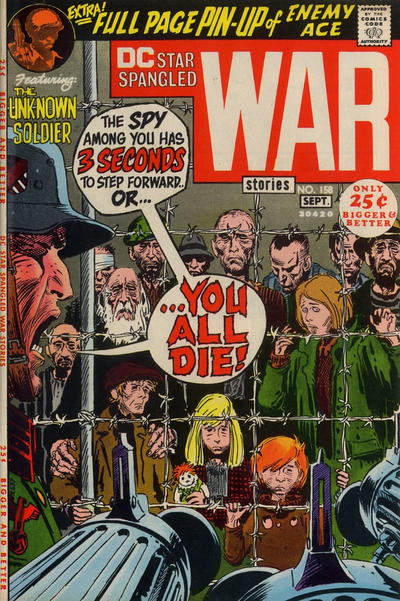
Star Spangled War Stories #158

Star Spangled War Stories #158 (On Sale: June 17, 1971), has an Unknown Soldier cover by Joe Kubert.

We begin with the Unknown Soldier in "Totentanz" by Bob Haney and Joe Kubert. The Unknown Soldier is sent to the Totentanz concentration camp to rescue Erika Hauser, code name "Berengaria," who helped hundreds of important people and children escape from the Nazis. Furthermore, she is deeply tied to the entire network of underground fighters in Germany. Berengaria was captured by the Gestapo, but they do not yet know of her identity.

The Soldier allows himself to be capture and taken to Totentanz. After smuggling a packet containing his disguise to the camp, he then disguises himself as Obersturmführer Adolf Eichmann and tricking the camp commandant Colonel Schneider into releasing Berengaria to his custody. The ruse is eventually discovered when the real Eichmann was on his way to the camp. Fortunately, the Soldier and Berengaria successfully escape to Switzerland. Reprinted in Showcase Presents the Unknown Soldier Vol. 1 TPB (2007). 

This is the kind of book that made the "25 cents bigger and better" slogan hard to swallow. The 11-page Unknown Soldier story is the only new content in this issue.

Our first reprint is "The Flattened Point" by Robert Kanigher and Irv Novick and reprinted from Our Fighting Forces #74 (1963).

This is followed by Enemy Ace in "Enemy Ace" by Robert Kanigher and Joe Kubert and reprinted from Our Army at War #151 (1965). Hans von Hammer celebrates his 50th kill when he is grazed by the wildly fired bullet of his 51st victim. He hovers in and out of consciousness but still manages to land his plane. He broods on the fact that even in the arms of a beautiful nurse and among his fellow pilots, he still feels lonely as if they stand apart from the "killing machine". 

He finds some solace in taking a rifle into the forest and hunting for a while with another predator, a wolf, who recognizes a kindred spirit. Then, Hans takes to the skies once more to defend a zeppelin on a bombing run from three enemy fighters. He manages to shoot two down, but the third deliberately rams his damaged plane into the zeppelin.

We end this issue with "Lame Duck Glider" by France Herron and Russ Heath and reprinted from All American Men of War #57 (1958).

Edited by Joe Kubert.

Wednesday, March 2, 2016

DC Special #12

DC Special #12 (On Sale: March 2, 1971), has a Viking Prince cover by Joe Kubert.

We begin with Viking Prince in "Battle for the Dragon Ship" by  Robert Kanigher and Joe Kubert and reprinted from Brave and the Bold #1 (1955). This reprints the first appearance of the Viking Prince. In the year 964 AD, Norwegian fisherman Captain Olaf comes upon a young lad floating on a log at sea. He brings him aboard his vessel, but the youth has no memory of his true name or identity. Olaf and his men bring the youth to shore, where a man named Sardluk the spy watches them from afar. 

Sardluk recognizes the blond-haired lad and reports back to his master Baron Thorvald. Thorvald is animated when he hears the news and orders his men to kill the boy. Sardluk's soldiers raid Captain Olaf's home, but the man fights back, ensnaring the soldiers with Olaf's fishing nets. He then picks up a stray sword and injures Sardluk. The boy has no idea why he is so proficient with a blade. Sardluk and his men run away, but promise to return to finish the job. 

Captain Olaf's daughter Gunnda is so impressed with the boy's bravery that she names him Jon the Viking Prince, after a famed Viking hero. A few days later, Baron Thorvald learns that Olaf's men have put to sea, and orders his dragon ship to give chase. As the dragon ship overtakes Olaf's fishing vessel, Jon has the Captain load him onto a spring-loaded harpoon and fire him across to the other ship. Once onboard, Jon swings across the mast then tears through one of the sails with his sword. He fights valiantly against the Viking warriors, forcing Baron Thorvald to flee by diving off his own ship. Jon is concerned that the Baron had information concerning his true identity and fears that he will never learn the truth about his own mysterious past.

Next is another Viking Prince tale, "The Ice Dragon" by Bill Finger and Joe Kubert and reprinted from Brave and the Bold #5 (1956). With winter setting in, the men of Olaf's tribe are forced to fish day and night to ensure there will be enough food to last. When a sea serpent attacks their fishing boats, the men are too scared to return to the water. Olaf's daughter Gunnda goes out by herself to show the men bravery.

Jon follows her and encounters the serpent. When he gets close, he discovers that the serpent is really a disguised iceberg, moved by one of Thorvald's boats. Jon and Gunnda are captured by Thorvald, but he escapes. When Thorvald's men pursue him, he harpoons a whale. The whale becomes enraged and overturns Thorvald's boats, allowing Jon and Gunnda to get away safely.

Our final Viking Prince story is "The Viking and the Mermaid" by Robert Kanigher and Joe Kubert and reprinted from Brave and the Bold #16 (1958). Jon, the Viking Prince, attempts to claim his throne by completing Thor's twelve tasks. Torgunn, the Claw, who sits on the throne as regent, seeks to thwart Jon. After the Viking Prince defeats Sven the Giant in combat to complete the first task, Torgunn's wife drugs Jon and causes him to temporarily lose his memory.

Accompanied only by a mute bard, Jon is sent to retrieve an ice demon's helm full of fire. The heat of a lava field clears Jon's head and restores his memory. He then battles the ice demons, saves a maiden, and fills one of the demon's helmet with fire.

Jon attempts to take the maiden, Ylla, back to her father, King Harold of Skane. Torgunn then attacks Jon at sea. The maiden falls into the ocean. Jon dives to the bottom of the sea to save her. However, the dive causes Jon to lose his memory yet again. Ylla is returned to her father, while Jon and the bard sail away with the Viking Prince once again seeking his true past.

Next is the origin of the Silent Knight in "Duel in Forest Perilous" by Robert Kanigher and Irv Novick and reprinted from Brave and the Bold #1 (1955). In the 6th century England, a jousting tournament was taking place between two rulers, Sir Oswald Bane and Sir Edwin Kent. When Kent's Lance strikes against Bane's armor, the lance shatters as if made of rotted wood. When he and Bane then duel with swords, Kent's weapon becomes slack, and he is dealt a fatal blow.

Brian Kent, Edwin's son, rushes to his father's side. With his dying breath, Edwin tells him that he will soon come of age that he can rule alongside Sir Oswald, as a just and merciful ruler. Oswald offers his sympathy to young Brian, lamenting that such an accident had to happen. Brian is not sure it was an accident, however. 

He soon becomes apprenticed to the knights and is trained by his father's friend, Sir Grot. Though Brian seems to be excelling in his training, Grot, strangely, keeps informing Bane that he is talent-less and a waste of time. One day, while Grot starts Brian on Hawkery training, Sir Bane's favorite hawk, Slasher, escapes out of the exit, and Brian gives chase. Slasher leads Brian into the Perilous Forest, so named because of the dangers that await within. When he catches up to Slasher, Brian finds him perched on a branch where a marvelous shining suit of armor, sword, and shield hung as if waiting for him. 

Suited in the armor, Brian follows the path back where he sees a young woman and her father being harassed by Oswald's men. Staying silent, so as not to give his identity away, Brian comes to the travelers' aide, fighting off the other knights' attacks, with Slasher assisting with his talons. His refusal to speak earns him the title of Silent Knight by Bane's men. Soon, Brian has warded off all the others and they retreat into the woods. He escorts the girl and her father back to the castle where they will be safe, then Brian returns to the forest, hiding his armor where he found it until he needs it again.

Back at the training camp, Sir Grot complains that while Brian was out cavorting with hawks, the word arrived of a mysterious Silent Knight that has been seen around the kingdom. Brian just shrugs and returns to his duties.

Following that tale is the origin of the  Golden Gladiator, "The Thunder of the Chariots" by France Herron and Russ Heath and reprinted from Brave and the Bold #1 (1955). In ancient Rome, a shepherd named Marcus stares into a fountain. From behind him, a centurion named Cinna ambushes Marcus and brings him before the Praetor Clodius Crassus. He accuses Marcus of trying to assassinate Crassus, even though it was actually Cinna and his men who tried to murder him. Marcus however, proves to be an apt patsy to cover up for Cinna's crimes. 

Praetor Clodius orders Marcus thrown into the slave galley. Aboard the galley, a Nubian lion escapes from his cage and begins attacking the crew. Marcus wrenches his slave chains from their moorings and uses them as a weapon against the lion. The ship's overseer is so impressed with Marcus' fighting prowess that he recommends him for gladiatorial combat. 

Marcus is brought back to Rome where he is forced to fight in the arena. His opponent Caius ensnares Marcus with a net then charges at him with his trident. Marcus is injured but manages to catch the spear and turn it back upon his foe. The Praetor rules to spare Caius' life so that he can "burn with rage" against Marcus. Cinna makes Marcus fight a second time – this time against a charging bull. Cinna deliberately arms him with a faulty spear, hoping that the bull will kill him. The bull indeed breaks Marcus' spear, but the former shepherd still succeeds in conquering the beast. Marcus' next challenge is a chariot race. He races against a fellow gladiator named Cotta and manages to unseat him with a hearty toss from his shield. Marcus manages to win the race and is granted his freedom.

Lastly, we have Robin Hood in "Three Arrows Against Doom" by Bob Haney and Russ Heath and reprinted from Brave and the Bold #9 (1956). Robin Hood, disguised as an old trader, tells the story of three different arrows that saved him from trouble.

Edited by E. Nelson Bridwell.

Thursday, February 11, 2016

G.I. Combat #147

G.I. Combat #147 (On Sale: February 11, 1971), has a cover by Joe Kubert.

we begin with the Haunted Tank in "Rebel Tank" by Robert Kanigher and Russ Heath. After his old commanding officer dies in combat, Jeb Stuart is reassigned to the command of Major Bragg. The major is offended that a Yankee has been given the name of a confederate general, so he orders Jeb to sit out of combat and make supply runs instead. The crew of the Haunted Tank complies, but after a while, they want to get back in the fight.

Eventually, Jeb disobeys orders and sends the Haunted Tank to Mount Abruzzi, where Major Bragg has launched an offensive. Jeb finds Bragg's tank and the others destroyed, Bragg orders Jeb to retreat, but once again he disobeys orders and attacks the Nazi position. By guiding the small tank along a mountain goat trail, the Haunted Tank is able to surprise the Nazis from behind and deliver the knock-out blow to their installation. Reprinted in Showcase Presents: Haunted Tank Vol. 2 TPB (2008).

Next, we have "Sniper's Roost" by Bob Haney and Mort Drucker and reprinted from All American Men of War #71 (1959). The story of a Nazi sniper, called "The Hawk" and how he looks at his targets as toys or insects until one gets far too close. Really wonderful artwork by MAD's Mort Drucker.

That is followed by "Tin Pot Listening Post" by Bob Haney and Jerry Grandenetti and reprinted from All American Men of War #70 (1959). A young recruit is sent into the jungle to be the forward listening post for his outfit. He is so jumpy he mistakes insects, monkeys, and birds for the enemy but each such mistake brings out a real enemy that the young recruit takes care of himself.

Next up is "Broomstick Pilot" by France Herron and John Severin and reprinted from Our Army at War #69 (1958). A young co-pilot on his way to bomb a Nazi submarine pen is startled when the pilot leaves formation and drops low to the ground to avoid enemy aircraft. The pilot says they are now "broomstick pilots" as they fly on at 100 feet, running enemy planes into tension wires and poles, dodging the fire of tanks and ground artillery. They take out the submarine pen then head back home hugging the ground all the way. 

Our next tale is "Battle Window" by Robert Kanigher, Ross Andru, and MikeEsposito and reprinted from All-American Men of War #36 (1956). New recruit Terry was a window washer before the war and everything in the war reminds him of the windows he hates.

This issue ends with "Target for an Ammo Boy" by Robert Kanigher and Joe Kubert and reprinted from All American Men of War #71 (1959). On a Pacific island, a recruit tags along with T.K., known by the men as Tank Killer. Everywhere they look, they find hidden tanks.

Edited by Joe Kubert.

Tuesday, December 8, 2015

G.I. Combat #146

G.I. Combat #146 (On Sale: December 8, 1970), has a cover by Joe Kubert

We start with the Haunted Tank in "Move the World" by Robert Kanigher and Russ Heath. Jeb Stuart and the crew of the Haunted Tank are stuck in a ravine in the North African desert while two other tanks are destroyed by Nazis. When Jeb gets the tank out, they are badly outnumbered. Jeb outraces the Nazi troop carriers following him, then stops to pick up Ulysses, an infantryman. The tank then heads to Fort Solitary.

When the Haunted Tank arrives, the fort has already been destroyed. The Nazis pursuing them are close, so Jeb has his men detach the tank's turret to use as a decoy. When the Nazis arrive, they are taken by surprise from multiple directions. Jeb and his men win the battle, then reassemble the tank. This story was reprinted in Showcase Presents: Haunted Tank Vol. 2 TPB (2008).

Our first reprint is "Hickory-Foot Soldier" by Bob Haney and Joe Kubert and reprinted from Our Fighting Forces #13 (1956).

Next, we have "A Flower for the Front" by France Herron, Ross Andru, and Mike Esposito and reprinted from Our Fighting Forces #5 (1955). 

That is followed by "The Secret Battle Eye" by Hank Chapman and Joe Kubert and reprinted from Our Fighting Forces #66 (1962).

Next is "The Bug That Won an Island" by Bob Haney, Ross Andru, and Mike Esposito and reprinted from Our Army at War #125 (1962),

We end this issue with Sgt. Rock in "Battle Tags for Easy Co." by  Robert Kanigher and Joe Kubert and reprinted from Our Army at War #120 (1962). Sgt. Rock calms a new recruit while under fire by telling him stories of Easy Company's past missions. He tells the soldier how Ice Cream Soldier, Bulldozer, and Wild Man each earned their nicknames. When it comes time to fight, Sgt. Rock also shows why he is called "the Rock" by standing in the face of enemy fire. The new recruit proves himself in battle, earning his own nickname, Green Apple.

Edited by Joe Kubert.

Tuesday, December 1, 2015

Super DC Giant S-22

Super DC Giant S-22 (On Sale: December 1, 1970), has a "Top Guns of the West" cover by Joe Kubert

The reprints begin with Johnny Thunder in "The Betrayal of Johnny Thunder" by Robert Kanigher and Gil Kane and reprinted from All-Star Western #97 (1957).

That is followed by Nighthawk in "The Man Without a Mask" by France Herron, Gil Kane, and Joe Giella and reprinted from Western Comics #59 (1956).

Next is Matt Savage Trail Boss in "The Dance Hall Queen and the Desperadoes" by Gardner Fox, Gil Kane, and Joe Giella and reprinted from Western Comics #85 (1961). Matt and Lute help an injured man, Dave Hardin, on the prairie. He was robbed by two bandits who stole the money he intended to use to buy a ranch. His girlfriend Abby Simms has the rest of the money, and he suspects the thieves will go after it. Matt offers to help, but the thieves get their first. They use Abby as a hostage then escape with the stolen money.

Matt pursues them alone since Hardin was injured during the confrontation with the bandits. The outlaws split up. Matt catches the first one, but he doesn't have the stolen money. When Matt catches the second thief, the bandit throws the money into a quicksand bog. Matt returns to town with two prisoners, but without the money.

After dropping off the outlaws, Matt believes he was tricked. He returns to the prairie and finds the stolen money under a rock. The outlaw dropped it and threw a money bag filled with rocks into the quicksand. Matt was tipped off because the money bag sank too quickly. Matt then returns the money to Dave and Abby who use it to buy a ranch. 

That is followed by Bat Lash in "Melinda's Doll" by Denny O'Neil and Nick Cardy and reprinted from Bat Lash #2 (1968). Bat Lash is about to be married to the youngest of the Gilkin daughters at gunpoint when youngsters he hired earlier release bags of mice into the church and cause a ruckus allowing Bat to escape though he loses his coat and right boot in the process. He rides off on Daisy into a snowy blind canyon.

Further in the canyon, a Marshal and his daughter, Melinda, are trying to escape two gunmen when their covered wagon hits a rock. The Marshal hides a metal cigar case inside Melinda's doll, Suzy, and hides Melinda in a hollowed tree stump. The Marshal is shot and killed. Bat arrives later and takes the Marshal's coat and boots when Melinda appears believing Bat to be her father (likely due to fear/denial). Bat takes her to the nearest city, Serenity, where he unsuccessfully tries to pass Melinda onto other people earning the ire of the townsfolks. This is observed by Samuel E. Styff, undertaker, who mistakes Bat for the Marshal whom he had ordered killed.

Bat goes into Polly's Inn to get some dinner and discovers Polly takes in children who have lost their parents. Two of Styff's henchmen enter but Bat chases them off causing Polly to take Bat's guns/belt until he's ready to leave. However, Styff promises a free funeral to whoever kills the Marshal, and Bat is forced to flee without his weapons. Bat and Melinda enter the cellar of the funeral parlor and hide in coffins and are unwittingly transported to the cemetery. There they discover that Styff has been selling guns to Native Americans by hiding/transporting the guns in coffins. 

Bat witnesses this and pockets the Native Americans' payment when they are ambushed by Styff and his men. One of them shoots Melinda and a tearful Bat takes them all down. Bat discovers Melinda is alive, the doll having stopped the bullet and Bat discovers the metal cigar case inside of which is a receipt proving Styff's actions. Bat takes the captured criminals back to town and reveals what's been happening to the townsfolk who are angry as the Native Americans have been using their guns against the townsfolk. They cart the criminals off to jail and Polly takes custody of Melinda; Bat gives Polly a bag of gold to pay for her care. Bat then enters a restaurant and begins wooing the beautiful Patty Lou Smithers when Melinda enters unwittingly driving off Patty and angering Bat. She only wanted to say goodbye and give Bat a flower she picked for him. Bat hugs her and takes her back home.

We end with Johnny Thunder in "The Gauntlet of Thunder" by Robert Kanigher and Gil Kane and reprinted from All-Star Western #104 (1958).

Edited by Dick Giordano.

Thursday, October 8, 2015

G.I. Combat #145

G.I. Combat #145 (On Sale: October 8, 1970) has another cool Haunted Tank  cover by Joe Kubert.

We begin this "BIG" issue with one of the original stories in it, "Sand, Sun & Death" starring the Haunted Tank, written by Robert Kanigher an drawn by Russ Heath. In the desert of North Africa, the Haunted Tank in surrounded by enemy tanks. When they run out of ammunition, Jeb orders the tank to take cover in a sand storm. When the storm clears, they are lost, but they soon find a crashed bomber. 

The pilot is still alive, but he has gone mad. Jeb convinces him to get back into the fight when the enemy tanks arrive. Rick, Slim, and Arch man the plane's guns while the pilot and Jeb strike at the enemy from behind. They win the battle, but the pilot is killed during the fight. This story was reprinted in Showcase Presents: Haunted Tank Vol. 2 TPB.

Next we have the first of the reprints, "A Hatful of War" by Bob Haney and Mort Drucker and reprinted from G.I. Combat #61 (1958). A green recruit asks his Sarge what the tightest spot he could expect to be in, to which the Sarge replies, "You'll know it when you're in it." Out scouting one day the kid gets pinned sown by a machine gun and his helmet starts to feel real tight, but the kid manages to get close enough to use a grenade to end the threat and his helmet suddenly feels much looser. Shortly, while guarding a deserted farmhouse, the kid sees a German grenade flying at him and uses his helmet to knock it away, He crawls under the farmhouse steps and from there is able to take out the Nazi who threw the grenade, making his restrictive helmet feel loose again.

A few days later he is in a foxhole when a German tank arrives and once again his helmet begins to tighten. He jumps onto the tank and manages to take it out. Later when the Sarge asks if he has found the tightest spot in the war yet, the kid points to his head and say, "Right in here!"

Our next reprint is "The Iron Punch" by France Herron and Arthur Peddy and reprinted from Our Fighting Forces #5 (1955). When Seabee Bob Tully is ordered to get supplies through a jungle he uses his bulldozer, Peg, to get the job done, promising to go "straight through the jungle." When attacked by snipers from up in some trees, Peg knocks them down. when attacked by machine guns in pillboxes, Peg bulldozes them over, and when challenged by an enemy tank, Peg pushes it over a cliff. Later at Seabee headquarters, Tully is shown an aerial photo of his rad and it is anything but straight.

Next we have a new two-page Battle Album, "Terror in the Sky!" on different types of anti-aircraft shells used during World War II. The art is by Sam Glanzman.

The next reprint is "Hot Corner" by Robert Kanigher and Joe Kubert and reprinted from G.I. Combat #59 (1958). When ball player Arnie gets his chance in the big leagues, his hitting is fine, but his fielding at third base, what his manager called the "Hot Corner" was so bad his career was over before it started. Too embarrassed by the stories in the papers to return home, Arnie joins the army and is shipped out to North Africa where he hopes to prove himself on the front, but it is not to be. He is ordered to babysit some supplies till another platoon comes to pick them up. 

While waiting he sees a platoon of Nazi infantry approaching and prepares to stop them with his machine gun. He is so distracted by the approaching men that he fails to see the Nazi sneaking up behind him, and they knock each other out in a fist fight. He awakens to the approaching Nazis and opens fire on them. Suddenly he is attacked from the air by a Stuka which in his mind is a running trying to score on him. He manages to shoot the Stuka down, but later he sees a tank attack as another runner trying to get past his corner. He manages to get a grenade into the tank and later when the second platoon shows up for his supplies and asks what he thinks he is doing just sitting there, he says he is, "Sitting on a hot corner!"

That is followed by "Mile-Long Step" by John Reed and Jerry Grandenetti and reprinted from Our Fighting Forces #2 (1954). After landing on a beach, an infantry group has to help another company three miles away. Their transport by truck is interrupted by a Nazi tank, which they mange to take out but they now have to hoof it to the next company. After dealing with some more Nazis, they arrive safely. A few weeks later they parachute into enemy land and are once again attacked but manage to fight their way out, one remarking that "War's only a step away--one after the other---a million of them."

Our last reprint is  "Glory Dive" by France Herron and Joe Kubert and reprinted from Our Army at War #32 (1955). On a US held island the soldiers put on a mini Olympics, but when one of the men from a submarine crew, Barney, participates in the high diving event, he does not come back u to the surface. He has dived into enemy frogmen who capture him and take him to a nearby island in their mini sub. There he is questioned for information but manages to escape, where he sees a hidden Japanese air-craft carrier. Barney steal a Japanese mini sub, returns to his men and an air strike is called to take out the carrier.

We end with the other new story, "Missing: 320 Men" a U.S.S. Stevens tale by Sam Glanzman. This is the story of Jerry Boyle a crewman who spent all his spare time drawing the hardware around him. After battles he would draw them from memory. The rest of the men loved his drawings, but after the war Jerry would notice that although he drew all the tings around him, he never drew any of the 320 men on the ship. 

Edited by Joe Kubert.

Tuesday, September 1, 2015

Tomahawk #131

Tomahawk #131  (On Sale: September 1, 1970) has a Hawk, Son of Tomahawk cover by Joe Kubert.

So, big changes this issue. Murray Boltinoff is out and Joe Kubert is in as editor, Tomahawk is out and Hawk, Son of Tomahawk is in. This series takes place years after the previous issue. Tomahawk is an older man now, married with children, one of them being, you guessed it, Hawk. We are introduced to this new character in "Hang Him High"14-page tale by Robert Kanigher and Frank Thorne. A young woman is being chased by men on horseback though a narrow canyon. A young man on horseback appears and scoops the woman up taking her to safety, or so it seems. The riders follow, shoot the lad's horse and knock him out. He awakens to find himself about to be hanged by the leader of the men, known as "the Judge" unless the young woman tells him the location of her secret gold mine. The woman says there is no gold mine and the Judge shouts for his men to hang the young-un. 

Suddenly bullets fly from the bushes and the man is cut lose from the noose, the men hanging him are removed from their guns and the grizzly old Tomahawk appears, saying, "For a son of mine, Hawk, you sure look like you got your wings clipped." Hawk and his dad take care of the Judge's men and the Judge is forced to retreat, promising that he will return to hold a new trial. An hour later the girl, Angela Addams, is brought to the ranch of Tomahawk and introduced to his wife and Hawk's mother, Moon Fawn and Hawk's kid brother, Young Eagle.

The next morning Hawk rides off to confront the Judge, but Angela rides out to join him. They ride through town getting the notice of the Judge and his men then ride out to the Addams' gold mine, followed by the Judge and his men. As night falls they attack, but Hawk has weakened the supports on a sluice and a few well-placed shots sends it down on the Judge and his men. The Judge hurls dynamite at the shack Hawk and Angela are in and then rushes in to finish them off, only to find that Hawk is very much still alive and deadly. As Hawk finishes off the gang, we see Tomahawk on a nearby hill deciding that his son has everything under control.  

Next is "The Moccasins That Won a War," a six-page reprint from All Star Western #84. This one features the character Strong Bow and is by France Herron and Jerry GrandenettiStrong Bow was a Native American warrior who traveled across Pre-Columbian era North America and helping the continent's many native tribes in times of trouble. An enigmatic man, Strong Bow said that he hailed from "beyond the Misty Mountains" and he was the last member of his tribe, which was tragically wiped out in a massacre. He first appeared in All-Star Western #58 and his last story appeared in All-Star Western #99. He made a brief appearance in All-Star Squadron Vol #55 during the Crisis on Infinite Earths.

This story features the mid-1950s Grandenetti who is a much more controlled artist than the guy we know and love from the current DC horror books. While visiting the village of Chief Kyana, Strong Bow learns that Running Buffalo has attacked some of the village's warriors and has the village surrounded. Strong Bow strikes out on his own to break through Running Buffalo's lines and get help from a nearby village. Attaching one of his moccasins to an arrow shaft, Strong Bow is able to create a footprints in a direction he did not go, throwing Running Buffalo's warriors off his trail. Later, when he is once again surrounded by hostile warriors, Strong Bow scrawls a message in his mud-filled moccasin and sends it down a stream to the nearby village, bringing their warriors into the fight and defeating Running Buffalo.

Next is a two-page text piece on "Arapaho Names" illustrated by Joe Kubert

That is followed by "Botalye -- Immortal Indian Warrior," yet another reprint, this one from Jimmy Wakely #7. I know, I always felt cheated when I paid new money for old stories, but I really did not mind that much this time as it featured the writing of Gardner Fox! OK, what I meant to say is it features the artwork of Frank Frazetta. This is the 1950 Frazetta, around the same time he did his long stint on White Indian. It is only three pages, but it contains some very nice figures and almost no backgrounds at all. The story tells the tale of Botalye, a young Kiowa brave who, after being called a coward by another warrior, charged the guns of a surrounded supply train four times totally unarmed.

The book ends with a two-page spread ad for next issue when Joe Kubert's Firehair returns as the back up feature in this book. I was a big fan of the Firehair tryout issues of Showcase and so was really looking forward to the saga continuing.

Edited by Joe Kubert.


Tuesday, August 18, 2015

World's Finest Comics #197

World's Finest Comics #197 (On Sale: August 6, 1970) has a Superman/Batman cover by Curt Swan and Murphy Anderson.  This is the final issue of World's Finest to feature this team for a couple of years, well, as the regular team at least. Starting next issue, and I could never understand why they did not wait two months for issue #200 to do this, World's Finest will become Superman's Brave and the Bold. That is, starting next issue, they will team up Superman with another character, not just Batman.

This issue is a pile of reprints beginning with the Superman/Batman team in  "The Capture of Superman." This 13-page tale is by
Jerry Coleman, Jim Mooney and Sheldon Moldoff and is reprinted from World's Finest Comics #122. Batman and Robin are forced by an alien, Klor, to capture Superman for crimes committed on his world of Belvos. Superman feels betrayed by his friend, but Batman succeeds in making the capture.

Superman is returned to Belvos to stand trial. He is accused of causing destruction on the planet during a visit there. Superman does not recall ever having been to Belvos and claims he was searching for a strange asteroid at the time.

Klor is secretly behind the destruction. Having found special weapons, he disguised himself as Superman and caused the damage. He wants to get Superman out of the way so he can obtain treasure which will make him master of Belvos. However, the heroes realize that Klor had been to Earth before and was responsible for the crimes. They convince the Belvosian tribunal and capture Klor in the act of robbing a jeweler on Earth.

Next is another Superman/Batman tale, "The Feud Between Batman and Superman," an 18-pager by Edmond Hamilton, Curt Swan and George Klein. When Batman is accidentally shot while pursuing some crooks, he gets an inferiority complex. Superman tries to help Batman by staging a fake menace inside Kandor where he has no super powers. Batman discovers the hoax and becomes angry, challenging Superman to a duel. Batman wins, then storms off.

The fake menace turns out to be real, when Jhan-Ar, the brother of Superman's friend Thar-Ar, becomes a Metalloid. Superman is taken prisoner, forcing Batman and Robin to rescue him. They succeed and defeat Jhan-Ar. Batman's confidence is restored, so he resumes his crime fighting career. This is reprinted from World's Finest Comics #143.

That is followed by Green Arrow in "The Unmasked Archers." This six-page tale is by France Herron, Jack Kirby and Roz Kirby. Oliver Queen and Roy Harper awaken to find that the morning newspaper contains a story revealing their secret identities. Believing their careers are over, they stop a few crooks then return to police headquarters where they unmask in front of the police commissioner.

The commissioner doesn't believe Oliver is the real Green Arrow. When Oliver checks the other newspapers, he discovers that his morning paper was a fake. It was created as part of an initiation prank for his men's club. Oliver then proves to the commissioner that he is not Green Arrow using a specially prepared trick. This is reprinted from World's Finest Comics #98. Hmm, strange how they seem to be reprinting a lot of Jack Kirby this month.

We end with a final Superman/Batman team-up story,  "The Prison for Heroes" from World's Finest Comics #145. This 16-page tale is by Edmond Hamilton, Curt Swan and George Klein. An alien race contacts Batman and brings him to an alien world under the pretense of aiding a great emergency. When he arrives on the alien world, Batman is hypnotized by the aliens into becoming a cruel prison warden. His prisoners are the innocent heroes of many worlds.

Batman then tricks Superman into coming to the planet. The aliens use a filter to cause the sun's rays to become red, removing nearly all of Superman's powers. Superman then becomes a prisoner.

With his last remaining bit of super powers, Superman manages to restore the powers of some of the other prisoners. They break free, help Superman fake his powers, and overthrow Batman. Superman then puts Batman to work as a prisoner.

The aliens discover Superman's escape and return to the planet to investigate. They discover that Superman does not have his powers. However, Superman has helped Batman break the hypnosis. While the aliens are investigating Superman, Batman destroys the red sun filter with the aliens' own ship. Superman's powers are restored. He frees the wrongly imprisoned heroes and ends the aliens' plans to conquer the galaxy.

Edited by E. Nelson Bridwell.

Tuesday, July 21, 2015

Super DC Giant S-15

Super DC Giant S-15  (On Sale: July 21, 1970) has a nice cover by Joe Kubert and features "Western Comics."  One of the things I always liked about this period at DC was that they were not about to give up on the western. They were reprinting a lot of stuff at the time in these giants, Kubert had done Firehair in Showcase, they were still publishing new Tomahawk books, and soon we would see the rebirth of All-Star Western and some of the best western comics ever.

And I liked that DCs westerns were westerns, not super-hero books in the old west like some of Marvel's books seemed to be. At DC the genre was kept in tact, even when it was merged with another genre such as in the El Diablo series in All-Star Western.

We start this giant with Pow-Wow Smith in "Attack of the Silent Avenger," by Gardner Fox and Carmine Infantino and reprinted from Western Comics #76.

Next is "Stand Proud the Warrior Breed," a 12-page new story written and drawn by Gil Kane. I'm not sure why this was buried inside rather than leading off the book. It just seems like an odd choice.

The new work is followed by Foley of the Fighting Fifth in  "Terror on the Telegraph Trail." This reprint from All-American Western #124 is by John Broome, Carmine Infantino and Joe Giella.

Next we have Buffalo Bill in "The Robbery of the Iron Horse" by Dave Wood and Joe Kubert. This story is a reprint from Frontier Fighters #7.

That is followed by the Vigilante in "The Capture of the Four Aces." This reprint from Action Comics #160 is by Dick Wood and Bob Brown. Not a lot is known about Dick Wood. He started working for Hillman in 1942 where he began with the "Origin of Airboy" in Air Fighters Comics #2 and stayed there less than a year. Around this time he also appeared to write for Crime Does Not Pay, Daredevil and Boy Comics. There is also some indication that in the 1941-42 period Dick tried his hand at both penciling and inking in Daredevil and Boy Comics.

The next time his credit reappears is in 1948 at DC where he wrote one Superman story and a half dozen Vigilante yarns. The story reprinted here is his first. In 1952 he started working regularly on Blackhawk for Quality. Around this time he also wrote the final issue of Dollman and a few issue of Plastic Man, GI Combat, Web of Evil and T-Man, all for Quality. His last Blackhawk was #106 in 1956 and he did not reappear till 1965 when he started a run on Gold Key's Doctor Solar, Man of the Atom, which he wrote till 1969. He also scripted the first three Gold Key issues of Star Trek. There are also indications that he worked on a few issue of Gold Key's The Man from U.N.C.L.E., Grimm's Ghost Stories and Boris Karloff Tales of Mystery.

We round out the issue with Pow-Wow Smith in "The Law's Outlaw" by France Herron and Carmine Infantino and reprinted from Western Comics #44.

The book was edited by Dick Giordano.

Friday, May 21, 2010

DC Special #8

DC Special #8 (On Sale: May 21, 1970) has a cover for WANTED: The World's Most Dangerous Villains by Murphy Anderson.

We begin with Superman and Batman  "Joker-Luthor, Incorporated"  by France Herron, Jim Mooney and Sheldon Moldoff and reprinted from World's Finest Comics #129. When Superman checks into a disturbance at an outdoor exhibit in Metropolis, he finds that the Joker has joined forces with
 Lex Luthor and using an atomic dispenser, they turn Superman into a stream of electronic particles. Hearing that the Joker has gone to Metropolis, Batman and Robin arrive at the exhibit, but are unable to capture the two fiends. After they escape Superman slowly returns to normal. 

Batman believes the Joker gave away their next crime and show up the next day at a spring flower show, where the Joker is found in a giant flower and Luther is inside a giant mechanical bee. Superman is again shot and turned into a stream of electronic particles and Batman and Robin are unable to keep the two from stealing some prized bulbs and escaping once more.  Mr. Webb, who put on the flower show says he is still going ahead with a gem exhibit the next night.

The next night we see Mr. Webb enter a bunker using a concealed elevator and arriving on the stage inside an impenetrable glass bubble where the gems will be displayed The Joker and his men arrive by helicopter and try to break into the dome. Meanwhile, inside the dome, Webb gathers all the jewels and asks to be let out of the dome. IT is all a ploy as once in the open, Webb uses jet shoes to fly out with the gems. However, Superman figured the whole thing out and stops the flying Webb, really Luthor and Batman and Robin handle the Joker.

Next is the Flash in "Who Doomed the Flash?" by John Broome, Carmine Infantino and Joe Giella and reprinted from Flash #130. The Flash’s runs into a number of his old foes around Central City, but when Flash checks on them, he finds that each is still in jail. The only connection between the villains is attorney Paul Barrett and when the Flash visits Barrett’s office, Barrett knocks him out.

Barrett disguises himself as the Flash and breaks Mirror Master out of jail. It was Barrett who was impersonating the villains and who has been under Mirror Master’s mind control since his trial.

The Flash awakens to find he has been imprisoned in a Mirror Master trap. He is able to escape using a filling from a recent dentist appointment. After freeing Barrett of Mirror Master's control, Barrett leads Flash to the crook’s next heist. Flash tracks down Mirror Master and returns him to jail.

This is followed by Green Lantern in "The Day 100,000 People Vanished" by John Broome, Gil Kane and Joe Giella and reprinted from Green Lantern #7. Green Lantern checks into the strange disappearance of all the citizens of Valdale, but comes up clueless.  Green Lantern realizes that he was supposed to be in Valdale when the disappearances happened and wonders if he was the real target. Suddenly Green Lantern is struck weak for a moment, his mind going momentarily blank.

The weakness was caused by the Guardians of the Universe who have once again pulled an astral projection of Hal Jordan to Oa. The Guardians relate to Hal the story of Sinestro, the rogue Green Lantern. Sinestro was the ring bearer of sector 1417 and initially he performed his duties well, but he soon became corrupt. First he built a fabulous palace and dispensed justice to his constituents. Sinestro then dissolved the high council and made himself dictator.

In response, the Guardians stripped Sinestro of his ring and power battery and banished him to the universe of Qward. Sinestro immediately got involved with the Weaponers of Qward and plotted revenge, beginning by capturing Hal Jordan.

After realizing that he was correct in guessing that the Valdale vanishings were meant to capture him, Green Lantern’s energy duplicate is returned to Earth, this time retaining his memory of the Guardians. Once he returns, Hal flies to the inter-universe aperture that allows access to Qward. He finds it sealed. So, he flies to Coast City and uses the power ring to make the citizens invisible as he learned that his transporter beam only affects visible humans. Green Lantern then walks around town baiting Sinestro.

Green Lantern’s plan is successful, as he is beamed to Qward by Sinestro, who believes Green Lantern is powerless. His ring still functions however, and he defends himself, but when Sinestro threatens to kill the people of Valdale if he does not stop, Green Lantern exchanges his life for theirs. They are returned to Earth and Green Lantern is placed into a yellow bubble until his ring runs out of charge.

But Green Lantern speeds up the Qwardian clock to make them believe his 24 hour charge has expired. His ring is still charged enough to defeat them all. He imprisons Sinestro in a force bubble of his own. Finally, Hal returns to Earth and attends his engagement in Valdale.

Lastly we have Hawkman in "Shadow-Thief of Midway City" by Gardner Fox and Joe Kubert and reprinted from Brave and the Bold #36. A creature made only of shadow robs the Midway City Bank just as the Thanagarian authorities recall Katar and Shayera, They postpone their departure to search for the fiend. Hawkman and Hawkgirl eventually catch up to the shadow thief as he robs a private residence of a fortune in rare coins. but are unable to prevent the crime.

We follow teh shadow thief and learn he is Carl Sands, who become fascinated by shadows in prison, and while using a color-disc magic-trick projector after his release, accidentally discovered another dimension, and a being in trouble there. Saving the alien, Thar Dan, gave him a Dimensiometer, a device which enabled Sands to exist in shadow, as a gift.  However, when Thar Dan discovered that use of this device would trigger another Ice Age, and requested his invention’s return, Sands ignored the plea and continued his ravaging of Earth.

Hawkman and Hawkgirl are able to identify the creature from mug shots, by comparing it to the shadow profile of convicted burglar Carl Sands. Hawkman believes that suspending Shadow-Thief in the air would prevent his escape, and when some birds tell them where the shadow thief is, they lift his mobile home into the sky..The Thief has to rip the Dimensiometer from his wrist in order to become solid on Earth, and they catch him. This action ruins the device, one use short of starting the new Ice Age.

Edited by Mort Weisinger.

Friday, October 23, 2009

From Beyond the Unknown #2 (On Sale: October 23, 1969) has a cover by Murphy Anderson.

We begin with "Parade of the Planets" by Otto Binder and Frank Giacoia from Mystery in Space #52. Next is "Giants of the Cosmic Ray" by France Herron, Carmine Infantino and Bernard Sachs from Strange Adventures #82. Lastly we have "The Brain-Masters of Polaris" by John Broome, Alex Toth and Sy Barry from Strange Adventures #12.

Edited by Julius Schwartz.

Friday, August 7, 2009

World's Finest Comics #188

World's Finest Comics #188 (On Sale: August 7, 1969) has a cover by Curt Swan and Murphy Anderson.

We begin with Superman and Batman in "The Super-Rivals" by Ed Hamilton, Dick Sprang and Stan Kaye and reprinted from World's Finest Comics #85. Princess Varina visits the United States and meets her heroes Superman and Batman. The heroes begin competing for Varina’s affection because if she elopes with Stefan, her royal guard, a commoner, she must abdicate. Abdication would lead to civil war in Balkania.

The heroes continue their pursuit of Varina, but when Pete Kaney’s gang try to steal the royal jewels, the heroes make Stefan appear to be a hero. Stefan’s notoriety allows him to safely marry the princess without risk of war pleasing not only the princess but Lois Lane and Vicki Vale as well.

Next is Superman and Batman in "The Super-Newspaper of Gotham City" also by Ed Hamilton, Dick Sprang and Stan Kaye and reprinted from World's Finest Comics #80. Lois Lane and Clark Kent are asked to work for the Gotham Gazette temporarily to save it from ruin. Bruce Wayne also joins the staff as a reporter to help track down a large crime ring. Bruce and Clark compete for stories, while working on breaking up the crime ring as Batman and Superman. They eventually track down the ring with Robin’s help and deliver the story to the Gazette. The newspaper increases in circulation due to the story and is saved from bankruptcy.

That is followed by Superman and Batman in "The Negative Superman" by France Herron, Jim Mooney and Sheldon Moldoff and reprinted from World's Finest Comics #126. Luthor uses a new device to cause Superman to split in a positive and negative half. The Negative Superman begins helping Luthor and other criminals. The real Superman is unable to stop his duplicate because of an energy field.

Batman and Robin assist the Man of Steel in combating the super-powered menace. Batman uses Kryptonite, but the mineral causes the Negative Superman to grow more powerful. When Superman collides with his negative half, the increased power of the Negative Superman breaks the energy field and allows them to merge back into one being.

Next is Green Arrow in "The World's Worst Archer" by Robert Bernstein and Lee Elias and reprinted from Adventure Comics #262. Roy Harper, a promising athlete and archer, wants to become Green Arrow’s partner. His guardian is Brave Bow, an Indian chief whose life was saved by Roy’s late father. Brave Bow has trained Roy to master the bow and arrow, but is now too old to care for Roy.

Green Arrow gives the boy a chance to prove himself at the Greenville Fair. Roy’s arrow misses the target horribly. Roy doesn’t give up and follows Green Arrow after some crooks. Roy uses Brave Bow’s lucky flint arrow to catch the criminals. Green Arrow misses the action and believes the crooks were caught by a lucky accident.

G.A. gives Roy another chance after Roy wins a track meet. Again the boy’s arrow goes wide of the target. Roy is disappointed, but again trails Green Arrow after some crooks. His flint arrow punctures the tire of the getaway car, but the shaft breaks off leaving no evidence that Roy was responsible. Roy finally gives up, but Green Arrow returns later to explain to Roy that his arrowhead was in the tire. The shots he missed were metal arrows which had become magnetized at the fair, causing them to go wide of the targets. Green Arrow gives Roy the nickname Speedy and takes him as a partner.

We end with Superman and Batman in "The Batman Nobody Remembered" by Bill Finger and Jim Mooney and reprinted from World's Finest Comics #136. Batman is forced to crash land the Batplane during a lightning storm. When he returns to Gotham City no one remembers him. He also discovers that certain things are different. Bruce Wayne is really Superman and lives with Robin and Alfred; Vicki Vale looks like Lois Lane; and the Joker is a TV comic.

Batman’s behavior causes Superman and Commissioner Gordon to think he is a criminal, so he is hunted. He eventually proves himself by helping Superman rescue Robin. After relating his story to Superman, the Man of Steel reasons that Batman has been on a parallel Earth. Then he sends Batman to his own dimension, where he belongs.

Edited by E. Nelson Bridwell.

Friday, July 24, 2009

World's Finest Comics #187

World's Finest Comics #187 (On Sale: July 24, 1969) has a cover by Curt Swan and Murphy Anderson.

We begin with Superman and Batman in "The Demon Sin" by Robert Kanigher, Ross Andru and Mike Esposito. The back-up strip is Green Arrow in "The Green Arrow's First Case" a reprint from Adventure Comics #256. This telling of Green Arrow's origin is by France Herron, Jack Kirby and Roz Kirby. Green Arrow and his partner Speedy learn of a scientific expedition bound for Starfish Island. G.A. is worried that the expedition will uncover his secret identity because the island was where he became Green Arrow. As the two archers fly to the island to intercept the expedition, G.A. tells Speedy the story of how he became Green Arrow.

One night, Oliver Queen fell overboard on a ship. He was unable to be rescued, so he swam to a nearby island. He made a home in a cavern on the island and fashioned a bow and arrow for hunting. At first his aim was poor, but long hours of practice paid off and he improved.

While fishing with his arrows, the fish would swim away after being hit, so Queen attached a vine to the arrow so that he could reel in his catch. This became his first trick arrow; a rope arrow. He soon created net and drill arrows, as well as a green leaf outfit for camouflage while hunting.

One evening Queen spotted a ship offshore. He swam to the ship to discover that the crew was mutinying. Using grease to cover the reflection of light on his white face, The masked Queen defeated the pirates and acted for the first time as Green Arrow.

Green Arrow kept a diary of events on the cavern wall. He is worried the expedition will find it and learn his secret identity. Using a fake-uranium arrow, G.A. scares off the expedition who believes there is radiation on the island. G.A. then destroys the diary so no one will learn his secret.

Edited by Mort Weisinger.

Wednesday, July 15, 2009

Phantom Stranger #3

Phantom Stranger #3 (On Sale: July 15, 1969) has its first cover by Neal Adams, and the new Neal Adams logo. What is interesting is that while the logo depicts the revamped Phantom Stranger, using his hat's shadow as a mask, the cover shows an entirely different guy, closer to the Bill Draut covers of the first two issues.

We begin with the Phantom Stranger in "How Do You Know My Name?" a reprint from Phantom Stranger #5 (1953) by John Broome, Frank Giacoa and Joe Giella. A carnival mystic, Vasti, predicts supernatural behavior will increase at an amusement park. Suddenly ghosts and spectres are seen and cause trouble for the park. The Phantom Stranger investigates in order to debunk the supernatural explanation. He exposes Vasti as a fraud, trying to force the park owner to sell cheaply.

Next we have Doctor 13 in "No Such Thing as Ghosts" a reprint from Star-Spangled Comics #126 by France Herron and Leonard Starr. We end with the only new material in the book, the Phantom Stranger in "Some Day in Some Dark Alley..." by Mike Friedrich and Bill Draut. This was reprinted in Showcase Presents: Phantom Stranger Vol. 1 TPB.

Edited by Joe Orlando.

Wednesday, May 13, 2009

Phantom Stranger #2

Phantom Stranger #2 (On Sale: May 13, 1969) has a cover by Bill Draut. The character is still two issues away from a stylistic redesign at the hands of Neal Adams which will transform the character forever.

The new story this issue is "The Man Who Died Three Times" by Mike Friedrich and Bill Draut. With this story they bring the Doctor Thirteen character into interaction with the Stranger. This was reprinted in Showcase Presents Phantom Stranger Vol. 1 TPB.

They round out the book with reprints. From the old Phantom Stranger #1 comes "The House of Strange Secrets" by John Broome, Carmine Infantino and Joe Giella. Neal Hunter is lured to a strange house after he is led of the main road. Neal enters the house and is greeted by a man who wishes to kill him. The Phantom Stranger appears and protects Neal. The killer then disappears and the house changes.

Neal and the Phantom Stranger explore the house as the killer strikes again. The Stranger learns that the killer is the former apprentice of a dead magician named Robart. He believes that by killing Hunter he will gain immortality. The Stranger then exposes the killer's magic as a fraud and rescues Neal. The apprentice is killed himself during an attack on the Stranger.

From Star Spangled Comics #128 comes Doctor Thirteen in "The Girl Who Lived 5,000 Years" by France Herron and Leonard Starr.

Edited by Joe Orlando.

Friday, March 13, 2009

Phantom Stranger #1

Phantom Stranger #1 (On Sale: March 13, 1969) has a cover by Bill Draut.

Fresh from his Showcase tryout we have the Phantom Stranger. We begin with "When Ghosts Walk" from Phantom Stranger #1 (1952) by John Broome, Carmine Infantino and Sy Barry. Three friends share a plane flight that ends in a fatal crash. Sometime after the crash, ghosts appear and carry out the plans of the dead men that they were unable to complete.

The ghost of Carson Rand attempts to take papers from Edgar Jones which were to be used to blackmail him. The ghost is stopped by the Phantom Stranger. Next the ghost of Bart Benson appears to break a unbreakable bronco. The Phantom Stranger appears to and reveals that it was a trick.

Finally, the apparent ghost of John Martin contacts his fiancee, Margo Phillips. The Phantom Stranger once again appears. The Stranger unmasks the ghost as Matt Wright, a night club employee which Margo caught stealing. Matt had used the ghosts to disguise his true goal of killing Margo. The Stranger's arrival saves Margo and exposes the ghostly hoax.

Next is Doctor 13 in "The Hermit's Ghost Dog" from Star Spangled Comics #125 by Francis Herron and Leonard Starr.

Lastly is the only new material in the book, "Defeat the Dragon Curse ...or Die" by Mike Friedrich and Bill Draut. This new story was reprinted in Showcase Presents Phantom Stranger Vol. 1 TPB.

Edited by Joe Orlando.