Friday, March 4, 2016

Super DC Giant S-24

Super DC Giant S-24 (On Sale: March 4, 1971), featuring Supergirl has a cover by Curt Swan, Murphy Anderson, Mike Sekowsky, and Dick Giordano.

We begin with "The Girl with the X-Ray Mind" by Leo Dorfman and Jim Mooney and reprinted from Action Comics #295 (1962). Linda Danvers's friend Lena Thorul has ESP powers and wants to join the FBI, but she has no verifiable past and cannot be accepted. Supergirl investigates and finds the reason why: Lena is really the younger sister of Lex Luthor and gained ESP powers through contact with a "space-brain" brought to Earth by Superboy.

Because of the Luthor family disgrace, Lena and her parents were forced to move from Smallville and change their last names to Thorul, though Lena never learned of her brother's criminal past and was told he died in an accident, not long before her parents died in a very real accident.

When the FBI learns the truth, they are adamant about not hiring her. Lena, however, pretends to infiltrate Bank Busters, a gang of bank robbers, and to use her powers on their behalf. When Luthor hears of it, he tells all to Supergirl and pleads with her to keep Lena from a life of crime. However, Lena was only playing along with the crooks to catch them in the act and helps Supergirl and the police capture the Bank Busters. Supergirl promises to tell the FBI about the case, in hopes that they will reconsider hiring her. But she gets nervous when Lena admits that she has Supergirl telepathically linked with Linda Lee Danvers and keeps Lena's family connection secret.

Next, we have "The Girl Who Was Supergirl's Double" by Leo Dorfman and Jim Mooney and reprinted from Action Comics #296 (1963). When Lena Thorul attends a costume ball dressed as Supergirl, a soiree also attended by Dick Malverne and Linda Lee Danvers, Dick is convinced by Lena's resemblance to the Girl of Steel and by the real Supergirl's appearance when thieves attempt a jewel robbery there, that Lena is really Supergirl. 

Other circumstantial evidence, later on, hardens Dick's mistaken belief. Linda becomes jealous when Dick's affections are turned to Lena. Lex Luthor, in the meantime, asks Supergirl to give Lena some diamonds he created from coal lumps, as a secret birthday gift. When Dick sees one of the diamonds fallen into the coal-scuttle at Lena's house, he is finally convinced beyond any doubt that Lena is Supergirl. Lena finally "admits" that she is the Princess of Power, and the real Supergirl, listening in with super-hearing, wonders why Lena has told a lie. This story is continued.

That is followed by the continuation of the story, "The Forbidden Weapons of Krypton" by Leo Dorfman and Jim Mooney and reprinted from Action Comics #297 (1963). Lena Thorul actually told Dick Malverne that she had super-powers because her mind was controlled by a device operated by Lesla-Lar, who has recently broken jail in Kandor. Using her teleport ray, Lesla exchanges places with Lena, and imitated her, convincing Supergirl that a special serum had given her super-powers.

Later, Lesla-Lar used a Phantom Zone Projector to free Jax-Ur, Kru-El, and General Zod from the Zone. The threesome armed themselves with a cache of forbidden Kryptonian weapons and repaid her by destroying her with a disintegrator gun. Since Superman was in another time-era on a mission, the three villains set up a force-field that blocked time-travel, and the people of Kandor were made prisoners of their bottle. 

Both Supergirl and the villains were stalemated when they tried to use their powers on each other, but the weapons gave the villains the edge. Kru-El infected Supergirl with a disease that turned living creatures near her into plants. But, when Supergirl told Lex Luthor that Lena was a prisoner in Kandor, he agreed to help her battle the three Kryptonians. This story is also continued.

We end with the story's final chapter, "The Super-Powers of Lex Luthor" by Leo Dorfman and Jim Mooney and reprinted from Action Comics #298 (1963). The warden of Metropolis prison refuses to believe Lex Luthor when he says that Supergirl wants him as an ally, so Luthor throws in with the Phantom Zone villains. Kru-El gives Luthor super-powers with a ray device, and, later, demonstrates a mind-over-matter helmet to him.

The Zoners, in a private conversation, plan to use Luthor to construct a magnet that will attract Gold Kryptonite to permanently remove Superman's and Supergirl's powers, but they also intend to strip away Luthor's new super-powers as well when they have it. Unknown to them, however, Luthor is listening with his super-hearing, and, once Kru-El drops the force-field so as to lure Superman into their trap, he switches sides again by using a fake Gold K meteor.

Supergirl, Superman, and Luthor triumph sending the Kryptonian villains back to the Phantom Zone destroying the weapons (and thus removing Luthor's powers and Supergirl's plant scourge), releasing Lena Thorul from Kandor, and returning Luthor to prison.

Edited by E. Nelson Bridwell.

Justice League of America #89

Justice League of America #89 (On Sale: March 4, 1971), has a nice cover by Neal Adams and Dick Giordano

This issue features "The Most Dangerous Dreams of All" by Mike Friedrich, Dick Dillin, and Joe Giella. A writer named Harlequin Ellis  (gee, I wonder who he is based on) becomes enamored of Black Canary and lapses into a mood of depression when she seems to prefer Green Arrow to him. 

Suddenly gifted with the power to make his story-plots into reality, Ellis creates scenarios in which he is first Superman, then Batman, in futile attempts to impress Black Canary and eliminate his rival for her affection. Unwittingly, he draws the real Black Canary and Green Arrow into his dream worlds. Realizing what is happening, Black Canary goes to Ellis and reconciles their differences, and they part as friends.

The final panel reads, "Many are the things that a writer is forced to do by the crash-pounding of his creative soul. This story was one of them. For in writing of this man, Harlequin Ellis, I am facing the eternal mirror... for who is it that creates our heroes' ever-recurring menaces to their lives, testing every fibre of their being to the limit? Superman, Batman, Green Arrow, Black Canary, Aquaman are just as real to me as to Harlequin Ellis-- I believe in them! I must! When Superman bursts through a monstrous boulder, it is I who flex my muscles! When the Batman looks with vengeance in his eyes on someone he hates, it is I who hate! When Aquaman dies from water-thirst, when Green Arrow faces a charging minotaur, when Black Canary looks into the eyes of another human being and sees his soul, it is I! And when Harlequin Ellis cries over the lack of returned love, it is I! Many are the things a writer is forced to do by the crash-pounding of his creative soul. This story was one of them; for there is no escape from the soul-shatter of the nova-awareness that I, in so many ways, am... Harlequin Ellis!"

The story is dedicated to science fiction and television writer Harlan Ellison. According to this issue's letter column, Ellison liked the story and requested that the character based on him have his name rather than the pseudonym that Mike Friedrich chose. Reprinted in Showcase Presents: Justice League of America Vol. 5 TPB (2011), Justice League of America Archives Vol. 10 HC (2012), and Justice League of America: The Bronze Age Omnibus Vol. 1 HC (2017).

Edited by Julius Schwartz.

Flash #206

Flash #206 (On Sale: March 4, 1971), has a nice cover by Neal Adams

This issue begins with the Flash in  "24 Hours of Immortality" by Robert Kanigher, Irv Novick, and Murphy Anderson. A plane carrying Susan Logan and her son crashes into a car driven by William Kandel. Susan's son and William's wife are killed. Susan and William's prayers to save their loved ones are answered by two aliens. A bargain is struck. Timmy and Sylvia are restored to life, but Susan and William will die the following day. During that day, both will be immortal.

Kandel next finds himself caught in the crossfire caused by some escaped convicts. He is shot while Flash rounds up the crooks. Flash is amazed that Kandel survived. He then hears the story. He decides to help Kandel complete an important surgery on a patient before the doctor's day is up.

Flash then seeks out Susan, who has entered a daredevil competition. The competition is threatened by a nearby forest fire, but the Flash quenches the blaze. Susan then wins the competition by falling to Earth without opening her parachute.

When their time is up William and Susan meet the aliens again. Flash intervenes on their behalf, hoping to spare their lives. The aliens try to kill the Flash, but his powers keep him alive. The aliens are impressed, so they decide to leave. William and Susan are given a second chance at life.

Our back-up feature is the Elongated Man in "Showdown in Elongated Town" by Cary Bates and Dick Giordano. The Elongated Man finds himself in a western ghost town with no idea how he got there. The town appears to be elongated too. Suddenly a man appears who attempts to shoot Ralph with a ray gun. Ralph escapes and he eventually realizes he is wearing contact lenses which distort his vision. Once the lenses are removed, the town returns to normal. He then deduces the true identity of his foe, the Mirror Master. Elongated Man then captures the rogue and jails him until the proper authorities arrive.

Edited by Julius Schwartz.

Adventures of Jerry Lewis #124

Adventures of Jerry Lewis #124 (On Sale: March 4, 1971), has a cover by Bob Oksner. This is the final issue of the Adventures of Jerry Lewis, which started life and lasted for 40 issues as the Adventures of Dean Martin and Jerry Lewis. I was not a fan, though I did buy the issue with the Flash in it and over the years collected the four issues that Neal Adams drew. 

We begin with our cover-story, "Hot Wheels and Cold Sweat" by Alan Riefe and Bob Oksner. Jerry takes a job moving a grandfather clock to Pier 6 when he sees two guys with a racecar and becomes enamored with it. The two men are looking for someone stupid enough to test drive the car. Being late for the pier, Jerry agrees and shoving the clock in behind him, takes off for the pier. 

The car has some experimental fuel in it and Jerry is unable to control the car, ending up in a race, where he among other things, ends up driving the wrong way down the track (just like the cover shows). In the end, he and the dar are thrown out of the race and he ends up crashing at the pier. There Jerry discovers that killer Tiny Tony was inside the clock and trying to make a getaway. He is captured by the police who offer Jerry any reward he wants and he asks for a newspaper as he now needs to look for a new job.

Next is a one-pager, "From Bed to Nurse" by Henry Boltinoff and Bob Oksner. Jerry works as a hospital orderly and has to come up with a unique solution when he is told to change the linens of a patient in traction.

We have another one-pager, "A Witch Doctor Who Makes Calls" also by Henry Boltinoff and Bob Oksner. When Renfrew gets sick, Uncle Jerry calls on a witch doctor.

Lastly, we have "The Bird with the Million-Dollar Beak" by Murray Boltinoff and Bob Oksner. When Jerry takes Renfrew for a vacation up in the mountains, he complains that he really wanted to go to the beach. That night, a violent rainstorm sweeps their cabin off the mountain and down to the water where it peacefully floats. The next morning a couple comes looking for the cabin and sees it out in the water. Jerry thinks the couple is coming to rescue them, but they are actually after a diamond they stashed in the cabin.

As the cabin sinks the couple makes Jerry swim down looking for the diamond, which has actually been picked up by a seagull. Spotting the gull, they all follow it to shore where the bird puts the diamond in his mouth and then joins a huge flock of other gulls. They spend the entire night searching for the diamond and Jerry eventually finds Renfrew sleeping in a gulls beak. Wow, what a sorry note to end the series on. 

Edited by Murray Boltinoff.

Wednesday, March 2, 2016

Wonder Woman #194

Wonder Woman #194 (On Sale: March 2, 1971), has a cover by Mike Sekowsky and Dick Giordano.

This issue features  "The Prisoner" written and penciled by Mike Sekowsky and inked by Dick Giordano. While on vacation in the European country of Daldonia, Diana Prince finds herself the victim of a kidnap attempt, but fights her way free and helps catch the perpetrators. However, she is astonished to find herself treated like royalty and hustled into the state palace. There, Diana soon discovers that she is an exact double for Princess Fabiola, who is to marry Prince Rupert on the next day. If she was abducted or done away with, however, her cousin Frieda would be next in line for the throne. 

General Rudolph asks Diana to stay a few days, feeling she will be needed, and she is: Fabiola is kidnapped that very night. Rudolph manages to persuade Diana to stand in for Fabiola until the princess is found. But when Rupert kisses her, he knows that she is not his intended. Diana and Rudolph secretly explain things to him, and they decide that the wedding must go through, with Diana still secretly substituting for Fabiola. 

As she is being led down the aisle to the altar, Diana is attacked by the kidnappers and fights them off, then trails them to where Fabiola is held. She soon defeats and unmasks the ringleader of the kidnap crew--Fabiola's cousin Frieda. Fabiola is recovered unharmed and goes through with the wedding to Rupert. Frieda and her husband Helmut are banished from Daldonia for life. Diana gains the thanks of Gen. Rudolph and returns home to I-Ching and Cathy Perkins. Reprinted in Diana Prince: Wonder Woman Vol. 3 TPB (2009).

Edited by Mike Sekowsky.

Our Army at War #232

Our Army at War #232 (On Sale: March 2, 1971), has a Sgt. Rock cover by Joe Kubert.

We being with Sgt. Rock in "3 Men in a Tub" by Robert Kanigher and Russ Heath. Sgt. Rock and Easy Company capture three Italian soldiers who claim to be working against the Nazis. Easy takes the prisoners with them and soon discovers that they possess useful skills including shoemaking and cooking. When Rock receives orders to attack Nazi-held Cortina Castle, the Italians claim to know a secret entrance.

Rock allows the Italians to guide him past Nazi patrols. However, the Italians seemingly turn against him and turn Rock over to the Nazis. The betrayal is only a ruse, and the Italians help Rock to invade the castle. They clear a path for the rest of Easy to take control and defeat the Nazis.

The back-up is "Buck Taylor You Can't Fool Me", another tale of the U.S.S. Stevens by Writer/Artist Sam Glanzman. Buck Taylor gets sent home for acting crazy. Or was it really an act? Reprinted in U.S.S. Stevens: The Collected Stories (2016).

Edited by Joe Kubert.

DC Special #12

DC Special #12 (On Sale: March 2, 1971), has a Viking Prince cover by Joe Kubert.

We begin with Viking Prince in "Battle for the Dragon Ship" by  Robert Kanigher and Joe Kubert and reprinted from Brave and the Bold #1 (1955). This reprints the first appearance of the Viking Prince. In the year 964 AD, Norwegian fisherman Captain Olaf comes upon a young lad floating on a log at sea. He brings him aboard his vessel, but the youth has no memory of his true name or identity. Olaf and his men bring the youth to shore, where a man named Sardluk the spy watches them from afar. 

Sardluk recognizes the blond-haired lad and reports back to his master Baron Thorvald. Thorvald is animated when he hears the news and orders his men to kill the boy. Sardluk's soldiers raid Captain Olaf's home, but the man fights back, ensnaring the soldiers with Olaf's fishing nets. He then picks up a stray sword and injures Sardluk. The boy has no idea why he is so proficient with a blade. Sardluk and his men run away, but promise to return to finish the job. 

Captain Olaf's daughter Gunnda is so impressed with the boy's bravery that she names him Jon the Viking Prince, after a famed Viking hero. A few days later, Baron Thorvald learns that Olaf's men have put to sea, and orders his dragon ship to give chase. As the dragon ship overtakes Olaf's fishing vessel, Jon has the Captain load him onto a spring-loaded harpoon and fire him across to the other ship. Once onboard, Jon swings across the mast then tears through one of the sails with his sword. He fights valiantly against the Viking warriors, forcing Baron Thorvald to flee by diving off his own ship. Jon is concerned that the Baron had information concerning his true identity and fears that he will never learn the truth about his own mysterious past.

Next is another Viking Prince tale, "The Ice Dragon" by Bill Finger and Joe Kubert and reprinted from Brave and the Bold #5 (1956). With winter setting in, the men of Olaf's tribe are forced to fish day and night to ensure there will be enough food to last. When a sea serpent attacks their fishing boats, the men are too scared to return to the water. Olaf's daughter Gunnda goes out by herself to show the men bravery.

Jon follows her and encounters the serpent. When he gets close, he discovers that the serpent is really a disguised iceberg, moved by one of Thorvald's boats. Jon and Gunnda are captured by Thorvald, but he escapes. When Thorvald's men pursue him, he harpoons a whale. The whale becomes enraged and overturns Thorvald's boats, allowing Jon and Gunnda to get away safely.

Our final Viking Prince story is "The Viking and the Mermaid" by Robert Kanigher and Joe Kubert and reprinted from Brave and the Bold #16 (1958). Jon, the Viking Prince, attempts to claim his throne by completing Thor's twelve tasks. Torgunn, the Claw, who sits on the throne as regent, seeks to thwart Jon. After the Viking Prince defeats Sven the Giant in combat to complete the first task, Torgunn's wife drugs Jon and causes him to temporarily lose his memory.

Accompanied only by a mute bard, Jon is sent to retrieve an ice demon's helm full of fire. The heat of a lava field clears Jon's head and restores his memory. He then battles the ice demons, saves a maiden, and fills one of the demon's helmet with fire.

Jon attempts to take the maiden, Ylla, back to her father, King Harold of Skane. Torgunn then attacks Jon at sea. The maiden falls into the ocean. Jon dives to the bottom of the sea to save her. However, the dive causes Jon to lose his memory yet again. Ylla is returned to her father, while Jon and the bard sail away with the Viking Prince once again seeking his true past.

Next is the origin of the Silent Knight in "Duel in Forest Perilous" by Robert Kanigher and Irv Novick and reprinted from Brave and the Bold #1 (1955). In the 6th century England, a jousting tournament was taking place between two rulers, Sir Oswald Bane and Sir Edwin Kent. When Kent's Lance strikes against Bane's armor, the lance shatters as if made of rotted wood. When he and Bane then duel with swords, Kent's weapon becomes slack, and he is dealt a fatal blow.

Brian Kent, Edwin's son, rushes to his father's side. With his dying breath, Edwin tells him that he will soon come of age that he can rule alongside Sir Oswald, as a just and merciful ruler. Oswald offers his sympathy to young Brian, lamenting that such an accident had to happen. Brian is not sure it was an accident, however. 

He soon becomes apprenticed to the knights and is trained by his father's friend, Sir Grot. Though Brian seems to be excelling in his training, Grot, strangely, keeps informing Bane that he is talent-less and a waste of time. One day, while Grot starts Brian on Hawkery training, Sir Bane's favorite hawk, Slasher, escapes out of the exit, and Brian gives chase. Slasher leads Brian into the Perilous Forest, so named because of the dangers that await within. When he catches up to Slasher, Brian finds him perched on a branch where a marvelous shining suit of armor, sword, and shield hung as if waiting for him. 

Suited in the armor, Brian follows the path back where he sees a young woman and her father being harassed by Oswald's men. Staying silent, so as not to give his identity away, Brian comes to the travelers' aide, fighting off the other knights' attacks, with Slasher assisting with his talons. His refusal to speak earns him the title of Silent Knight by Bane's men. Soon, Brian has warded off all the others and they retreat into the woods. He escorts the girl and her father back to the castle where they will be safe, then Brian returns to the forest, hiding his armor where he found it until he needs it again.

Back at the training camp, Sir Grot complains that while Brian was out cavorting with hawks, the word arrived of a mysterious Silent Knight that has been seen around the kingdom. Brian just shrugs and returns to his duties.

Following that tale is the origin of the  Golden Gladiator, "The Thunder of the Chariots" by France Herron and Russ Heath and reprinted from Brave and the Bold #1 (1955). In ancient Rome, a shepherd named Marcus stares into a fountain. From behind him, a centurion named Cinna ambushes Marcus and brings him before the Praetor Clodius Crassus. He accuses Marcus of trying to assassinate Crassus, even though it was actually Cinna and his men who tried to murder him. Marcus however, proves to be an apt patsy to cover up for Cinna's crimes. 

Praetor Clodius orders Marcus thrown into the slave galley. Aboard the galley, a Nubian lion escapes from his cage and begins attacking the crew. Marcus wrenches his slave chains from their moorings and uses them as a weapon against the lion. The ship's overseer is so impressed with Marcus' fighting prowess that he recommends him for gladiatorial combat. 

Marcus is brought back to Rome where he is forced to fight in the arena. His opponent Caius ensnares Marcus with a net then charges at him with his trident. Marcus is injured but manages to catch the spear and turn it back upon his foe. The Praetor rules to spare Caius' life so that he can "burn with rage" against Marcus. Cinna makes Marcus fight a second time – this time against a charging bull. Cinna deliberately arms him with a faulty spear, hoping that the bull will kill him. The bull indeed breaks Marcus' spear, but the former shepherd still succeeds in conquering the beast. Marcus' next challenge is a chariot race. He races against a fellow gladiator named Cotta and manages to unseat him with a hearty toss from his shield. Marcus manages to win the race and is granted his freedom.

Lastly, we have Robin Hood in "Three Arrows Against Doom" by Bob Haney and Russ Heath and reprinted from Brave and the Bold #9 (1956). Robin Hood, disguised as an old trader, tells the story of three different arrows that saved him from trouble.

Edited by E. Nelson Bridwell.

Thursday, February 25, 2016

Girls' Romances #156

Girls' Romances #156 (On Sale: February 25, 1971), has a cover by Don Heck and Dick Giordano.

We begin with "Forsake My Love" drawn by Ric Estrada and Dick Giordano. Sue breaks up with Tom, her true love, when she learns that she is going blind.

Next, we have "The Game of Love" drawn by Lee Elias. Anne loves Jim, but she is tempted by Mitch, a new man in town.

We end with "Battle of the Sexes" drawn by Mike Sekowsky and Bernard Sachs and reprinted from Secret Hearts #60 (1960). Jinny tries to use Tom to make Bart jealous, but her plotting has a surprising result.

Edited for the first time by Dorothy Woolfolk.


Detective Comics #410

Detective Comics #410 (On Sale: February 25, 1971), has a Batman cover by Neal Adams and Dick Giordano.

We begin this issue with Batman in  "A Vow from the Grave" by Denny O'Neil, Neal Adams, and Dick Giordano. Batman is on the trail of an escaped killer on the outskirts of Gotham when he manages to corner the criminal in a rocky area, but he is attacked by a big man, who allows the killer to escape. Forced to confront the big man, Batman manages to knock him unconscious. Batman meets three more people, all of whom are physically different. Their leader explains that they used to be circus freaks and that they retired to live in seclusion. They also inform Batman that the big man, whose name is Goliath, didn't intend to attack him.  

The killer still on the loose, Batman continues his search and stumbles upon an abandoned town hall, which is being used as the freaks' home. When he hears the fat lady scream, Batman investigates and learns that the thin man had been hanged a few moments prior. Batman notices that the escaped killer is just outside the building and he captures the criminal, taking him inside. Batman has deduced that the killer did not murder the thin man, but rather, that the crime was committed by Goliath, seeking to eliminate his competitor for the fat lady's affections.

Batman follows Goliath to the bell tower, where he threatens to drop the seal-boy unless Batman jumps down first. Batman complies, but Goliath tosses "Flippy" anyway. However, he is rescued by Batman, who was still hanging from the tower with help from his Batrope. Afterward, Batman confronts Goliath and the killer, both of whom started to work together against a common enemy, and Batman gets help from the fat lady and Flippy. With their help, Batman manages to capture two killers and as dawn breaks, he takes them back to meet their justice. This story has been reprinted in Limited Collectors' Edition C-59 (1978), Saga of Ra's Al Ghul #4 (1988), Batman in the Seventies TPB (2000), Batman Illustrated by Neal Adams Vol. 2 HC (2004), Batman Illustrated by Neal Adams Vol. 2 TPB (2013), Showcase Presents: Batman Vol. 6 TPB (2016), and Batman by Neal Adams Vol. 2 TPB (2019).

This issue's backup story is Batgirl in  "Battle of the Three M's" by Frank Robbins, Don Heck, and Dick Giordano. When a popular fashion model, Mamie Acheson, is injured and has to select one of three models (Maxi, Midi, or Midi) to act as her replacement while her leg heals, it causes quite a stir in the fashion world. Batgirl soon finds herself involved after a suspicious visit from a member of a fashion company to her library seeking to get certain books.

Learning that they were last taken out by J. Thayer, Mamie Acheson's fashion designer, a curious Barbara decides to check things out as Batgirl. Arriving at the fashion studio, Batgirl finds a man there attempting to take pictures of the fashion from a skylight. Batgirl fights him off and follows him back to another garment manufacturer, where it turns out that they are indebted to a crook named Serpy who threatens to kill them if they don't square up an I.O.U.

Batgirl tries to intervene, however, is easily knocked out and soon finds herself strapped into a fabric cutter, with Serpy getting ready to slice her in two. This story is continued next issue and has been reprinted in Showcase Presents: Batgirl Vol. 1 TPB (2007) and Batgirl: The Bronze Age Omnibus Vol. 1 HC (2018).

Edited by Julius Schwartz.

Adventure Comics #405

Adventure Comics #405 (On Sale: February 25, 1971), has a Supergirl cover by Mike Sekowsky and Dick Giordano.

This issue features Supergirl in "Starfire's Revenge" written and drawn by Mike Sekowsky and inked by Dick Giordano. Supergirl is questioning her own self-worth now her powers are coming and going and she has failed to capture the crimelord known as Starfire. Forcing herself to stop her inner brooding, Kara Zor-El uses her super-senses to scan the city and find Starfire. Sadly, her powers vanish right when she has spotted her enemy.

Starfire and Dr. Kangle take a flight to Paris where Starfire plans to pull off her next heist. Starfire also plots to eliminate Supergirl's powers forever with a stronger dose of Kangle's formula. To get someone to administer it to her, Starfire contacts Derek Ames's brother Rodney. She tells him that Supergirl murdered his brother while maddened by Kangle's serum. Rodney desires vengeance for his brother, and Starfire hands him a gun loaded with capsules of the formula and tells him she will lure Supergirl to Paris. Once de-powered, Supergirl can be killed in any way Rodney chooses.

The next days Starfire makes herself visible in Parisian high society. Kara, seeing photos of her foe and a story detailing Derek's death, reasons that she had Derek murdered. Despite his actions, she can not help but feel sorry for his horrible death. She also thinks if she can prove Starfire murdered him, she can end her criminal career.

Supergirl flies to Paris to capture Starfire, who is executing the theft of the entire fall fashion line of Paul De Paris, a designer. Supergirl fails to capture Starfire, and Rodney fails to de-power or kill Supergirl. But she convinces Rodney to listen to her side of the story, and that he may be in danger for having failed Starfire like his brother did.

When Rodney brings Starfire an apparently unconscious and depowered Supergirl, she has them both thrown in a barred pit and lets in a gorilla to kill them. Supergirl renders the ape unconscious, frees them both, and battles Starfire and her gang. Starfire leaps to freedom from a high window in her castle hideout, landing in the moat. She emerges onshore after Supergirl and Rodney lead Kangle and her gang away.

Edited by Mike Sekowsky.

Action Comics #399

Action Comics #399 (On Sale: February 25, 1971), has a Superman cover by Neal Adams and Dick Giordano.

We begin with "Superman, You're Dead... Dead... Dead" by Leo Dorfman, Curt Swan, and Murphy Anderson. While attempting to stop an out-of-control solar furnace, Superman is transported through time, landing in a crystalline dome with George Washington, Abraham Lincoln, and George Custer. Superman escapes the dome and finds himself in a 24th Century museum. The researchers at the museum brought the historical figures into their time moments before their own deaths. Superman is told that he is actually the third Superman. Two others had died previously. He sees their bodies (Once again, the outrageous DC cover is actually a real scene from the story).

Superman is convinced by the researchers who then send Superman back to his own time. He believes he will die stopping the solar furnace, but he doesn't. Superman then realizes that the research lab must have existed on a parallel Earth. Some of their facts such as Washington freeing the slaves were clearly wrong indicating that their history was different. On his Earth, Superman is the only Superman, and he is still alive. Reprinted in Superman from the Thirties to the Seventies HC (1971), Best of DC #12 (1981), and Superman from the 30s to the 80s HC (1983).

Our backup is "Superbaby's Lost World" by Leo Dorfman, Curt Swan, and Murphy Anderson. When Clark is a toddler, the Kents visit an amusement park where Clark gets separated from his foster parents. Two jewel thieves, Connie and Hyde, offer to help Clark, but they are really using him as a cover to hide from the police. When Clark begins using his powers, the thieves nearly drown. Clark then takes them to a fake volcano, where the smoke nearly kills them. Clark uses his super-breath to cause the crooks to fall from the top of the volcano into the waiting hands of the police. No one believes their story about there being a super-child. The Kents are able to find Clark and take him home.

Edited by Murray Boltinoff.

Tuesday, February 23, 2016

Sugar & Spike #95

Sugar & Spike #95 (On Sale: February 23, 1971), has a cover by Sheldon Mayer.

As normal, all Sugar and Spike stories are written and drawn by Sheldon Mayer. This issue, they include: "Cock-Eyed Crockery", "Spike's Big Problem", "Sugar, the Sweet Little Mommie" and "Where Did the Window Went?".

Edited by E. Nelson Bridwell.


Star Spangled War Stories #156

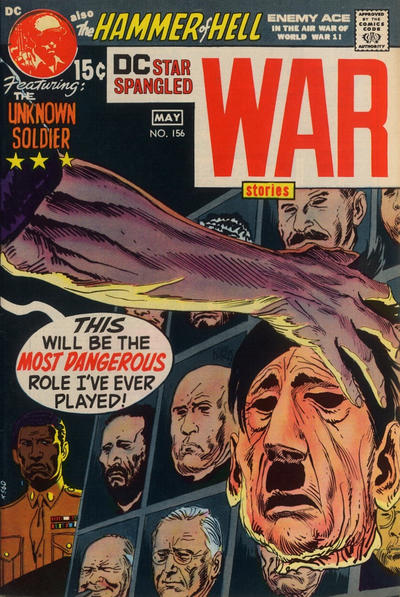
Star Spangled War Stories #156 (On Sale: February 23, 1971), has a terrific Unknown Soldier cover by Joe Kubert

We begin this issue with the Unknown Soldier in "Assassination" by Bob Haney and Joe Kubert. The Unknown Soldier meets a British agent who tells him of a meeting on July 20th which Adolf Hitler will attend. Disguised as a German lieutenant, the Unknown Soldier infiltrates the Wolf's Lair and plants a bomb intending to kill Hitler. 

One of Hitler's own advisers, Colonel Von Stauffenberg also carries a bomb to the meeting. He leaves it in the meeting room concealed in a briefcase. However, a soldier returns the briefcase to the colonel outside the room just as it is about to go off. The explosion does not succeed in killing Hitler. The bunker is sealed and the Unknown Soldier's bomb is uncovered. Fortunately, he was able to get outside before the doors were shut. The Soldier, disguised as an old woman, escapes to Switzerland. This story was reprinted in Showcase Presents the Unknown Soldier Vol. 1 TPB (2007).

The backup is "A Dream Came True" by Hank Chapman and Irv Novick and is reprinted from Our Army at War #154 (1965). A one-panel cameo of Enemy Ace has been added to introduce this story, with art by Joe Kubert. During World War I, an American pilot named Mike Mason is humiliated because he never shoots down any enemy planes. One day, he lies to his commanding officer and says he shot down five Germans. However, he knows his lie will be exposed when the intelligence officers are unable to confirm the kills. The next day, Mason is sent on a solo mission, and he manages to shoot down two zeppelins and three planes. His dreamed-up tale has become a reality.

Edited by Joe Kubert.

Green Lantern #83

Green Lantern #83 (On Sale: February 23, 1971), has a Green Lantern/Green Arrow cover by Neal Adams.

This issue features Green Lantern, Green Arrow, and Black Canary in "...and a Child Shall Destroy Them" by Denny O'Neil, Neal Adams, and Dick Giordano. While walking down the street, Carol Ferris bumps into a stranger and is subsequently cursed by a young girl named Sybil, and she falls in a seizure.

A month later, Dinah Lance decides to take a job as a teacher at Meadowhill School, accompanied by her friends Oliver Queen and Hal Jordan. They are suddenly attacked by a flock of birds, requiring the men to put on their costumes to protect Dinah. When the birds are dealt with, they decide to see if her new boss knows anything about the occurrence.

They are greeted at the door by the man who Carol had bumped into earlier, who introduces himself as Grandy, the cook. He is accompanied by Sybil. The owner of the school, Jason Belmore, introduces himself, but expresses disapproval of the costumed heroes, prompting Green Arrow and Green Lantern to leave. Strangely, Mr. Belmore seems to have made them leave at Grandy's behest. Grandy directs Sybil to make the heroes sorry. 

We should probably mention that Grady bears more than a passing resemblance to disgraced Vice President Spiro Agnew.

Outside, Green Arrow and Green Lantern notice Carol hanging around their car in a wheelchair. Carol has them drive her away and explains her case. She reveals that Belmore is her fiancé, but that he seems changed. Suddenly, Green Arrow loses control of the vehicle, which crashes. If not for Green Lantern's ring they might all have died. They soon realize that they have left Dinah in danger.

After dismissing her final class early, Dinah realizes that the children are oddly quiet and inanimate. Grandy appears and chastises her, ominously promising punishment for the early dismissal. Dinah returns to her room and dons her costume as Black Canary. She easily defeats a reluctant Mr. Belmore and Grandy, but Sybil's powers cause her to collapse on the floor. She is dragged to the cellar by the children, where Grandy releases angry wasps to attack her.

Green Arrow and Green Lantern arrive to save her, but they are soon incapacitated by Sybil's powers. Green Arrow uses a trick arrow to distract her, allowing them to escape and find Dinah. Green Lantern deals with the wasps, and Dinah is alive, fortunately. Green Lantern angrily confronts Grandy, who once again calls upon Sybil to punish him. This time, though, Sybil refuses, saying she wants to be like a normal child. When Grandy angrily slaps Sybil across the face, she uses her powers again – not to punish Green Lantern, but instead to bring the wing of the building down around them. Green Lantern and Green Arrow manage to escape with Mr. Belmore, Dinah, and the children, but Grandy and Sybil are trapped inside and are presumed to have perished when the wing collapses.

Before leaving, Green Lantern reveals his identity to Carol and confesses his love for her. She is unsurprised and accepts his feelings, finally. As they walk away, Sybil appears to be seen standing over Hal's discarded domino mask. Has she somehow survived? This story has been reprinted in Green Lantern/Green Arrow #4 (1984), Green Lantern/Green Arrow Collection Vol. 1 TPB (1992), Green Lantern/Green Arrow Collection HC (2001), Green Lantern/Green Arrow Vol. 2 TPB (2004), Showcase Presents: Green Lantern Vol. 5 TPB (2011), Green Lantern/Green Arrow TPB (2012), and Absolute Green Lantern/Green Arrow HC (2016).

Edited by Julius Schwartz.

From Beyond the Unknown #10

From Beyond the Unknown #10 (On Sale: February 23, 1971), has a cover by Murphy Anderson.

We begin the repeats with our cover story, "The Fish-Men of Earth" by John Broome, Carmine Infantino, and Bernard Sachs which comes to us from Strange Adventures #56 (1955). Aliens use a weapon that causes the atmosphere of Earth to become super-dense, like their homeworld. Dr. Walker and his assistant Jim find a way to counter the effect.

Next up is "The Devil's Island of Space" by Joe Millard and Murphy Anderson and reprinted from Mystery in Space #46 (1958). Willy Elkins promises to escape from a prison planetoid in 30 days.

That is followed by "The Most Dangerous Man on Earth" by Gardner Fox, Mike Sekowsky, and Bernard Sachs and which is reprinted from Strange Adventures #129 (1961). While experimenting on a ray to prevent the common cold, Jeff Carter accidentally causes himself to emit radiation that causes all vegetation to grow wildly out of control.

The next story is "Destination – Star" by Gardner Fox and Carmine Infantino and is reprinted from Mystery in Space #14 (1953). Ralfe Gordon warns other space travelers that going faster than the speed of light is dangerous.

Our next story is "Tomorrow's Hero" by John Broome and Sid Greene and reprinted from Strange Adventures #112 (1960). Ral Grayson is a mutant with the ability to understand things quickly by just seeing a portion of the process. He uses his ability to figure out the one weakness of the Borg who have taken over Earth.

That is followed by "The 24,000-Hour Day" by Otto Binder, Manny Stallman, and John Giunta and is reprinted from Mystery in Space #49 (1959). Brad Stanton and Jim Kirby answer an ad for space-miners promising to pay them $1000 a day. When they sign on they learn that one day on this asteroid is 24,000 hours long.

Our last story is "The Answer Man of Space" by Gardner Fox and Sid Greene and reprinted from Mystery in Space #73 (1962). Evan Wright can answer any question whose answer is in a book he has read, but can he answer a question about something he has never read before?

Edited by Julius Schwartz.

Thursday, February 18, 2016

Young Romance #171

Young Romance #171 (On Sale: February 18, 1971), has a cover by Don Heck and Dick Giordano.

We begin with "Let Me Share My Heart with You" by Robert Kanigher, Artie Saaf, and Tony DeZuñiga.

Next is the reprint "Strangers in Love" penciled by John Romita and originally published in Heart Throbs #93 (1965) where it was entitled "A Date with Heartbreak!".

Next is a one-page "Do's and Dont's of Dating" drawn by Tony DeZuñiga.

That is followed by "How Much Can My Love Buy?" by George Kashdan, Artie Saaf, Vince Colletta, and Tony DeZuñiga.

Next, we have "Which Man Is Mine" with pencils by John Romita and which is reprinted from Secret Hearts #68 (1961).

Following that is a one-page "How to Lose 5 lbs. in 5 Days!" by Liz Berube.

Our next reprint is "Afraid to Love" also with pencils by John Romita and which is reprinted from Falling in Love #36 (1960).

We end with "Nice Girls Are Out of Style" by Barbara Friedlander, Kurt Schaffenberger, and Vince Colletta.

Edited for the first time by Dorothy Woolfolk.

Superman's Pal Jimmy Olsen #137

Superman's Pal Jimmy Olsen #137 (On Sale: February 18, 1971), has a cover by Jack Kirby and Neal Adams.

This issue features "The Four-Armed Terror" written and penciled by  Jack Kirby and inked by Vince Colletta. While Superman and Jimmy Olsen join the Newsboy Legion and the Hairies to test a new solar-phone, the Project is attacked by a four-armed creature that feeds on nuclear energy. Superman tells the others to stay behind while he goes to fight the four-armed terror. 

The Newsboys and Jimmy follow anyway. The creature traps them all in a cocoon of energy, then prepares to cause an atomic explosion beneath the city of Metropolis. Simyan and Mokkari celebrate while they hatch another batch of the creatures in the Evil Factory. This continues next issue. Reprinted in Jimmy Olsen: Adventures by Jack Kirby Vol. 1 TPB (2003), Jack Kirby's Fourth World Omnibus Vol. 1 HC (2007), Jack Kirby's Fourth World Omnibus Vol. 1 TPB (2012), The Fourth World Omnibus by Jack Kirby (2018), and Superman's Pal, Jimmy Olsen by Jack Kirby (2019).

Edited by Jack Kirby.

New Gods #2

New Gods #2 (On Sale: February 18, 1971), has a cover by Jack Kirby.

This issue features "O' Deadly Darkseid" written and drawn by Jack Kirby and inked by Vince Colletta. Orion is met and confronted by Darkseid and Brola, an Apokolips warrior, in an apartment in Metropolis to which he takes the four Earth abductees. He battles and defeats Brola, who phases out along with Darkseid. 

On Apokolips, Darkseid confers with another lieutenant, Desaad, about discovering Earth people who can comprehend the Anti-Life Equation, which Darkseid says will allow him "to control all free will". He allows Desaad to use a "fear machine" that strikes panic into the inhabitants of Metropolis, in hopes of smoking out a mind with the Anti-Life properties they seek. 

Orion is briefing his four newfound allies about Apokolips and Darkseid's agents when the fear machine is unleashed. He finds it and destroys it. Darkseid tells DeSaad that no suitable minds have been found among those victimized. The four abductees agree to work with Orion. Reprinted in New Gods #1 (1984), Jack Kirby's New Gods TPB (1998), Jack Kirby's Fourth World Omnibus Vol. 1 HC (2007), Jack Kirby's Fourth World Omnibus Vol. 1 TPB (2012), The Fourth World Omnibus by Jack Kirby (2018), and New Gods by Jack Kirby TPB (2018).

Edited by Jack Kirby.

Tuesday, February 16, 2016

Unexpected #124

Unexpected #124 (On Sale: February 16, 1971), has a cover by Neal Adams.

We begin this issue with "These Walls Shall Be Your Grave" by George Kashdan and Jerry Grandenetti. A mad psychologist is humored by the personnel of the asylum into believing that he is the director of the institution.

Next up is our cover story, "Gift of the Ghouls" by George Kashdan and George Tuska. A boy and his family move into a new neighborhood wherein resides a coven fearful of the boy as he possesses the power to destroy them when he comes of age. They attempt to kill him while making it seem like an accident,  but the boy calls them out on their intentions much to his parent's chagrin. The mother begins to suspect their neighbor's odd behavior, but the father is convinced they are decent folk when they offer their son a cake for his upcoming birthday. They hope the poisoned cake will save them, but when the boy has an intuition to blow out the candles, the snuffed flames destroy the evil witches.

We end this issue with "The Incredible Rebirth of Martin Phipps" by Carl Wessler and Jack Sparling.

Edited by Murray Boltioff.


Superboy #173

Superboy #173 (On Sale: February 16, 1971), has a cover by Neal Adams and Dick Giordano.

We begin with Superboy in "The Super-Clark of Smallville" by Leo Dorfman, Bob Brown, and Dick Giordano. Clark Kent pretends that he has gained powers from ambrosia dust, the "food of the gods", which Professor Lang has discovered when Lana catches him lifting a heavy bookcase off her father with one hand. At first, Clark finds it amusing to use his powers openly as Clark Kent, but the novelty soon wears off. Lex Luthor comes to Smallville and saps Superboy's powers with a device. Superboy concocts some real ambrosia, eats it, and gains the powers of the gods, enabling him to defeat Luthor. When the ambrosia wears off, Superboy's normal powers return.

The back-up Legion of Super-Heroes story is  "Trust Me or Kill Me" by Cary Bates and George Tuska. Mordru makes a duplicate of Cosmic Boy and Superboy must determine which of the two is the real Cosmic Boy. This story was reprinted in Legion of Super-Heroes Archives Vol. 10 HC (2000) and Showcase Presents: Legion of Super-Heroes Vol. 4 TPB (2010).

Edited by Murray Boltinoff.


Heart Throbs #131 (On Sale: February 16, 1971), has a cover by Werner Roth and Vince Colletta.

We begin this issue with "Kisses Without Love" drawn by George Tuska and Vince Colletta. When Fran's boyfriend elopes with another woman she doesn't believe she can love again but before long she finds herself torn between two more men.

Next, we have "His Other Love" drawn by Gil Kane and Joe Giella reprinted from Secret Hearts #22 (1954). Lizabeth accepts Vernon's sudden marriage proposal, but when they visit his home town she finds out about his former relationship with Vera, whom everyone expected him to marry.

This issue ends with  "My First Romance" drawn by Win Mortimer and Vince Colletta. Susan is reluctant to marry David, especially when her first boyfriend Allan shows up unexpectedly.

Edited for the first time by Dorothy Woolfolk.

Brave & the Bold #95

Brave & the Bold #95 (On Sale: February 16, 1971), has a cover by Neal Adams and Dick Giordano.

This issue features "C.O.D. Corpse on Delivery" by Bob Haney and Nick Cardy. The team-up, only hinted at on the cover, is Batman and Plastic Man of Earth-1, someone who did not really exist up till now. Batman is hired by Ruby Ryder Inc. owner, Ruby Ryder to find her fiance Kyle Morgan, whom she claims went missing in South America. However, when Batman finds Morgan and brings him back to Ryder, she shoots him dead. Batman then goes on the trail to find Ryder when she escapes. Aided by a mysterious benefactor, Batman finds her in Morocco and takes her back to the States, where she is sentenced to death for the murder of Morgan.

However, Batman stops the execution when he reveals that Kyle Morgan isn't dead, but in the room and Morgan then reveals himself to be alive. He explains that he was once the hero known as Plastic Man, but he took on the guise of Kyle Morgan to try and live a normal life and had a relationship with Ruby Ryder. After learning that she was a power-seeking person, he left her and faked his death, which only fueled her revenge. With the mystery sorted out, Ruby's charges were lessened to attempted murder, however, she leaves the room scoffing at the concept of marrying a freak and tells the authorities to get in touch with her lawyers, while Plastic Man considers his future. Reprinted in Showcase Presents: The Brave and the Bold Batman Team-Ups Vol. 2 TPB (2008), Batman in the Brave and the Bold: The Bronze Age Omnibus Vol. 1 HC (2017), and Batman in the Brave and the Bold:The Bronze Age Vol. 2 TPB (2019).

Edited by Murray Boltinoff. I complain a lot about Boltioff as an editor, but B&B was one book I always loved and looked forward to, and he was the guy who let Neal Adams run wild with Batman, turning him from camp TV guy to the Dark Knight.

Thursday, February 11, 2016

Witching Hour #14

Witching Hour #14 (On Sale: February 11, 1971), has a cover by Neal Adams, Al Williamson, and Carlos Garzon

This beauty is one of the great comics of 1971 and a final treat to us all from departed editor Dick Giordano. Murray Boltinoff never put out a book this good in his life. The framing sequence throughout the book is drawn by George Tuska and is notably shortened this issue, after the initial first page being delegated to 1/2 to 1/3 pages. But hey, it is not the reason this book is so grand. Really, check this out...

We begin with "Fourteen Months" by Gerry Conway and Jeffrey Catherine Jones. It will be 27 years before Jones will draw another story for DC and that one will be her last. If you don't count the uncredited work Jeff did on Nightmaster in Showcase, this is her first work for DC. It has been fourteen months since the starship Klondike has been attacked and began limping home. Captain Scott is manning the bridge when a Krill warship appears. He screams at the unresponsive engine room but still manages to blast the Krill ship as we see that Scott has been living for fourteen months as the only survivor aboard the Klondike. Three and a half pages of Jones' magic.

Jeffrey Catherine Jones is best known for the over 150 book covers she painted from the mid-1960s through 1976, as well as the fine art produced after that time. Frank Frazetta called Jones "the greatest living painter." Although Jones first achieved fame as simply Jeff Jones and lived for a time as a male, she later changed her name and transitioned to female. Jone's first comic book work appeared in Warren magazines, starting with Creepy #16 in 1967. Starting in 1972, Jones would produce a monthly strip, Idyl, for National Lampoon. By the early 1980s, she had a recurring strip in Heavy Metal titled I'm Age.

In 1964 while attending Georgia State College, Jones met fellow student Mary Louise Alexander (later notable as writer Louise Simonson). The two began dating and were married in 1966. Their daughter Julianna was born the following year. After graduation, the couple moved to New York City but divorced in the early 1970s.

From 1975 to 1979 Jones shared a workspace in Manhattan's Chelsea district with Bernie Wrightson, Barry Windsor-Smith, and Michael Kaluta, collectively named The Studio. Dragon's Dream produced a volume of their work in 1979.

Jeffrey Catherine Jones passed away on May 19, 2011, from severe emphysema and bronchitis as well as hardening of the arteries around the heart.

Next, we have  "Which Witch Is Which?" by David Kaler and Stanley Pitt, the second of only three stories Pitt would draw for DC. In 2370 a space captain is bewitched by a woman who seeks revenge on behalf of another the space captain seduced and dumped. His partner thinks he is acting crazy so he slugs him, and when the captain wakes, finds himself with his partner in deep space. He gets into a physical confrontation with his partner in an effort to turn the rocket around and go back to his love when the eject button is hit and they are both sent to their death.

Stanley John Joseph Pitt was an Australian cartoonist and commercial artist. Pitt was heavily influenced by the classic style of Alex Raymond's artwork, particularly his method of switching from a pen to a brush. His comics career began in 1943 when he began illustrating comics for Frank Johnson Publications. These included Larry Flynn, Detective

In 1945 he produced comic strip advertisements for Colgate Palmolive, which led to Associated Newspapers placing him under contract to develop a new science fiction strip, Silver Starr (or Silver Starr in the Flameworld). Silver Starr debuted in the Sydney newspapers The Guardian and Sunday Sun in November 1946. The strips ran until November 1948. Silver Starr was a Flash Gordon-style comic strip. 

From 1948 on, Pitt produced a number of comic book series and newspaper strips, mostly limited in distribution to Australia. He did strips such as  Jim Atlas and Dr Peril of Igogo as well as the comics Captain Power and Yarmak-Jungle King, a Tarzan knockoff.

The work of Pitt's life though seemed to be Gully Foyle. Based on Alfred Bester's novel The Stars My Destination, the strip was a copyright nightmare that seemed like it would never be completed. In 2001 a limited edition of Gully Foyle was finally published and released. Pitt died the next year, at the age of 77.

The last story of the issue is "The Haunted House in Space" drawn by Al Williamson and Carlos Garzon. This is the second of only three stories Al Williamson will draw for DC, and Carlos Garzon's first work with the company. Space pirates come across a haunted house placed on an asteroid in space. As they argue and turn against one another, the killing begins. But after the first pirate dies he is reformed as the attic of the house. A witch appears and tells them that they will each be turned into the room they most fear. The last pirate ends up in the torture chamber.

The entire issue was reprinted in Showcase Presents: The Witching Hour Vol. 1 TPB (2011).

This artistic extravaganza (Adams, Garzon, Jones, Pitt, Williamson) is credited to the editorship of Murray Boltioff, but this is Dick Giordano's baby from front to back.

Secret Hearts #151

Secret Hearts #151 (On Sale: February 11, 1971), has a cover by Werner Roth and Vince Colletta

We begin with "Mother, Let Me Go" by Jack Miller and Lee Elias. Elaine avoids serious relationships because her mother constantly pressures her to get married.

Next, we have "The Loser" drawn by Ric Estrada and Vince Colletta. Rosalie reviews her failed relationship with Kent and realizes that she's better off without him.

We end with "Follow My Heart" drawn by Mike Sekowsky and Mike Peppe and reprinted from Secret Hearts #59 (1959). Tobey is torn between two men: one who's romantic and one who's responsible.

Edited by Dorothy Woolfolk.

G.I. Combat #147

G.I. Combat #147 (On Sale: February 11, 1971), has a cover by Joe Kubert.

we begin with the Haunted Tank in "Rebel Tank" by Robert Kanigher and Russ Heath. After his old commanding officer dies in combat, Jeb Stuart is reassigned to the command of Major Bragg. The major is offended that a Yankee has been given the name of a confederate general, so he orders Jeb to sit out of combat and make supply runs instead. The crew of the Haunted Tank complies, but after a while, they want to get back in the fight.

Eventually, Jeb disobeys orders and sends the Haunted Tank to Mount Abruzzi, where Major Bragg has launched an offensive. Jeb finds Bragg's tank and the others destroyed, Bragg orders Jeb to retreat, but once again he disobeys orders and attacks the Nazi position. By guiding the small tank along a mountain goat trail, the Haunted Tank is able to surprise the Nazis from behind and deliver the knock-out blow to their installation. Reprinted in Showcase Presents: Haunted Tank Vol. 2 TPB (2008).

Next, we have "Sniper's Roost" by Bob Haney and Mort Drucker and reprinted from All American Men of War #71 (1959). The story of a Nazi sniper, called "The Hawk" and how he looks at his targets as toys or insects until one gets far too close. Really wonderful artwork by MAD's Mort Drucker.

That is followed by "Tin Pot Listening Post" by Bob Haney and Jerry Grandenetti and reprinted from All American Men of War #70 (1959). A young recruit is sent into the jungle to be the forward listening post for his outfit. He is so jumpy he mistakes insects, monkeys, and birds for the enemy but each such mistake brings out a real enemy that the young recruit takes care of himself.

Next up is "Broomstick Pilot" by France Herron and John Severin and reprinted from Our Army at War #69 (1958). A young co-pilot on his way to bomb a Nazi submarine pen is startled when the pilot leaves formation and drops low to the ground to avoid enemy aircraft. The pilot says they are now "broomstick pilots" as they fly on at 100 feet, running enemy planes into tension wires and poles, dodging the fire of tanks and ground artillery. They take out the submarine pen then head back home hugging the ground all the way. 

Our next tale is "Battle Window" by Robert Kanigher, Ross Andru, and MikeEsposito and reprinted from All-American Men of War #36 (1956). New recruit Terry was a window washer before the war and everything in the war reminds him of the windows he hates.

This issue ends with "Target for an Ammo Boy" by Robert Kanigher and Joe Kubert and reprinted from All American Men of War #71 (1959). On a Pacific island, a recruit tags along with T.K., known by the men as Tank Killer. Everywhere they look, they find hidden tanks.

Edited by Joe Kubert.

Binky #78

Binky #78 (On Sale: February 11, 1971), has a cover by Stan Goldberg and Henry Scarpelli.

We begin with Binky in "All in a Day's Work" by John Albano, Stan Goldberg, and Henry Scarpelli. Binky accidentally runs Prof. Dripp over with his bike, hits him in the head with a piece of lumber, and blows him up with some highly explosive chemicals. Reprinted in Best of DC #39 (1983).

Next is Binky in "Real Swinging Advice" by John Albano, Stan Goldberg, and Henry Scarpelli. Binky gives out advice that doesn't work for anybody. Reprinted in Best of DC #53 (1984).

We have another Binky story, "The Hobo" by John Albano, Stan Goldberg, and Henry Scarpelli. Binky hires a hobo magician to entertain at a child's birthday party. Reprinted in Best of DC #53 (1984).

Continuing our Binky extravaganza we have "Nobody Nose" by  John Albano, Stan Goldberg, and Henry Scarpelli. Binky finds Buzzy a date. Reprinted in Best of DC #53 (1984)

Yep, it is Binky again in "The Exterminator" by John Albano, Stan Goldberg, and Henry Scarpelli. Binky works in pest control. Reprinted in Best of DC #53 (1984).

Binky (duh) is next in "The Forty Dollars That Grew" drawn by Stan Goldberg and Henry Scarpelli.  Binky and Buzzy build a coffin.

As a change of pace, we have Buzzy in "All the Help I Can Get"  drawn by Stan Goldberg and Henry Scarpelli. Buzzy has to hide from Big Stanley.

Edited by Joe Orlando.

Tuesday, February 9, 2016

Superman #236

Superman #236 (On Sale: February 9, 1971), has a cover by Neal Adams and Dick Giordano.

We begin with Superman in "Planet of the Angels" by Denny O'Neil, Curt Swan, and Murphy Anderson. After teaming up with Batman to catch a gang of criminals, Superman returns to his Fortress where he begins work on a brain-wave scanner. During a test of the device, Superman suddenly finds himself surrounded by flames and attacked by devils. He easily beats them. He then meets three angels, Gabriel, Raphael, and Michael. They inform him that he has crossed into the afterlife.

The angels enlist Superman to kill the devils. However, Superman suspects something is fishy. When he meets the devils again, he snaps a hypnotic suggestion and sees them as they really are, law officers from an alien world. The angels are criminals. Superman then turns on the angels. One of them tries to attack Earth, but Superman stops him too. Reprinted in Best of DC #12 (1981) and Superman: Kryptonite Nevermore HC (2009).

The back-up is a World of Krypton story, "The Doomsayer" by Denny O'Neil and Dick Giordano. Superman joins Green Arrow and Black Canary for a picnic. When Green Arrow sees a factory dumping waste into the nearby river he begins preaching about saving the environment. Black Canary is skeptical regarding Ollie's view that the planet is in danger. Superman then tells them a story about Krypton.

Twenty years before the destruction of the planet in the city of Surrus, Dr. Mo-De discovered that Krypton's core was unstable. He developed a plan to save the planet. However, the Surrusans were reluctant to listen to his warnings for they were enchanted with beautiful flowers that produced music.

Determined to get his point across to the people Mo-De began destroying a field of flowers. When faced with the possible loss of their music, the townspeople beat Mo-De. When he asks why they won't listen, they tell him they only want to hear beautiful things. To punish Mo-De they lock him in a room surrounded by the flowers. Eventually, Mo-De becomes enchanted with them too. The Surrusans return to their happy ways until their planet explodes twenty years later.

Inspired by the story, Black Canary leaves the picnic to talk with the factory owner about handling the waste more responsibly. Reprinted in Best of DC #40 (1983) and Superman: The World of Krypton TPB (2008).

Edited by Julius Schwartz,

Flash #205

Flash #205 (On Sale: February 9, 1971), has a cover by Dick Giordano.

We begin with the Flash in "Menace of the Reverse-Flash" by John Broome, Carmine Infantino, and Joe Giella and reprinted from Flash #139 (1963). This is the first appearance of Professor Zoom. A time capsule is sent into the future by Dr. Walter Drake, which contains an atomic clock, a spare Flash uniform, and some other items. Dr. Drake realizes that the method with which he propelled the capsule through time changed the atomic clock into a bomb. He enlists the Flash to help him prevent a disaster.

In the year 2463, a criminal known as the Professor finds the capsule and takes the Flash uniform. Using future science, he is able to enable the costume to give him super-speed. He begins a crime wave as Professor Zoom.

Flash arrives in the future and begins his search for the atomic clock. He learns about Zoom and confronts him. The two speedsters are evenly matched and battle to a stalemate. Flash learns that the aura protecting him from friction was duplicated by Zoom using chemicals. He manages to force a break down of the chemicals which eliminates Zoom’s aura. Without this protection, Zoom is defeated and turned over to the authorities.

Flash locates the atomic clock and safely disposes of it. He then returns to the present and informs Dr. Drake that the bomb was destroyed. He also destroys the costume of Professor Zoom.
 
Our next reprint is a little different, as it has never been printed before. This tale of the Golden-Age Flash was written and drawn in the 1940s but never published, "Journey into Danger" is by Robert Kanigher, Carmine Infantino, and Bernard Sachs. Jay Garrick and Joan Williams are taking the train back to Keystone after Jay has presented a paper at a Chemist's convention on decelerating energy to conserve fuel. As they get close to the city Jay notices that a plane that should land at the airport flies right by and when the train reaches the station it continues on as well, not stopping. Switching to the Flash, the engineer informs Jay that the train will not stop and is heading for another train on the same track. Jay stops the collision of the two trains by vibrating between them, creating an air pressure brake.

A farmer rushes up to see the commotion and spills some seed, which immediately grows full-grown stalks of corn that raise the train into the air. Flash once again saves the day and the train resumes. As the Flash Jay sees that gunmen are holding up Joan demanding to be shown Jay. Jay arrives and knocks the guys out and takes them to the police, Arriving back at his lab he finds it a shambles and a note saying that he needs to come to a specified location that night or Joan is a goner. 

Arriving, the Flash is caught by a trap door and placed into a cage by the farmer who spilled the seeds. He says they will wait for Jay to show up and the farmer admits that he has invented a speed-up chemical but cannot control it and needs Jay's research on decelerating energy. When Jay attempts to vibrate out of the cage he is electrocuted by it. The farmer and his gang take Joan and leave the Flash to die in the house set to explode in five minutes. After they leave, Jay vibrates through the floor and out of the house. Outside he finds everyone running around at uncontrollable speed and a helicopter spraying the people with a chemical. 

Jay heads to his lab and uses his formula to offset the speed chemical, curing the crowd. He then brings down the copter and takes out the farmer and his men.

Next up is Kid Flash in "The Race to Thunder Hill" by John Broome, Carmine Infantino, and Joe Giella and reprinted from Flash #116 (1960). While returning home from fishing with his friend Jimmy, Wally West switches to Kid Flash to rescue Kitty Clark from falling off a runaway horse. Wally returns home so he can serve as his father’s navigator in a car rally. Once the rally is underway, Wally and his father are stopped on the road by a pair of thieves who hi-jack Mr. West’s roadster. Mr. West is knocked out, and both he and Wally are locked in an empty house.

Wally escapes, and, as Kid Flash catches the thieves. Then Wally tows the car back to the house where his father was left. A doctor arrives to treat his father. The next day Wally and his dad continue in the rally. The team performs perfectly, and they are awarded the victory.

We end with our fourth speedster, Johnny Quick in "Too Many Speed Kings" drawn by Ralph Mayo and Sy Barry and reprinted from Adventure Comics #189 (1953). Johnny Chambers visits the lab of Professor Rollins, a chemist. Rollins has created a speed formula that he secretly gives to Johnny. Johnny is forced to use his speed and give away his secret identity, but the professor believes the formula works.

To protect his identity, Johnny must convince the professor that the formula works and also that it should not be used. Rollins distributes the chemical to a boxer and waiter. Johnny uses his own speed to fake theirs and convinces them to stop using the formula. Then he also convinces the professor.

Edited by Julius Schwartz.

All-Star Western #5

All-Star Western #5 (On Sale: February 9, 1971), has a classic Outlaw cover by Neal Adams.

We begin with the final tale of Outlaw, "Hangman Never Loses" by Robert Kanigher and Jim Aparo. When Rick Wilson's father Samuel gets the drop on him and arrests him, Rick tries to get away when Samuel's deputy arrives with Stammerin' Sam, one of the Gunpowder Gang. However, the attempt does not work and the two are locked up in the same jail. This is during Founding Day celebrations, where a golden horseshoe is a prize for a shooting contest.

However, they are freed by Gunpowder and his minion Peg-Leg, escaping the law they hide out at Gunpowders hideout, an abandoned train station. When Gunpowder believes that Rick is going to try and take control of the gang, they have him tied up in a train with a bunch of TNT in hopes of using it as a diversion to steal the horseshoe.

Rick frees himself, thanks to his hawk, and stamps out the TNT when the train crashes, Rick and his father team up to stop the gang and kill them all. Samuel reveals Rick to be a Texas Ranger and that the two made up a story that Rick had gone outlaw so that he could infiltrate the gang. Afterward, Rick wins the shooting contest. Reprinted in Showcase Presents Jonah Hex Vol. 1 TPB (2006).

In "The Devil Rides for Vengeance" by Robert Kanigher, Alan Weiss, and Dick Giordano, El Diablo comes into a town where a massacre has happened. One man, Arnie Olsen, clings to life. Before dying, Arnie tells El Diablo that the Carpetbagger was responsible. The man was trying to force ranchers off their land. When they refused, he got impatient and killed them.

After Arnie dies El Diablo tracks down the killers. He kills the Carpetbagger's three henchmen, but he is wounded then by the boss. When El Diablo then attempts to help Olsen's family, the Carpetbagger returns with more hired killers. El Diablo beats them all before killing the Carpetbagger which ends the threat to the ranchers. 

Alan Weiss began his professional comics career at Warren Publishing by writing and drawing the story "Gunsmoke Charly!" in Creepy #35 (1970). The western artwork caught the eye of editor Dick Giordano and resulted in this, Alan's first work for the color comics. Alan would do one more El Diablo story, a few horror tales and some Marvel romance work and an inking assist on Neal Adams' pencils for the classic Avengers #96, before becoming the penciler for the Pellucidar strip in DC's Korak, Son of Tarzan and Weird Worlds.

For Marvel Alan would draw issues here and there of the Avengers, Captain America, Cat, Daredevil, Doctor Strange, Dracula, Inhumans, Iron Man, John Carter, King Kull, Sub-Mariner, Spider-Man, and X-Men, but he would only have one Marvel series: Steelgrip Starkey, of which he drew and/or wrote the first six issues. 

For Atlas, he did an issue of the Brute and for Archie, he did an issue of The Shield.  In the 1990s, for Defiant, he drew and or wrote the first six issues of War Dancer. I also recall seeing some sexual comics by Alan signed as "Vice" instead of Weiss.

At DC he did not only El Diablo and Pellucidar, but also issues of Super-Team Family (Supergirl and The Flash), Richard Dragon, Superman Family (Supergirl), Shazam!, Secret Origins, Captain Atom, and Batman. His most enduring DC title was Tom Strong, for which he did 13 issues.

Edited by Joe Orlando, taking over for the departing Dick Giordano.

Thursday, February 4, 2016

Swing With Scooter #33

Swing With Scooter #33 (On Sale: February 4, 1971), has a cover by Stan Goldberg and Henry Scarpelli.

We begin with Scooter in "Temporary Manners" drawn by Artie Saaf and Henry Scarpelli. The boys try to brush up on their manners to impress their pretty new teacher.

Next, we have Scooter in "Trips Can Be Too Cool" inked by Henry Scarpelli. Scooter and Sylvester are sent back to the time of King Arthur, where they help the early development of steam power, baseball, and miniskirts.

We have yet another Scooter tale,  "All for the Love of Miss Throbb" inked by Henry Scarpelli. The boys stage a publicity stunt to sell tickets to the school play.

Next is "David Cassidy and the Girls He Loves!" written by Barbara Friedlander. This text feature is on the Partridge Family singer, but due to a production mishap, the article is accompanied by a photo of Barry Williams from the Brady Bunch.

That is followed by Malibu in "Midnight Snack" drawn by Henri Scarpelli. Malibu feeds bats in the park instead of birds.

Next, it is back to Scooter in "Not a Very Safe Place to Be" by John Albano, Stan Goldberg, and Henry Scarpelli. Accidents are constantly happening to Mr. Otis when Scooter is around. Reprinted in Best of DC #70 (1986).

Next, we have Penny and Cookie in "Tale of a Pussycat" drawn by Stan Goldberg and Henry Scarpelli. Apparently, Penny's cat has magical powers, as a witch is trying to get it back.

That is followed by Sylvester in "The Plenty Potent Potion" by John Albano, Stan Goldberg, and Henry Scarpelli. Malibu gives Sylvester a magic potion to make him irresistible to girls. Reprinted in Best of DC #70 (1986). 

We end with Penny and Cookie in "True Love" inked by Henry Scarpelli. Why did that boy steal Penny's hat?

Edited by Joe Orlando.